PLASTIC SURGERY
All Procedures / Eyes · Ptosis
Ptosis & Mid-life Eyes
Ptosis
For sleepy-looking eyes, we first distinguish between excess skin and weak eyelid-opening function.
Suture Removal
5–7 days
Return to Daily Activities
After 2–3 days
This may vary depending on your condition and the extent of surgery.
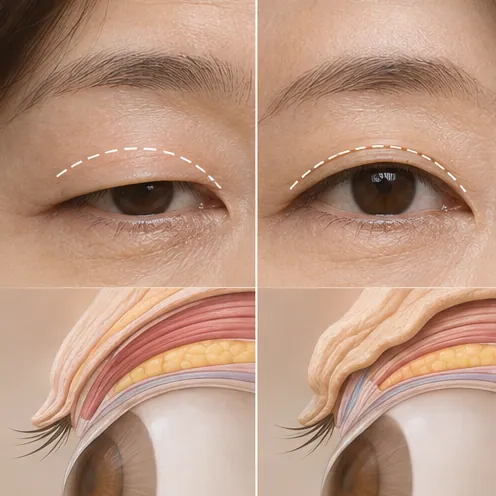
Sleepy-looking eyes do not always mean ptosis.
Key Questions Answered
Do sleepy-looking eyes always mean ptosis?
True ptosis involves actual weakness of the eyelid-opening muscle, while pseudoptosis occurs when muscle strength is normal but sagging eyelid skin covers the pupil. True ptosis requires ptosis repair (adjustment of muscle function), while pseudoptosis may improve with removal of excess skin or creation of an eyelid crease alone.
— True ptosis · Pseudoptosis
— Eyelid-opening strength
— Skin coverage
YOUR CONCERN
Do any of these concerns
sound familiar?
“My eyelids feel heavy when I open my eyes, and I strain my forehead.”
“My eyelids droop more in the afternoon.”
“My eyelid creases have faded, and I look sleepy.”
We assess eye appearance and eyelid-opening function separately.
A sleepy appearance alone does not establish a diagnosis of ptosis. We assess eyelid position and movement, compensatory eyebrow movement, excess skin, and eyelid closure to determine whether correction is needed for the underlying cause.
Ptosis and Ptosis Repair,
What does the surgery involve?
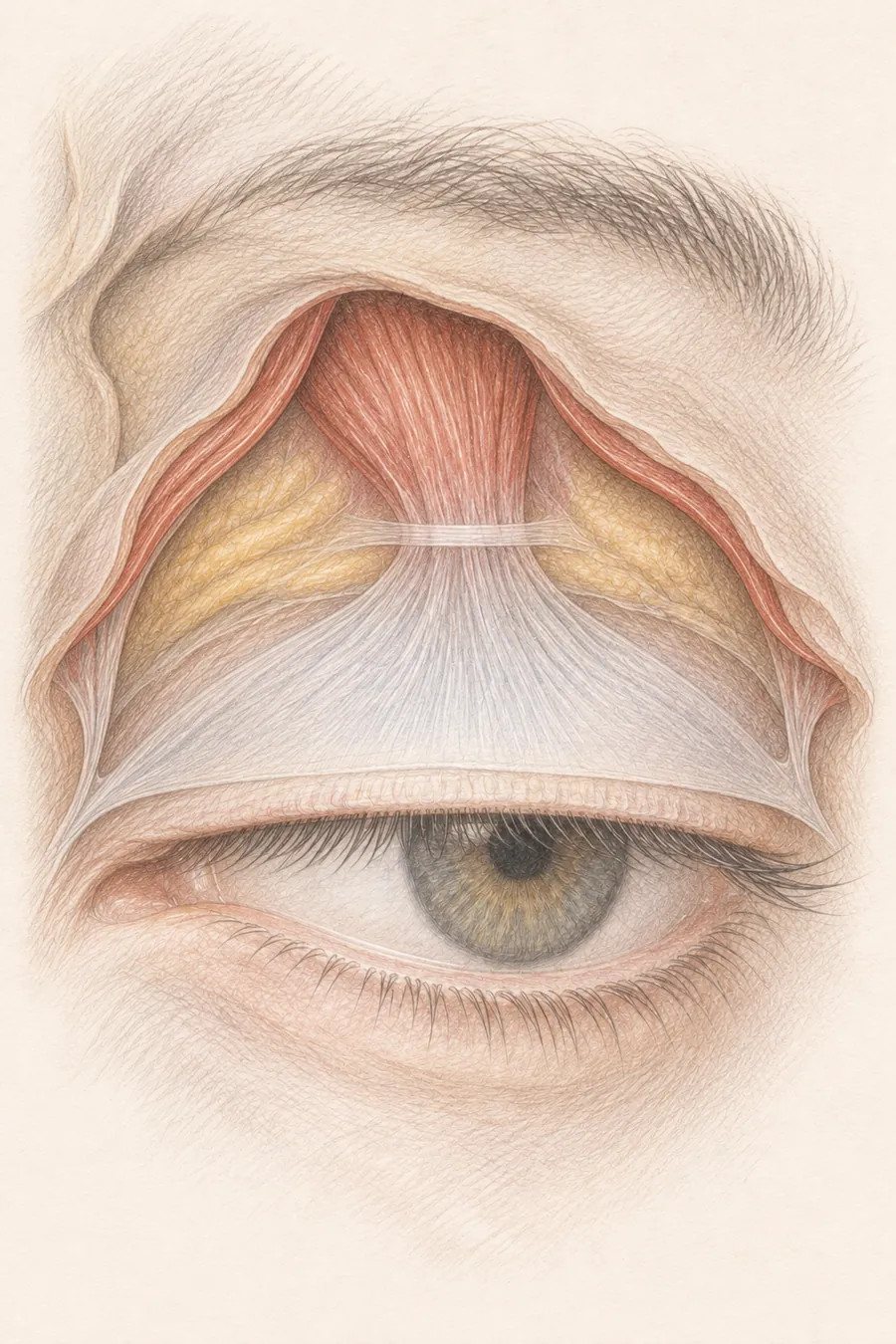
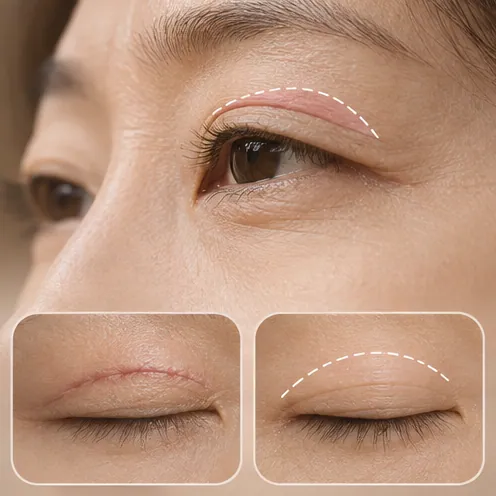
Ptosis is a condition in which weakness of the eyelid-opening muscle and its aponeurosis allows the upper eyelid to cover the pupil. It is often first noticed as a sleepy appearance, but it can obstruct vision and lead to eye fatigue and forehead wrinkles as the forehead muscles strain to help open the eyes. Treatment differs from that for pseudoptosis, in which sagging eyelid skin covers the pupil, so we first measure how much of the pupil is exposed to distinguish between them. Unlike surgery that only creates an eyelid crease, ptosis repair directly affects eyelid-opening function and eyelid height.
- MRD1
- This is the distance from the light reflex at the center of the pupil to the upper eyelid margin. It is used to measure how much of the pupil is exposed.
- True Ptosis
- The eyelid-opening muscle itself is weak. Ptosis repair adjusts the muscle's function.
- Pseudoptosis
- Muscle strength is normal, but sagging skin covers the pupil. Removing excess skin or creating an eyelid crease may help.
- Aponeurosis
- This thin sheet of tissue connects the end of the eyelid-opening muscle to the tarsal plate inside the eyelid. If it stretches or detaches, the muscle's force is not transmitted effectively to the eyelid.
For Ptosis and Ptosis Repair
in Lower Blepharoplasty
We measure pupil exposure to determine whether surgery is needed
We do not recommend ptosis repair based on a sleepy appearance alone. We measure MRD1, the distance from the center of the pupil to the upper eyelid margin, and do not perform ptosis surgery if it is within the normal range of approximately 4 mm. In this case, the condition is pseudoptosis, in which skin covers the pupil, so we first consider whether removing excess skin will address it. Taking this measurement helps avoid unnecessary muscle surgery.
Forehead wrinkles can start with the eyes
When the eyes do not open easily, the forehead muscles help lift the eyelids. Over time, this habit can leave forehead wrinkles and elevated eyebrows. For this reason, we check eyelid-opening strength before treating deep forehead wrinkles. If the cause lies in the eyes, lifting only the forehead may make the problem worse.
We recommend it for vision rather than appearance
The doctor explains this procedure as surgery for vision rather than for the shape of the eyelid crease. Like the analogy of salamanders that lose their sight because they have no need to use their eyes in dark caves, drooping eyelids covering the pupils are like window blinds left halfway down. The first priority is to lift the eyelids and open a path for light; improved appearance comes afterward. Problems with vision itself require a separate ophthalmologic evaluation.
If you are concerned about a change in appearance, we plan a low, hidden crease
We explain two things to people who hesitate because they worry about a change in appearance. First, eyelid-opening function can be corrected while keeping the crease low and largely hidden. Second, even if swelling lasts longer than expected during recovery, there is a reason to correct eyelids that cover the pupils. We view the eyelid crease as a structure that protects the eye, with improved appearance as an additional change.
It involves more tissue than double eyelid surgery
Ptosis repair involves more eyelid tissue, so it causes more swelling and bruising than surgery that only creates a crease. When true ptosis is present, both eyelid-opening strength and appearance may change, but dry eyes and incomplete eyelid closure can occur after surgery. Dryness may last 1–2 months, but usually improves with artificial tears. If symptoms persist, we reassess based on the course of recovery.
Eye rubbing and contact lens wear can also contribute
The eyelid-opening muscle inside the eyelid is like a thin rubber band that is forcibly stretched each time you rub your eyes. Even contact lens wear alone can weaken eyelid-opening strength. During surgery, damage to the inner tissues from years of eye rubbing can be readily visible. For this reason, we also advise patients to avoid rubbing their eyes, reduce contact lens wear, and use artificial tears frequently after surgery.
A Word from the Doctor
Dr. Hyungwoo Yim’s own words from his blog and interviews.
01Same Name, Different Causes
“Ptosis is a diagnosis, It is not the cause.”
Whether the aponeurosis is stretched, degenerated, or torn, it is all called by the same name. That is why we first identify the cause and check twice: once in the operating room and once in the recovery room.
02It’s Not Just About Vision
“I feel like I want to launch a nationwide awareness campaignabout this.”
Many people think ptosis surgery is performed only because of vision problems.
From an interview with the doctor
03Balance over size
“The goal was not simply to make the eyes look bigger. It was to balance the strength used to open each eyeand restore natural symmetry.”
During surgery, we checked the balance between both eyes directly by having the patient repeatedly open and close their eyes. The correction must be neither excessive nor insufficient.
Dr. Hyungwoo Yim, Medical Director
The Surgical Process Varies
Depending on Your Condition
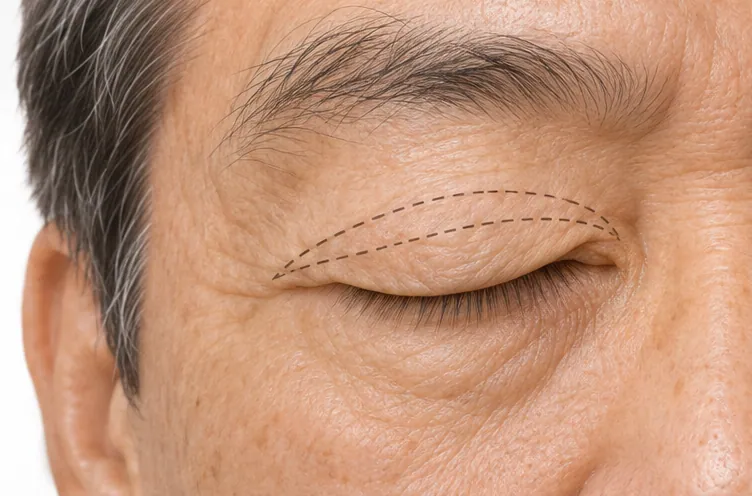
When skin covers the pupil (pseudoptosis)
 1
We measure MRD1 to confirm normal muscle strength and mark the width of skin to remove
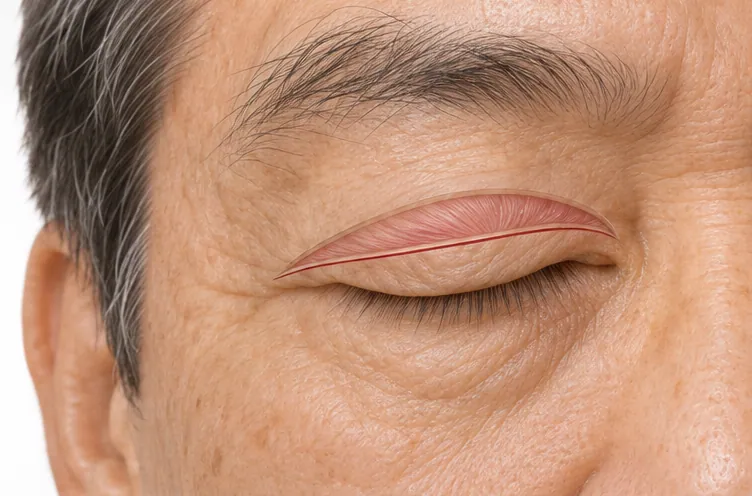 2
We make an incision along the marked line and trim excess skin and orbicularis oculi muscle
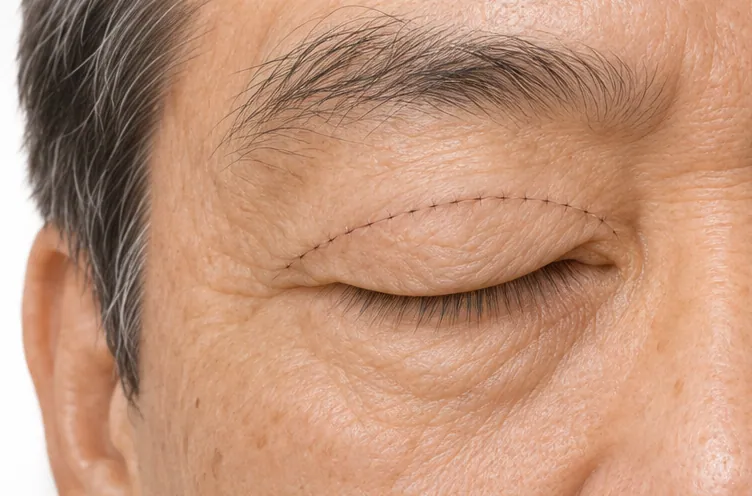 3
After checking eyelid closure, we close the incision along the eyelid crease with fine sutures
When eyelid-opening strength is slightly reduced
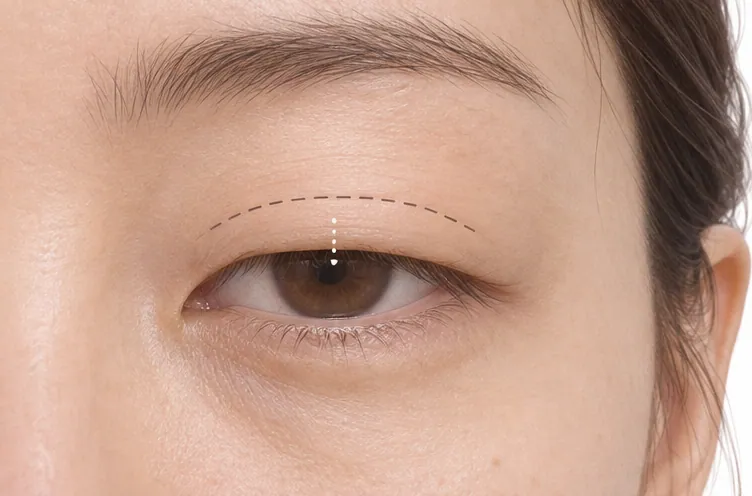 1
We measure differences in pupil exposure and eyelid height between the eyes to determine how much to lift
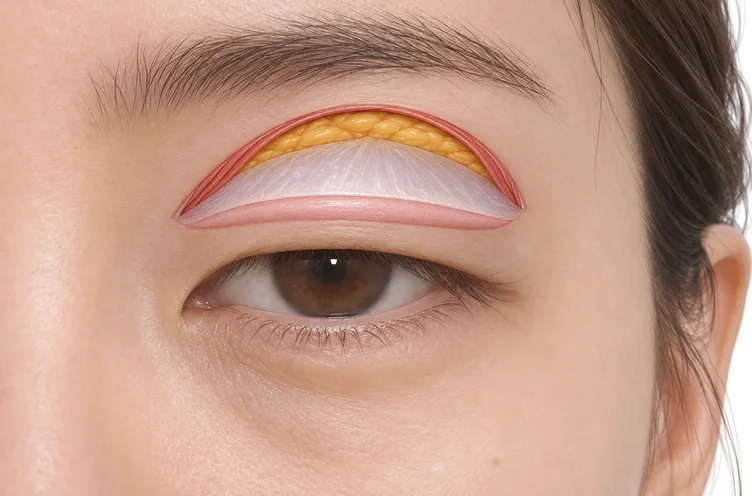 2
We use a non-incisional approach without a long skin incision, or a partial-incision approach through a small opening
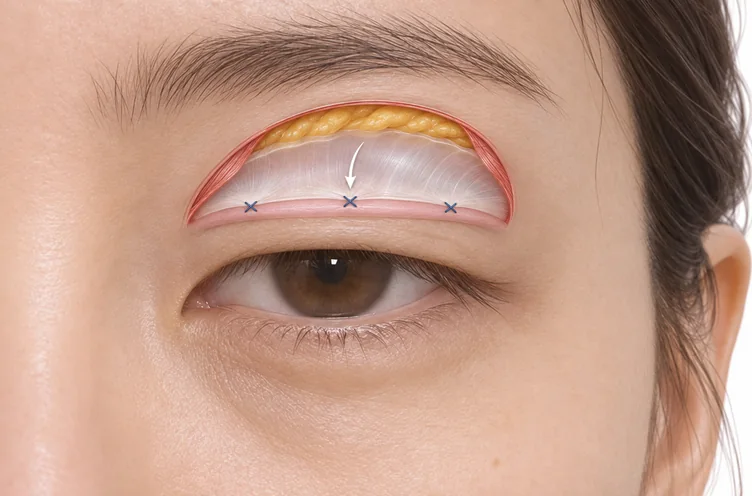 3
We fold a portion of the eyelid-opening muscle and aponeurosis and secure it to the tarsal plate inside the eyelid
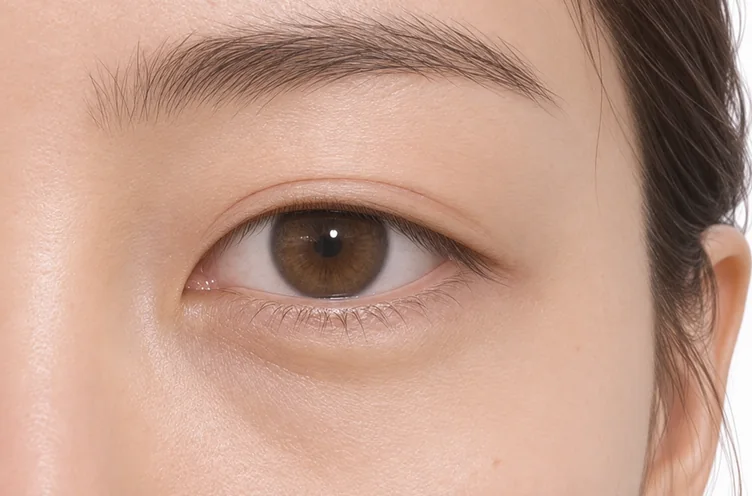 4
We check eyelid height and symmetry before completing the procedure
When weakness is pronounced or sagging skin is also present
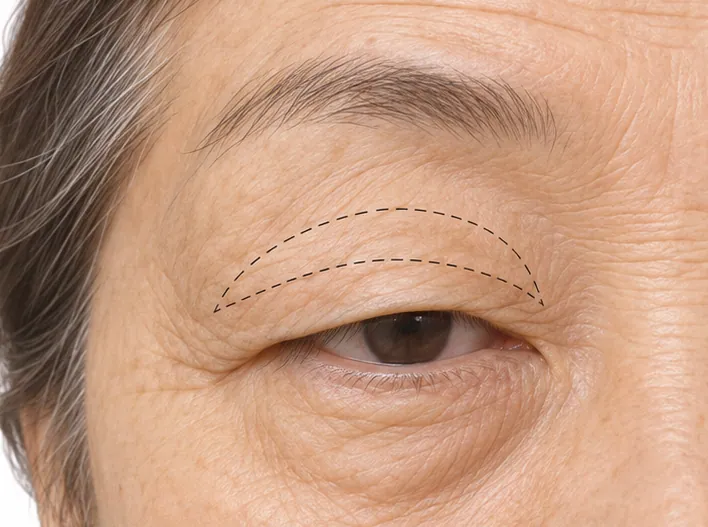 1
We assess muscle function, excess skin, and dryness together and design the incision line
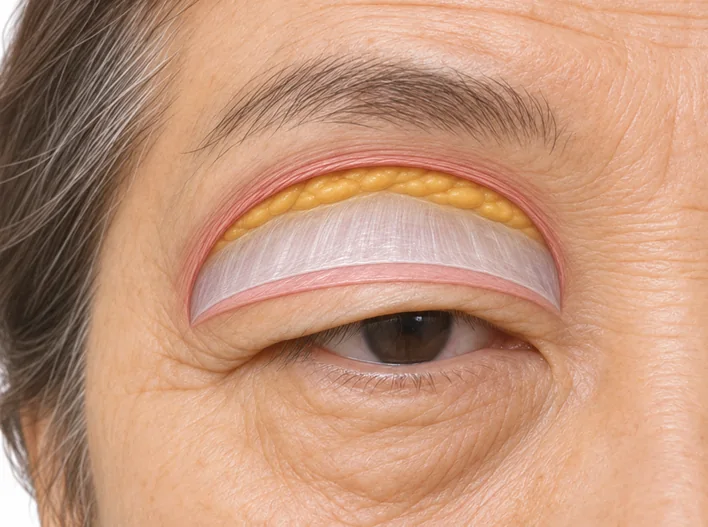 2
We make an incision along the eyelid crease to locate the eyelid-opening muscle and aponeurosis
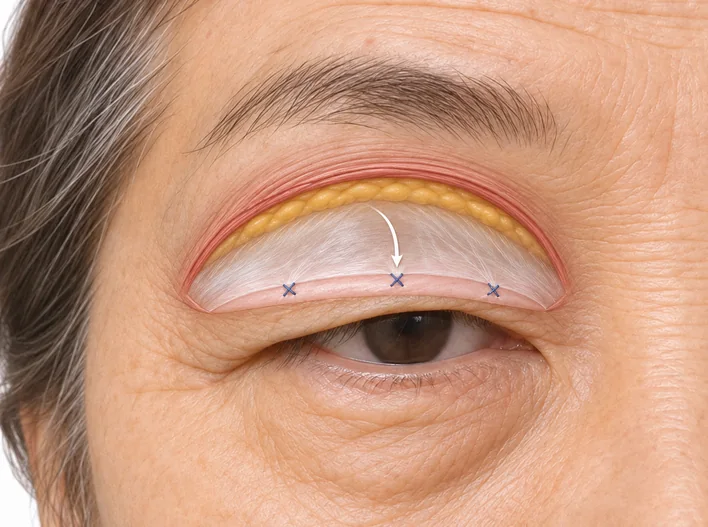 3
We reattach the aponeurosis to the tarsal plate inside the eyelid and adjust the height
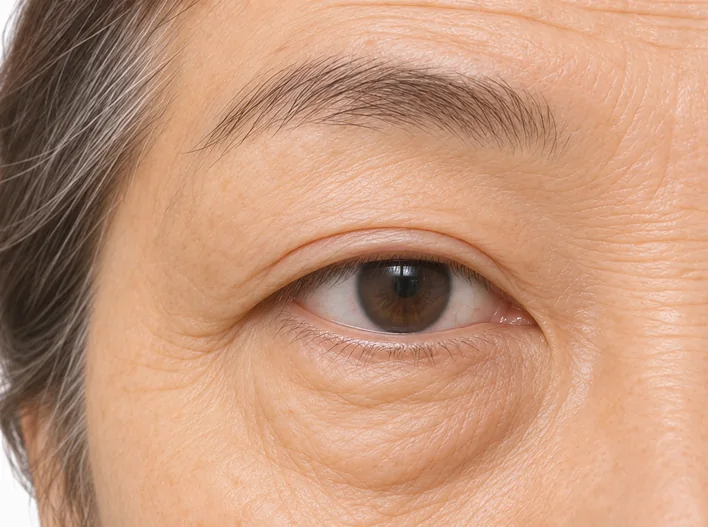 4
We trim excess skin and orbicularis oculi muscle, then close the incision to create a low, hidden crease or a crease at the desired height
Illustration for explanation · Not an actual patient. This is a simplified description of typical steps. The actual technique and extent of surgery are determined after examination.
DOCTOR’S NOTE
Ptosis is a problem with the blinds over the windows of your eyes, rather than simply a sleepy appearance.
When drooping eyelids cover the pupils, the field of vision narrows, and you may unknowingly use your forehead muscles to open your eyes. We first assess eyelid-opening function. If correction is needed, we adjust muscle function using an approach that takes natural recovery into account.
— Dr. Hyungwoo Yim
MYTH → FACT
“Can rubbing your eyes create an eyelid crease?”
It can actually cause an existing crease to fade and ptosis to develop. This happens because the thin, rubber band-like muscle inside the eyelid is repeatedly stretched.
IN HIS WORDS
The Story of Cave Salamanders
“They say salamanders living in caves with no light eventually lose their sight. When a drooping eyelid covers the pupil like a roof, it is like leaving window blinds halfway down.”
THE DETAIL
The Degree of Muscle Adjustment
How much eyelid-opening strength is adjusted affects both comfortable eyelid closure and a natural appearance. The key is to determine the range between overcorrection and undercorrection.
RELATED RESEARCH
Semin Plast Surg 2015 · The Evolution of Looks and Expectations of Asian Eyelid and Eye Appearance
1
Eyebrow Position
2
Hollow Areas
3
Eyelid Height
4
Eyelid Muscle Strength · Excess Skin
Ptosis & Function
We distinguish between weak eyelid-opening function and overlying skin.
True ptosis, in which the eyelid-lifting muscle (levator) is actually weak, requires a different approach from pseudoptosis, in which muscle function is normal but skin covers the pupil.
Suture Removal
5–7 days
Return to Daily Activities
After 2–3 days
VITAL PROTOCOL
How We Evaluate Ptosis
STEP 01
Distinguish True Ptosis from Pseudoptosis
We assess eyelid-opening muscle strength and overlying skin separately.
STEP 02
Check Function · Field of Vision
We check forehead muscle use, visual obstruction, eyelid closure, and dryness.
STEP 03
Choose a Correction Method
For true ptosis, we first consider ptosis repair; for pseudoptosis, excess skin removal · crease creation.
STEP 04
Plan for Hollowing · Skin Together
If eyelid hollowing or sagging skin is present, we address it within the same plan.
WHAT WE CHECK
We also assess how the eyes open and close
Eyelid-opening Muscle Strength
We measure muscle function to determine whether true ptosis is present.
Eyelid Position
We check how much of the pupil is covered.
Forehead · Eyebrow Compensation
We check whether the forehead muscles are used to open the eyes.
Excess Skin
We check whether sagging skin covers the pupil.
Eyelid Closure · Dryness
We also assess the eye surface when determining the extent of correction.
Daily Habits
We check acquired factors such as contact lens wear and eye rubbing.

When
to consider a consultation
- When difficulty opening your eyes causes forehead strain
- When your eyelids cover your pupils, making your eyes feel heavy and look sleepy
- When differences in eyelid-opening strength make the eyes look different in size
- When opening your eyes is uncomfortable after previous double eyelid surgery
- When your eyes gradually look smaller after long-term contact lens wear or habitual eye rubbing
When
Surgery is not our first recommendation
- When MRD1 is within the normal range and removing excess skin is sufficient
- When a history of thyroid eye disease, glaucoma, autoimmune disease, or another condition needs to be reviewed first
- When you take anticoagulants or have uncontrolled high blood pressure or diabetes
- When a thorough examination and explanation are difficult to complete
WHEN WE WAIT
In These Cases
We do not recommend immediate surgery.
When symptoms require an ophthalmologic evaluation first
When ocular surface conditions, such as severe dry eye, need to be managed first
When tissue is still recovering from previous surgery
When the changes you expect are beyond what is medically possible
Preparing for surgery and
recovery by stage
- 3–4 days after surgery
This is when swelling and bruising are at their worst. Sleep with your head elevated. For the first 2–3 days after surgery, apply a cold compress gently, without letting ice touch your skin or eyes directly. Starting on day 4, use a warm compress. While you cannot close your eyes completely, use artificial tears frequently and apply eye ointment before bed.
- Days 5–7
If an incision was made, the stitches are removed. Keep the surgical area dry until then. Avoid eye makeup, eyelash extensions, and contact lenses for 2 weeks, and saunas and Korean bathhouses for 1–2 weeks. You can resume light daily activities after 2–3 days, although swelling and bruising may remain.
- 3 weeks–3 months
During this period, the tissue may feel firm and tight. This is part of the healing process, so decisions about revision surgery are not based solely on appearance at this stage. Avoid strenuous exercise, rubbing or tightly closing your eyes, and sleeping face down for 1 month after surgery.
- 3 months–1 year
The tissues soften, redness fades, and the two sides gradually become more balanced. We check your progress at 1 · 3 · 6 months · 1 year.

No smoking · No alcohol
You will be advised before surgery to avoid alcohol and smoking for 2–4 weeks afterward, as they can affect bleeding and wound healing.
Medications · Supplements
We recommend stopping herbal medicines and supplements such as omega-3 when possible because they may increase bleeding. Please tell us about every medication you take.
Medical history
Thyroid eye disease, glaucoma, severe dry eye, autoimmune disease, or anticoagulant use may be reasons to postpone or avoid surgery.
Eye care habits
Limit contact lens use as much as possible, use artificial tears frequently, and avoid rubbing your eyes. Tell us if you have used double eyelid tape or glue.
Recovery timelines are general estimates and vary by individual. Contact us immediately for sudden severe pain, decreased vision, bleeding that does not stop, or rapidly worsening swelling on one side.
LIMITS & RISKS
Along with possible improvements,
we explain the limitations and risks.
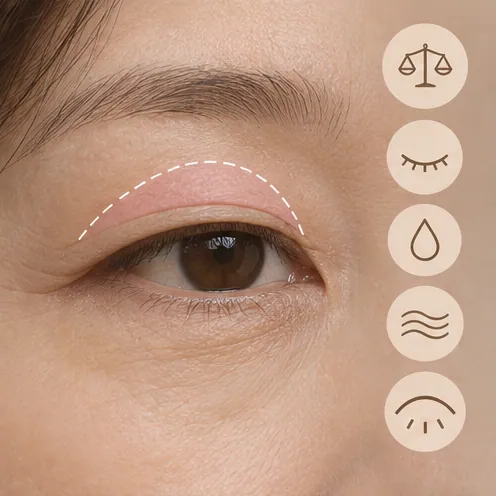
Asymmetry
Undercorrection or Overcorrection
Difficulty Closing the Eyes
Dryness
Crease Changes
Swelling
Bruising
Do not wait if you have these symptoms
If you experience sudden severe pain, decreased vision · An obstructed field of vision, bleeding that does not stop, or rapidly worsening swelling on one side, contact us immediately instead of waiting for your appointment.
This is not a complete list of possible risks. Risks may vary depending on your health, previous treatments, and the technique and extent of surgery. Surgical results vary by individual.
Common questions
during consultations
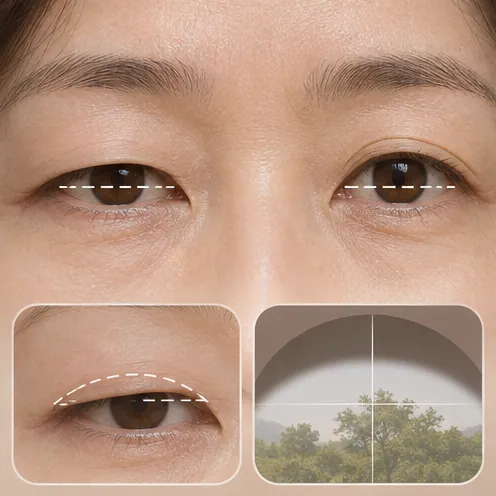
Is ptosis surgery covered by National Health Insurance?
The current official coverage notice does not specify numerical criteria such as an MRD1 below a certain number of millimeters or a visual field below a certain number of degrees. The clearest supporting evidence is a photograph showing whether the eyelid covers the pupil when looking straight ahead, along with medical records documenting a ptosis diagnosis and reduced eyelid-opening muscle function. Coverage is usually determined through an insurance review, so a doctor's judgment alone does not establish eligibility.
Can I have surgery if I have dry eyes?
In most cases, we proceed if ptosis repair or double eyelid surgery is necessary. Even if dryness develops for 1–2 months after surgery, it usually improves with artificial tears. Before surgery, however, we first assess how severe the dryness is and whether your eyes close completely.
Do I need surgery now, or can it wait?
If there are no functional problems, discomfort is mild, and the changes are stable, observation is an option. We do not recommend rushing into surgery simply because you are getting older. If the eyelid covers the pupil and affects your field of vision, or if pain and functional problems persist, we evaluate them without delay.
Returning to your original concern
“My eyelids feel heavy when I open my eyes, and I strain my forehead.”
A sleepy appearance alone does not confirm ptosis. We first measure the function of the muscles that open the eyes to determine whether it is true ptosis.
Three things we check first during your consultation
- Eyelid position and movement
- Whether the brow muscles are compensating
- Excess skin and eyelid closure
When booking “Please measure how well my eyelid muscles work first.”Leave this brief note, and we can start your consultation with that concern.
These are our principles of care. The actual approach is determined after an examination. You do not need to decide the day of your consultation.
Related Treatments
Q & A
Before you decide,
frequently asked questions
Q
How much skin is removed?
−
A
We take measurements and remove only a minimal amount of skin while preserving the ability to close the eyes properly. Excessive removal can cause incomplete eyelid closure or dryness.
Q
Can I Have Revision Surgery If I Have Had Surgery Before?
−
A
Yes, but adhesions and structural changes from the previous surgery must be assessed accurately. We consider your surgical records, current symptoms, and stage of tissue healing—at least 6 months to 1 year or longer after surgery—to honestly explain the limitations and expected benefits of additional surgery.
Q
When can I return to work, wear makeup, and exercise?
−
A
Stitches are usually removed 5–7 days after surgery. You can return to light work after 2–3 days, but most swelling and bruising improve over 2–6 weeks. Avoid eye makeup, eyelash extensions, and contact lenses for 2 weeks; saunas and Korean bathhouses for 1–2 weeks; and strenuous exercise for 1 month.
Q
What Symptoms Should Prompt Me to Contact the Clinic Immediately After Surgery?
−
A
If you experience sudden, severe pain in one eye, decreased vision, an obstructed field of vision, bleeding that will not stop, or rapidly increasing swelling, contact us immediately rather than waiting for your scheduled appointment.
Q
Do I need a large double eyelid crease?
−
A
The goal of correction goes beyond crease size. We explain your options based on eyelid function, skin condition, and your desired appearance.
Q
Can you diagnose ptosis from photos alone?
−
A
Photos serve only as a reference. An in-person examination is needed to assess eyelid movement and function, brow compensation, and other factors.
Q
Can surgery be finalized through a photo consultation alone?
−
A
Photos are only a reference. An in-person examination is needed to assess tissue condition and function, taking your current health and previous treatments into account.
Q
Are surgical results and recovery times the same for everyone?
−
A
No. Results and recovery speed vary depending on your individual condition and the extent of surgery. Risks include bleeding, infection, scarring, and asymmetry.
~ 1 WEEK
Check the wound · bleeding · infection · early function, remove sutures
1 MONTH
Early scar contracture: assess tightness · firmness and begin regenerative care if needed
3 MONTHS
Peak contracture · transition phase: assess remodeling and consider continued injections · laser treatment
6 MONTHS
Compare with initial photos and decide whether additional treatment is needed
1 YEAR
Check tissue maturation · long-term progress
IN HIS WORDS
Our standard is based on
measurement, not impressions.
“
Our standard is science. We use MRD1 to measure how much of the eye is exposed. If the measurement is within the normal range (about 4 mm), we consider it pseudoptosis caused by overlying skin and address only the skin, rather than performing ptosis surgery.
Doctor Interview · 2026.10
“
When the eyelid obstructs your field of vision, this surgery is performed for your vision and eye health as well as your appearance. The double eyelid crease is an important anatomical structure.
Doctor Interview · 2026.10
“
When it is difficult to open your eyes, you may use your forehead muscles to help, which can cause forehead wrinkles. Lifting only the forehead may actually make the problem worse.
Doctor Interview · 2026.10
Dr. Hyungwoo Yim, Medical Director · Based on the doctor's own answers. The actual scope of care is determined after an examination.
RELATED SURGERY
Related Procedures
DOCTOR'S COLUMN DOCTOR'S COLUMN DOCTOR'S COLUMN
Must Read
Care Notes Written by the Doctor · Please Read Before Your First Visit
No.1
No.3
VIEW MORE →
RESERVATION
You do not need to decide the day of your consultation.
Organize questions about this page without entering your name, contact information, or medical history. This does not submit an appointment request.