PLASTIC SURGERY
All Treatments / Surgery
Forehead lift
Forehead Lift
We assess how forehead and brow position affect the eyelids.
This may vary depending on your condition and the extent of surgery.
SHORT ANSWER
What do we check first for a forehead lift?
We assess how forehead and brow position affect the eyelids. During consultation, we check brow position, the condition of the forehead, scalp, and skin, and eyelid drooping and function.
01 · START WITH YOUR CONCERN
Do any of these concerns
sound familiar?
What brings you in?
1
Skin
2
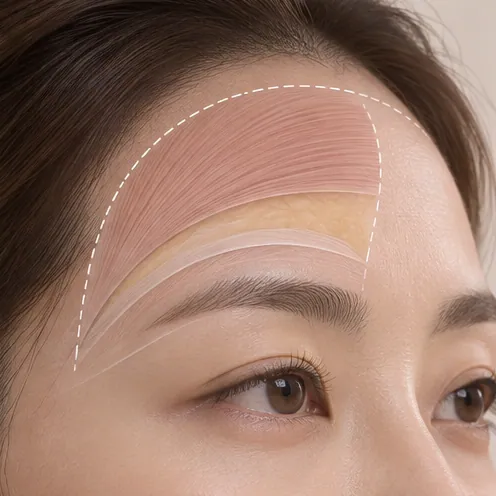
Fascial Layer (SMAS)
3
Retaining ligaments · Muscles
4
Move the deeper layers together
“My brows have dropped, and my eyes feel heavy.”
“I use my forehead muscles to open my eyes.”
“I'm deciding between upper blepharoplasty and a forehead lift.”
We assess how forehead and brow position affect the eyelids.
We assess tissue position and support as well as skin laxity. We distinguish volume loss from sagging and consider how the different areas of the face relate to one another.
Forehead Lift,
What does the surgery involve?
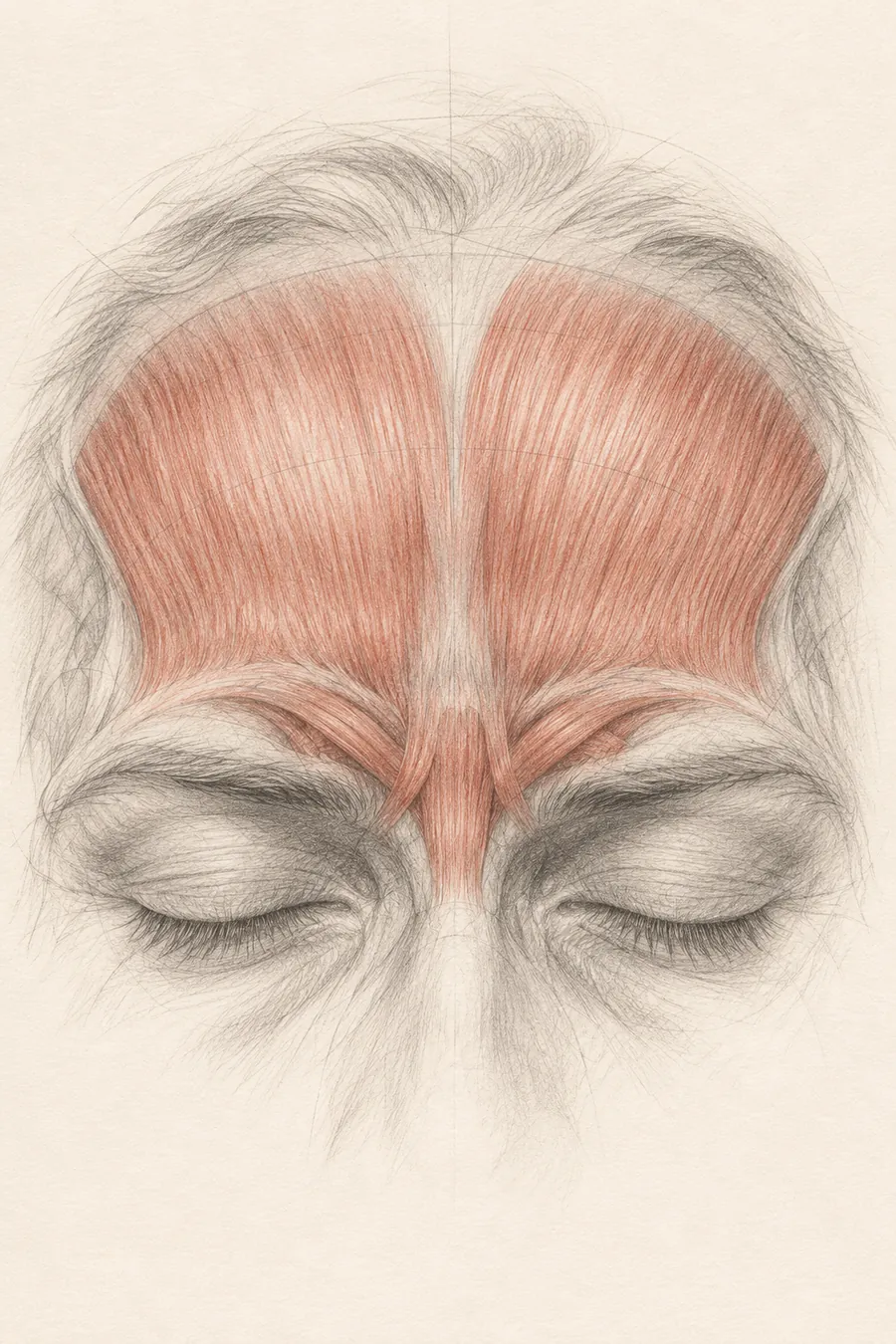
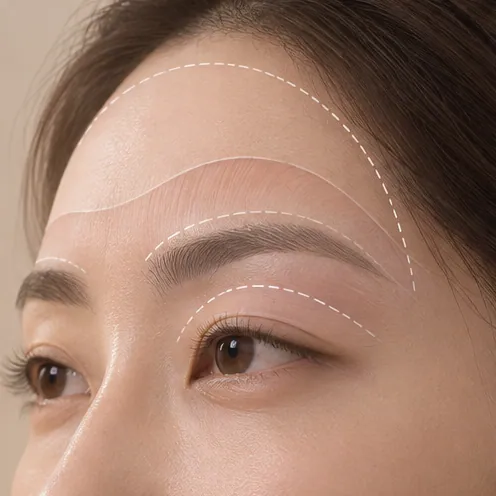
A forehead lift raises a lowered forehead and brows to address heaviness above the eyelids and forehead wrinkles. It is also considered when removing upper eyelid skin alone may not adequately relieve a heavy feeling in the upper eyelids. First, we need to distinguish whether you use your forehead muscles because of weak eyelid-opening strength or whether your brows have actually dropped. Incisions may be placed within the scalp or along the hairline, depending on forehead height and scalp condition.
- MRD1
- This is the distance from the center of the pupil to the upper eyelid margin. It measures how much of the pupil is covered.
- Pseudoptosis
- The eyelid muscles have normal strength, but skin covers the pupil, making the eyelid look droopy. Removing excess skin alone may help.
- Endoscopic Forehead Lift
- An endoscope is inserted through small incisions within the scalp to release and lift the forehead tissues.
- Subbrow Lift
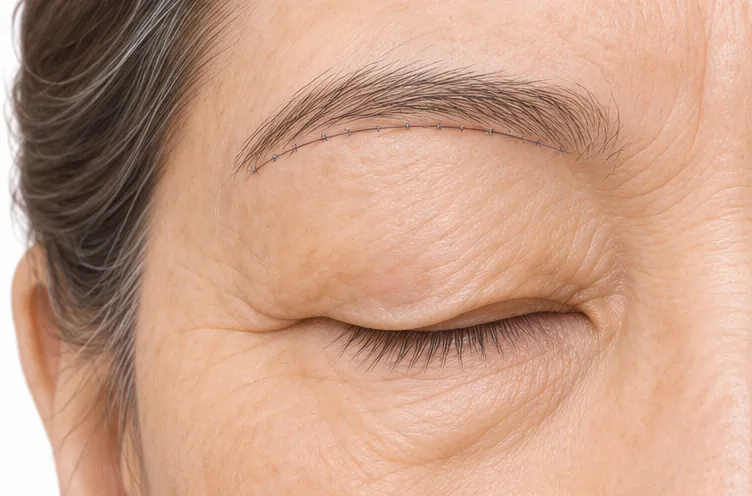
- An incision is made below the brow, and the orbicularis oculi muscle and muscle layer are pulled upward and secured toward the frontalis muscle.
For a Forehead Lift
in Lower Blepharoplasty
We first check whether the eyelids are causing forehead wrinkles
When opening your eyes is difficult, you may use your forehead muscles to help, which can deepen forehead wrinkles. In this case, lifting the forehead alone may lead you back to the same habit. We measure pupil exposure using MRD1. If the measurement meets the normal reference of 4mm, we do not perform ptosis surgery. If eyelid-opening strength is weak, we discuss ptosis correction first.
We distinguish eyelid drooping from brow descent
The procedure differs depending on whether upper eyelid hooding is caused by the skin itself or by lowered brows. If manually lifting the brows relieves the heavy feeling, we also assess the forehead as a contributing cause. If excess skin is the main issue, we compare upper blepharoplasty and a subbrow lift. A subbrow lift pulls the orbicularis oculi muscle and muscle layer upward and secures them toward the frontalis muscle, addressing a different area than a forehead lift.
We plan brow height with your expressions in mind
Lifting the brows higher is not always better. Raising them too much can create a surprised appearance, so we assess your usual expressions and brow movement together. The outer brows often drop first, so we plan to restore their position first and check how this changes the eyelids. Please let us know beforehand if you are concerned about changes to your expression.
We account for the paths of the nerves
Nerves extend upward from the brow area, making the forehead an area that requires care. These nerves are involved in forehead sensation and movement. After surgery, the forehead may feel numb or different, and movement may rarely change. Plans for scars and handling the nerves should be discussed in advance. Before surgery, we explain these possibilities along with the tissue layer we plan to access.
Incision placement depends on forehead height and scalp condition
Incisions within the scalp hide scars in the hair, but may slightly raise the hairline. If your forehead is already tall, we compare an incision along the hairline. With thin hair, scars may be visible, or hair around the incisions may temporarily thin, so we also assess hair loss. We also ask how you usually wear your bangs.
We also assess how forehead surgery may affect dry eyes
Lifting the brows also raises the upper eyelids, so closing your eyes may feel awkward at first. Combining this with upper blepharoplasty can add to this effect. We therefore check for dryness and assess eyelid closure before surgery. If double eyelid surgery or ptosis correction is also needed, surgery is generally performed even in patients with dry eyes, and dryness lasting 1–2 months usually improves with artificial tears. In some cases, staging the procedures may be preferable to performing them on the same day, depending on recovery considerations.
A Word from the Doctor
Dr. Hyungwoo Yim’s own words from his blog and interviews.
01What Does the Surgery Lift?
“Rather than lifting the forehead, forehead lift surgery lifts the eyebrows.”
The procedure is performed to lift the eyebrows. Western doctors called it a “forehead lift,” and the name stuck.
02What We Ask First During Your Consultation
“Is your goal to get forehead filler? Or is your goal to improve your appearance?”
For someone with low-set eyebrows, injecting filler or fat simply because the forehead is flat misses the main issue.
Dr. Hyungwoo Yim, Medical Director
The Surgical Process Varies
Depending on Your Condition
When Both the Eyebrows and Forehead Have Dropped
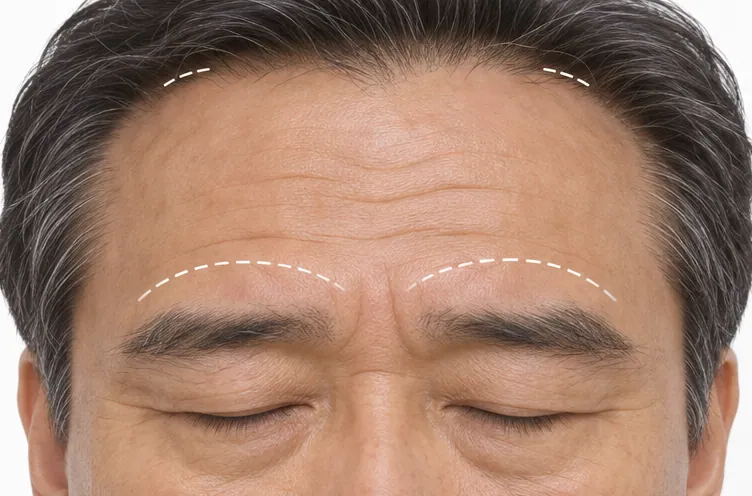 1
We plan brow height and fixation points while you are seated
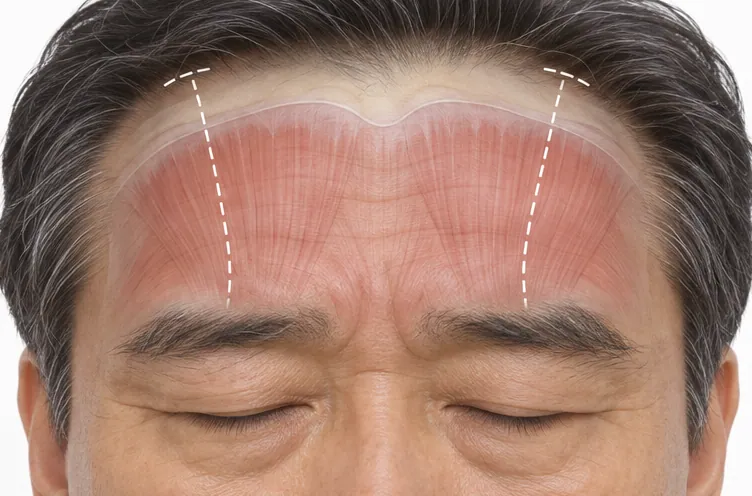 2
We make small incisions within the scalp and access the layer beneath the forehead tissues
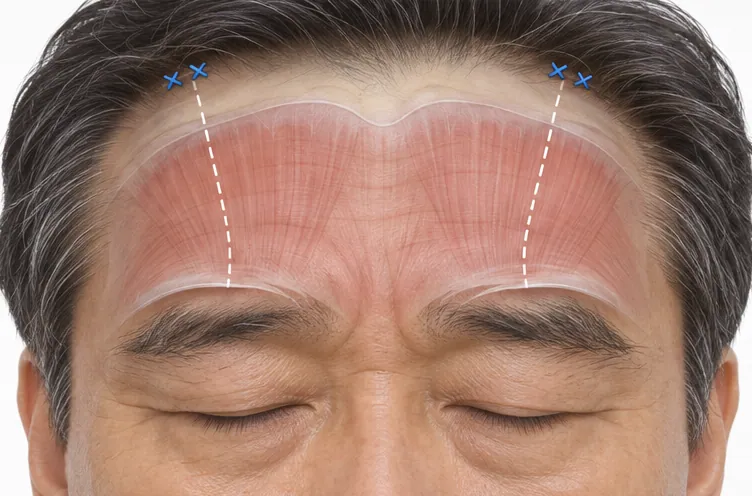 3
We release the tissues around the brows, lift them, and secure them
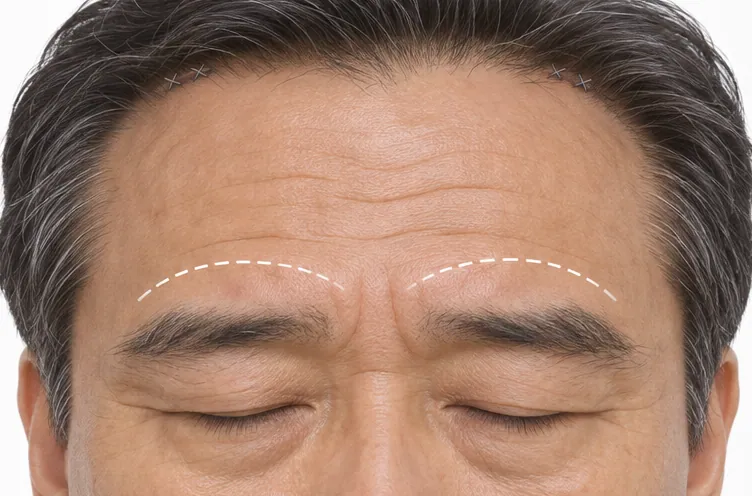 4
We close the scalp incisions with sutures
When the forehead is already tall
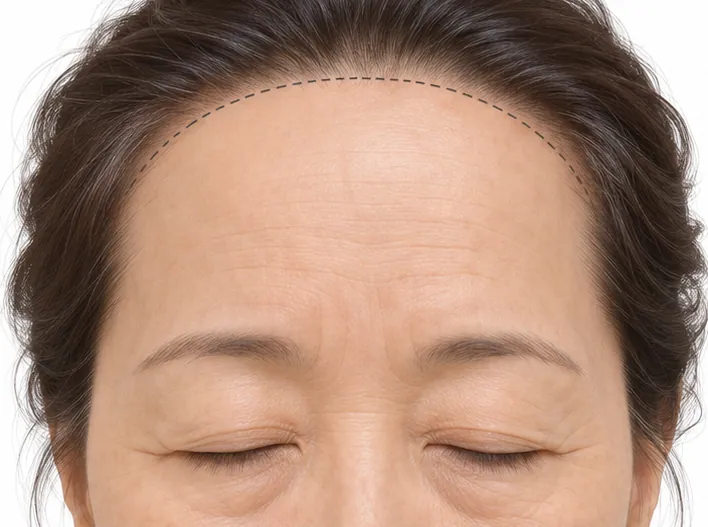 1
We measure forehead height and mark the incision along the hairline
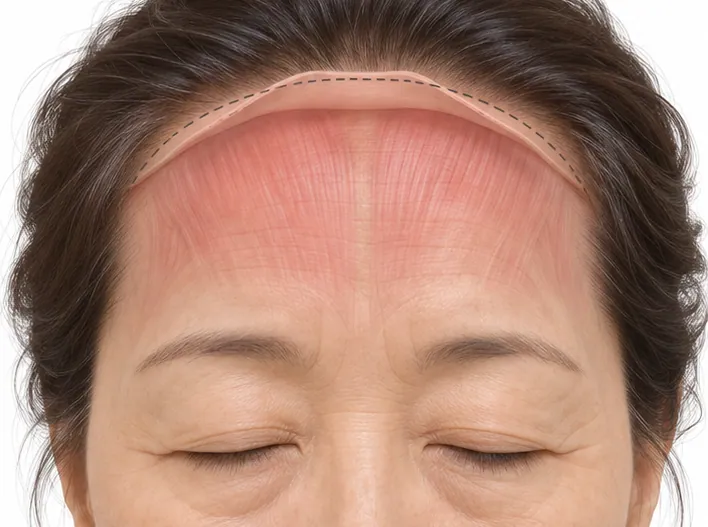 2
We make an incision at the hairline and dissect beneath the forehead tissues
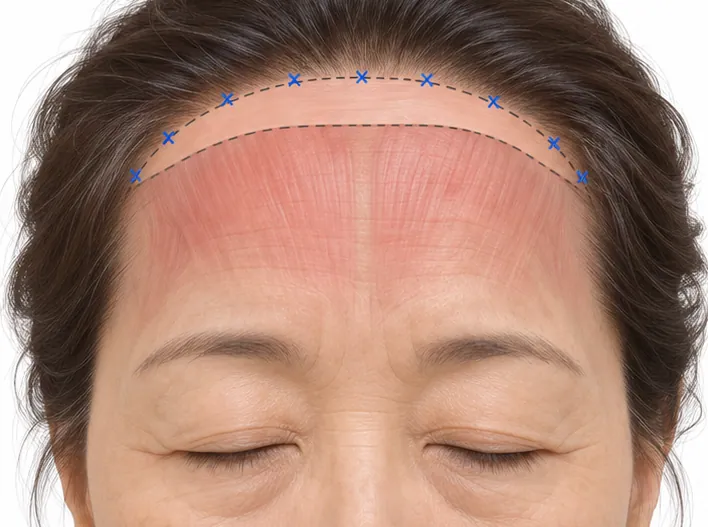 3
We lift and secure the forehead and brows, then remove excess skin
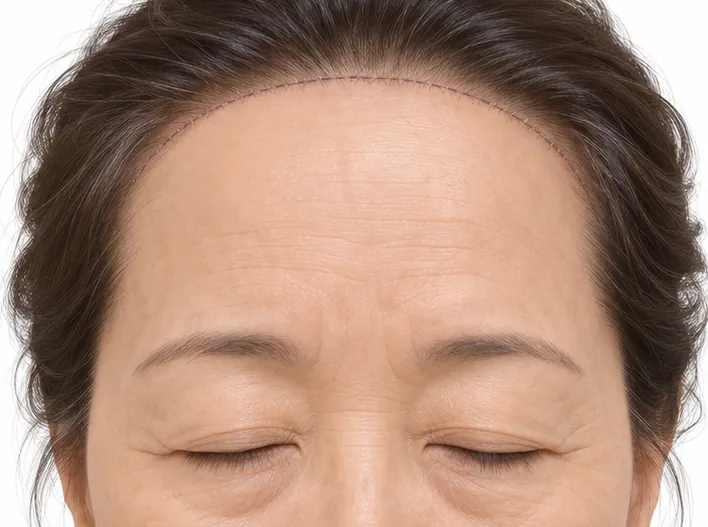 4
We close the incision along the hairline with fine sutures
When excess eyelid skin is the main cause of hooding
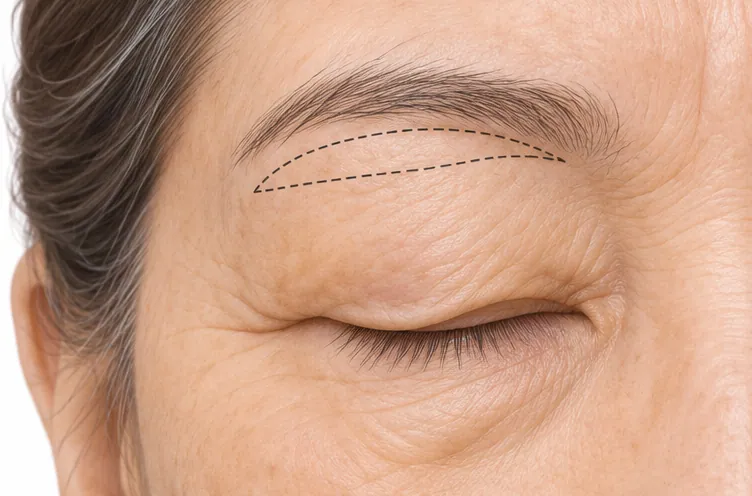 1
We assess whether a forehead lift is necessary and mark an incision below the brow
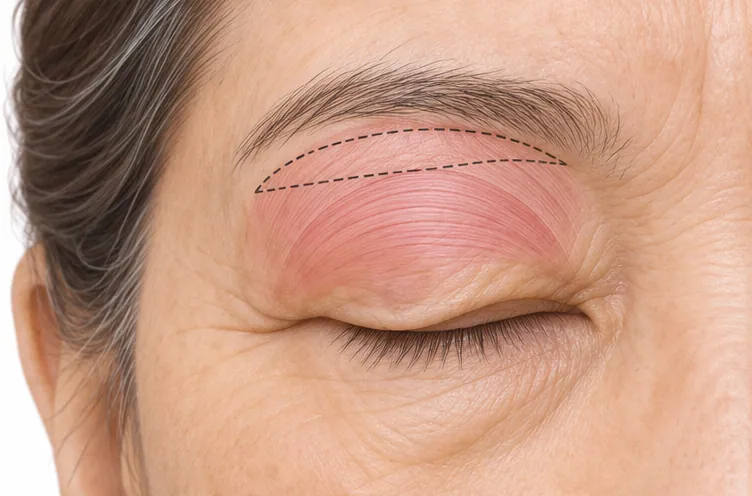 2
We make an incision below the brow and remove excess skin
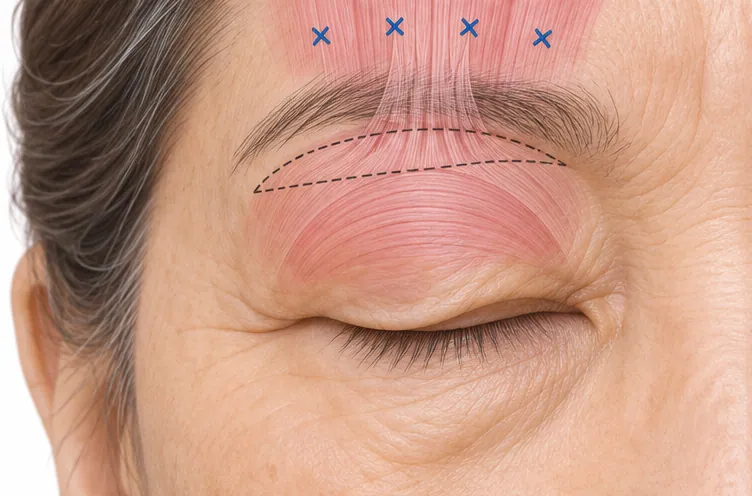 3
The orbicularis oculi and muscle layer are pulled upward and secured toward the frontalis
 4
We close the incision along the brow border with fine sutures
Illustration for explanation · Not an actual patient. This is a simplified description of typical steps. The actual technique and extent of surgery are determined after examination.
02 · WHAT WE LOOK AT
Even when concerns look similar,
the factors to assess differ.
Brow Position
We assess tissue position and support as well as skin laxity.
Forehead, Scalp, and Skin Condition
We distinguish volume loss from sagging and consider how the different areas of the face relate to one another.
Eyelid Drooping and Function
We review your previous surgery, scars, and health together.
03 · DOCTOR'S DECISION
When choosing an approach, Dr. Hyungwoo Yim
looks at three things first.
Distinguish eyelid issues from brow descent
Using your medical history and examination findings, we distinguish your current condition from your desired changes. At this stage, we identify the necessary conditions before choosing a treatment.
Compare the scope of upper blepharoplasty and lifting procedures
When comparing available methods, we explain the expected changes, the burden on the tissues, recovery, and potential remaining problems.
Explain incision placement and recovery demands
We give you time to understand the explanation and ask questions. We may not recommend immediate treatment if its burden is greater or if you cannot allow enough time for recovery.
VITAL Plastic Surgery's principle is to recommend necessary treatment at the appropriate time. Having a consultation does not mean you need to decide on a procedure or surgery that day.

When
to consider a consultation
- When lowered brows feel like they are pressing on the eyelids
- When your brows are low and you habitually use your forehead muscles to open your eyes
- When removing upper eyelid skin alone may leave a heavy feeling
- When forehead wrinkles are deep and the brows sit low
When
Surgery is not our first recommendation
- When weak eyelid-opening strength is the main cause
- When excess skin is the only issue and upper blepharoplasty or a subbrow lift appears sufficient
- When your forehead is already tall or your hair is thin, requiring discussion of the incision approach first
- When health conditions such as high blood pressure or diabetes need to be controlled first
04 · LIMITS & RISKS
Along with possible improvements,
we explain the limitations and risks.
Your desired changes — First, tell us what bothers you most and which aspects of your appearance you want to keep. We do not promise changes identical to photos or someone else's results.
Changes in Sensation
Scarring
Hair Loss
Asymmetry
Previous Treatments
Do not wait if you have these symptoms
If you experience sudden severe pain, sudden swelling of the forehead or scalp, dark red or purple skin discoloration, bleeding that does not stop, or warmth, pus, or a fever of 38°C (100.4°F) or higher, contact us immediately rather than waiting for your scheduled appointment.
Conditions to address first — We first assess your health, inflammation and stage of recovery, and the range of feasible treatments. If needed, testing, observation, or other medical care may take priority.
Risks and limitations to review during consultation — changes in sensation, scarring, hair loss, asymmetry, and possible nerve injury. This is not a complete list of possible risks. Risks may vary depending on your health, previous treatments, and the technique and extent of the procedure. These will be explained in detail during your examination and informed consent process.
Preparing for surgery and
recovery by stage
- 1 week after surgery
Sleep with your head elevated at least 30 degrees. Keep the compression dressing on for the instructed period, and avoid straining, lifting heavy objects, and strenuous exercise for 2 weeks.
- 10–14 days
Scalp stitches are removed after 10–14 days. Until then, wash your hair as instructed, and wait at least 6 weeks before coloring or perming your hair.
- 2–6 weeks · Several months
Most swelling, bruising, and tightness improve over 2–6 weeks. Sensation in the forehead and crown returns over several months, and discomfort around the fixation device usually goes away within 3–6 months.
- Up to 1 Year
The final result is assessed after 6 months, and scars may continue to change for a year or more. Follow-up visits are at 1, 3, and 6 months and 1 year.

No smoking · No alcohol
We provide these essential instructions before surgery. Smoking and alcohol affect bleeding and wound healing.
Medications · Supplements
We recommend stopping herbal medicines and supplements such as omega-3 when possible because they may increase bleeding. Please tell us about every medication you take.
Medical history
We first check for high blood pressure, diabetes, and anticoagulant use. If these conditions are not controlled, surgery cannot proceed right away.
Filler · Thread History
Please tell us about previous fillers, threads, and lifting procedures. If needed, we use ultrasound to assess their location and distribution.
Recovery times are averages and vary by individual. Please contact us immediately if you experience sudden severe pain, bleeding that does not stop, rapidly worsening swelling on one side, warmth, pus, or a fever of 38°C or higher.
05 · FOLLOW THE CHANGE
We also document
and monitor changes after treatment.
01
STEP 01
Documenting your condition before treatment
We review previous treatments, your current condition, and the changes you hope to see.
02
STEP 02
Check Early Reactions · Wound Healing
We explain treatment-specific precautions and symptoms that require contacting us.
03
STEP 03
Comparing appearance and function
Along with photos, we assess discomfort and changes in function.
04
STEP 04
Assessing additional care
We explain additional treatment based on your condition rather than recommending the same treatment to everyone.
This is a general explanation of the process, not an actual patient case. Specific care schedules vary depending on the treatment method and recovery progress. If you experience symptoms such as sudden severe pain, vision changes, or persistent bleeding, contact a medical facility immediately rather than waiting for your scheduled appointment.
Common questions
during consultations
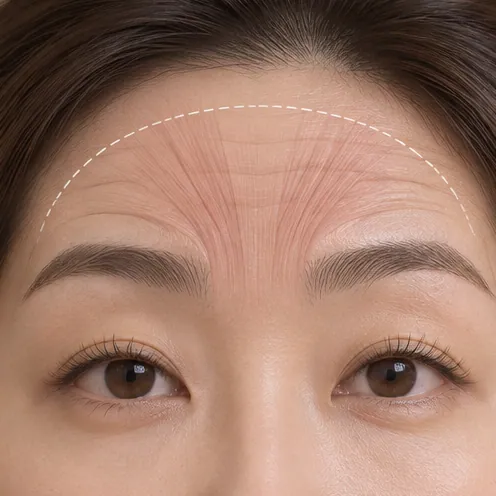
Can forehead Botox be used instead?
Botox temporarily blocks nerve signals to muscles to address wrinkles caused by movement. If you use your forehead muscles to open your eyes, weakening those muscles may make your eyes feel heavier, so we assess eyelid function first. Its purpose differs from treatment that raises brow position.
Will my forehead look taller?
Hairline position changes depending on the incision approach. Incisions within the scalp may slightly raise the hairline, so we compare a hairline incision if your forehead is already tall. We measure forehead height and discuss it with you before surgery.
Will my forehead feel numb after surgery?
Because surgery involves areas where sensory nerves run, you may experience reduced sensation or itching. This usually changes over time, but the duration and degree vary. If your forehead does not move or symptoms persist, we assess this at follow-up visits.
BEFORE YOU DECIDE
Before you decide,
frequently asked questions
Questions to review together before deciding.
Based on questionnaire responses from Dr. Hyungwoo Yim · Last updated October 2026 Specific methods and their scope are discussed individually after an examination.
Q
Is a forehead lift always used instead of upper blepharoplasty?
−
A
The two procedures address different concerns and areas. We compare excess skin, brow position, and eyelid-opening function to explain the approach you need.
Q
Are the cost, number of treatments, and recovery period fixed?
+
Q
Can a treatment plan be finalized through a photo consultation alone?
+
DOCTOR'S COLUMN DOCTOR'S COLUMN DOCTOR'S COLUMN
Must Read
Care Notes Written by the Doctor · Please Read Before Your First Visit
No.1
No.3
VIEW MORE →
Once you feel fully informed, schedule a consultation.
Forehead Lift Book a Consultation
You do not need to decide the day of your consultation.