PLASTIC SURGERY
All Procedures / Eyes · Upper Eyelids · Forehead
Upper Lid & Brow
Upper Eyelid Surgery
When drooping upper eyelids cover your eyes and make them look heavy, we assess both eyelid and eyebrow position.
Suture Removal
Eyes: 5–7 days · Scalp: 10–14 days
This may vary depending on your condition and the extent of surgery.
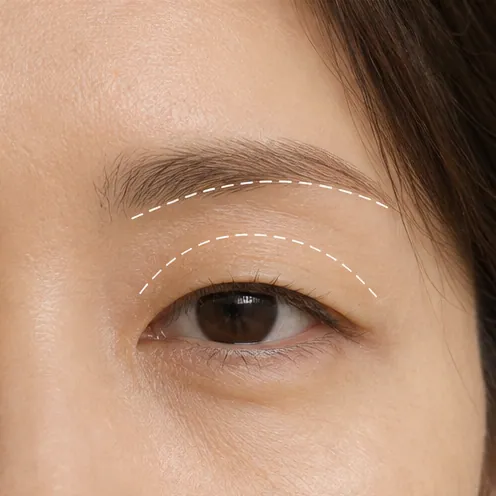
Before removing eyelid skin, we check whether the eyebrows have dropped.
Key Questions Answered
Drooping upper eyelids: what needs to be corrected?
Drooping upper eyelids may be caused by eyelid skin alone or by a lowered forehead and eyebrows. Removing skin alone can narrow the space between the eyebrows and eyes, so we determine whether upper blepharoplasty or a forehead lift should come first.
— Excess Skin
— Eyebrow Position
— Forehead Muscle Use
YOUR CONCERN
Do any of these concerns
sound familiar?
1
Eyebrow Position
2
Hollow Areas
3
Eyelid Height
4
Eyelid Muscle Strength · Excess Skin
“My upper eyelids droop and cover my eyes.”
“My eyes look heavy and hooded.”
“My forehead wrinkles are getting deeper, and I keep raising my eyebrows.”
Upper Blepharoplasty and Forehead Lift,
What does the surgery involve?
Heavy-looking eyes may be caused by eyelid skin, a lowered forehead and eyebrows, or weak eyelid muscles. Upper blepharoplasty removes excess eyelid skin and muscle, while a forehead lift raises the forehead and eyebrows. The procedures address different tissue layers and use different incision locations. The source of the drooping determines whether one or both procedures are needed and in what order. This page explains how we choose between them.
- Eyebrow Position
- When the forehead droops, the eyebrows also descend and can appear to press down on the eyelids. We check how much the hooded appearance improves when the eyebrows are lifted by hand.
- Forehead Lift
- This surgery lifts the forehead and eyebrows through an incision within the scalp (a coronal incision or small incisions for an endoscope) or along the hairline. The eyelids are not directly incised.
- Areas at Risk
- Certain areas of the face require particular care because nerves pass through them. During training, these are taught as seven areas, or five broader regions. Nerves that run upward from the eyebrows into the forehead are also considered.
For Upper Blepharoplasty and Forehead Lifts,
in Lower Blepharoplasty
We Lift the Eyebrows to Guide the Assessment
During the examination, we lift the eyebrows to their proper position and reassess the eyelids. If excess skin remains, upper blepharoplasty may be an option. If lifting the eyebrows alone improves the hooding, a forehead procedure may be considered first. If both issues are present, we plan for both. Lifting your eyebrows yourself in front of a mirror can make the difference easier to understand than a verbal explanation.
We First Check Whether You Use Your Forehead to Open Your Eyes
Some people with deep forehead wrinkles use their forehead muscles to lift their eyelids because their eyelid muscles are weak. In these cases, lifting the forehead alone may make the problem worse. We first measure MRD1 to assess how much of the iris is visible. If ptosis is present, we consider correcting the eyelids first. As opening the eyes becomes easier, forehead muscle use may decrease, so we reassess the forehead afterward.
The Order of Surgery Affects How Much Skin Is Removed
Raising the forehead also changes the amount of excess eyelid skin. If too much skin is removed during upper blepharoplasty before the forehead is lifted, the eyes may not close fully afterward. When both procedures are needed, we calculate how much eyelid skin to remove with the forehead in its lifted position. If one procedure must be done first, we make this calculation in advance.
We Account for the Nerves That Run Through the Forehead
While incisions can be made anywhere on the face, some areas require care because nerves pass through them. The forehead has nerves that travel upward from the eyebrow area, which are considered when determining the depth and extent of tissue dissection. After surgery, the forehead and crown may feel numb or itchy, with sensation recovering over several months. During that time, take care to avoid burns from hair dryers or curling irons. Discuss how scars and nerves will be managed thoroughly before surgery.
Incision Placement Depends on Forehead Length and Hair Density
Forehead lift incisions can be placed within the scalp (a coronal incision or small incisions for an endoscope) or along the hairline. Incisions within the scalp conceal the scar, but a coronal incision may move the hairline back and make the forehead slightly longer. An incision along the hairline helps maintain forehead length, but scar care is more important. The choice depends on forehead length, hair density, and your usual hairstyle.
We Discuss Whether to Combine or Stage Procedures
Having several procedures at once does not simply add their recovery periods together, but it can increase swelling, discomfort, and aftercare demands. Although combining procedures may be preferable from the surgeon’s perspective, staging them may sometimes be better for normal recovery. We decide based on your health, total surgery duration, and schedule.
The Surgical Process Varies
Depending on Your Condition
When Eyelid Skin Is the Main Cause
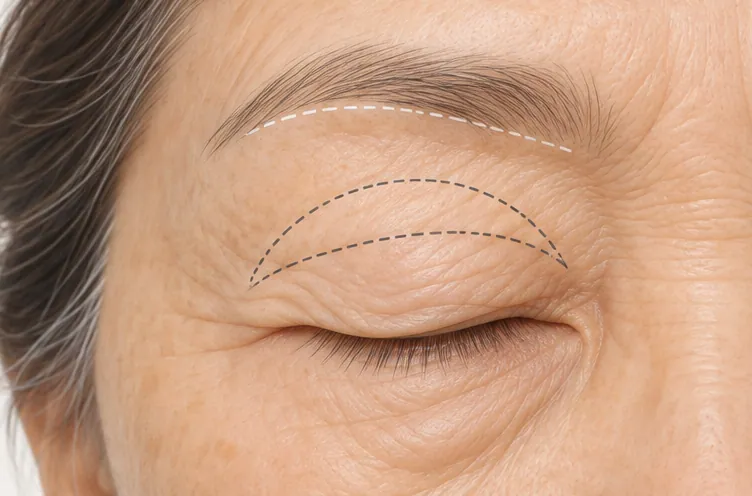 1
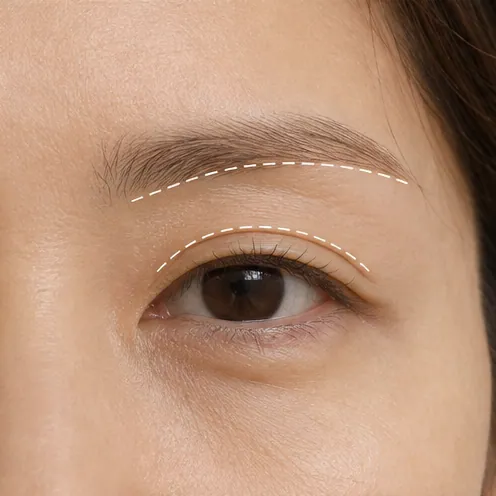
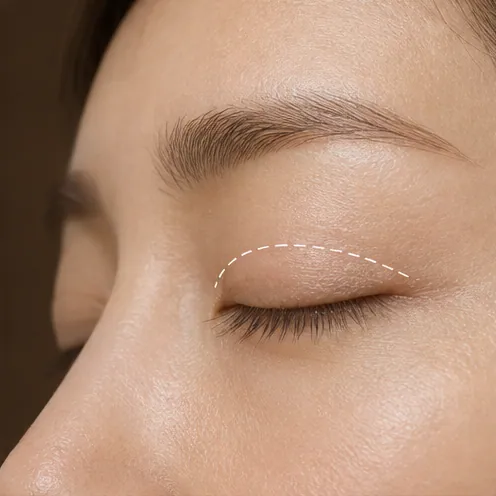
With the eyebrows in their proper position, we mark the excess skin and incision lines.
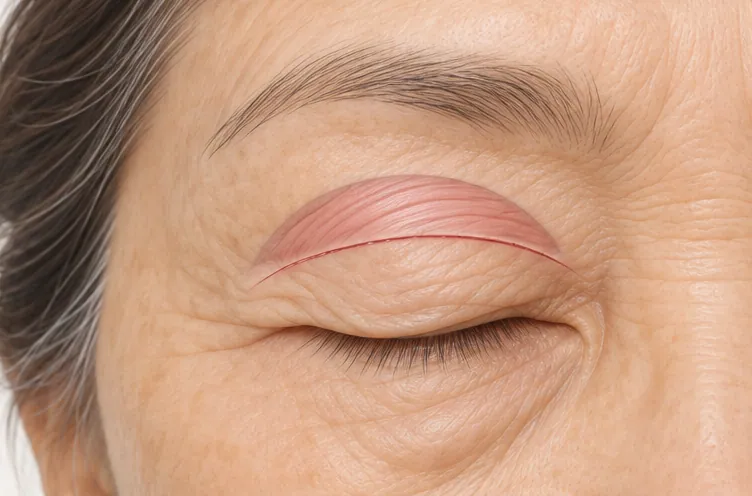 2
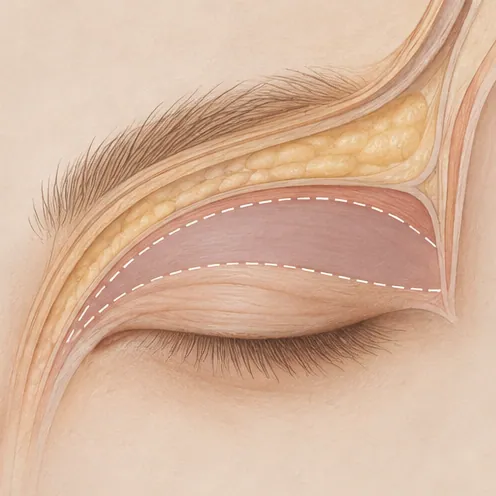
We make an incision along the upper eyelid crease or beneath the eyebrow to remove excess skin and orbicularis oculi muscle.
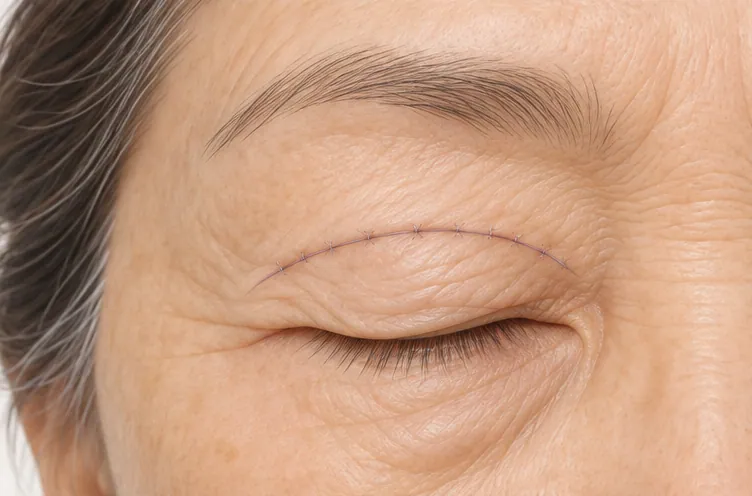 3
We check eyelid closure, then close the incision with fine sutures.
When Both the Eyebrows and Forehead Have Dropped
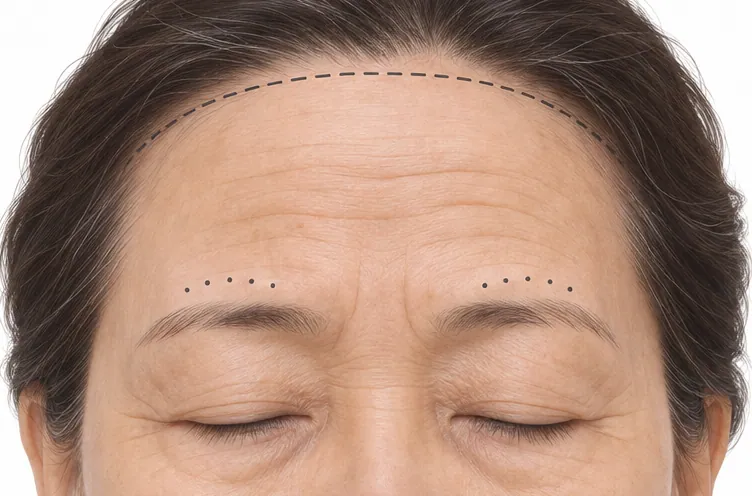 1
With the eyebrows lifted, we check the remaining excess skin and mark the incision lines.
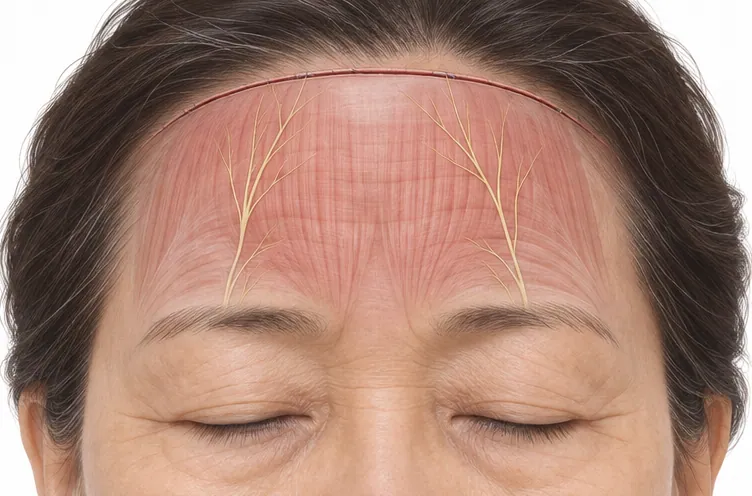 2
An incision is made within the scalp (including small endoscopic incisions) or along the hairline, and the forehead tissue is dissected down to just above the eyebrows.
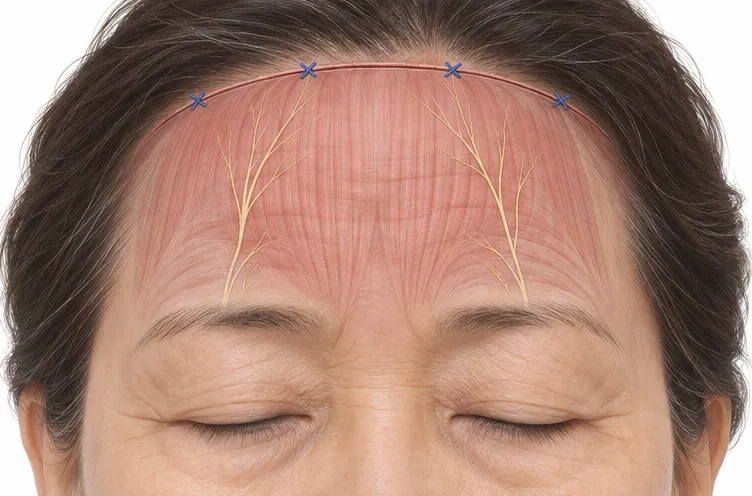 3
We lift and secure the forehead and eyebrows while accounting for the nerves that pass through the area.
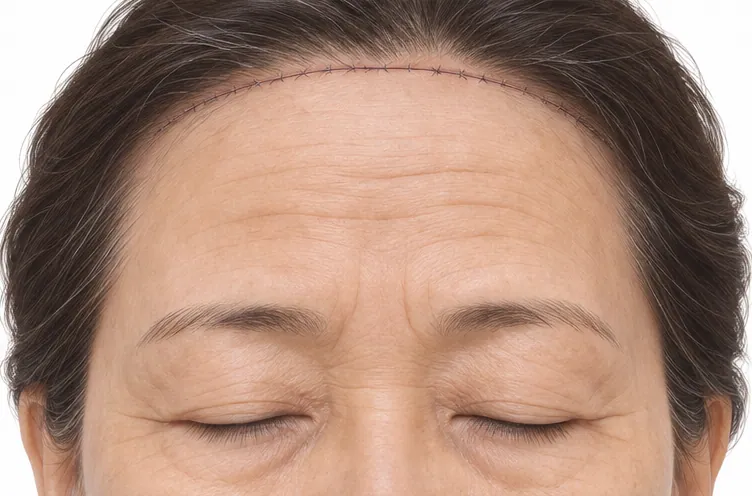 4
After closing the incisions, we assess whether remaining excess eyelid skin should be addressed with upper blepharoplasty at the same time or later.
When Forehead Wrinkles Result from Effort to Open the Eyes
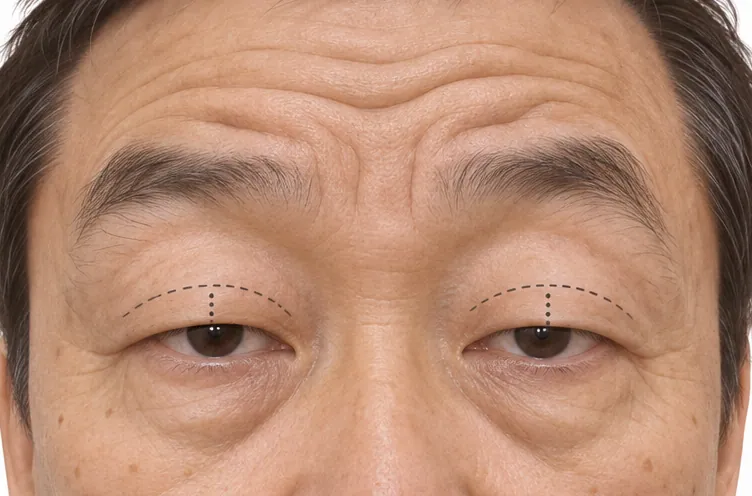 1
With the forehead muscles relaxed, we measure MRD1 and eyelid height and mark the incision lines.
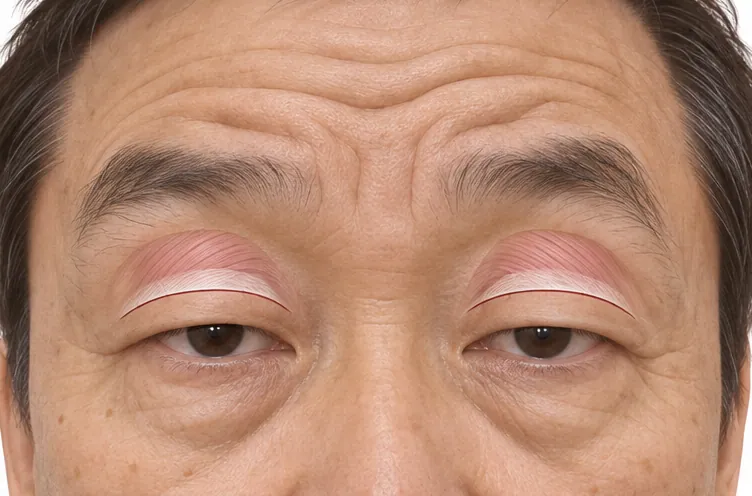 2
We make an incision along the upper eyelid crease to correct the eyelid-lifting muscle and its aponeurosis.
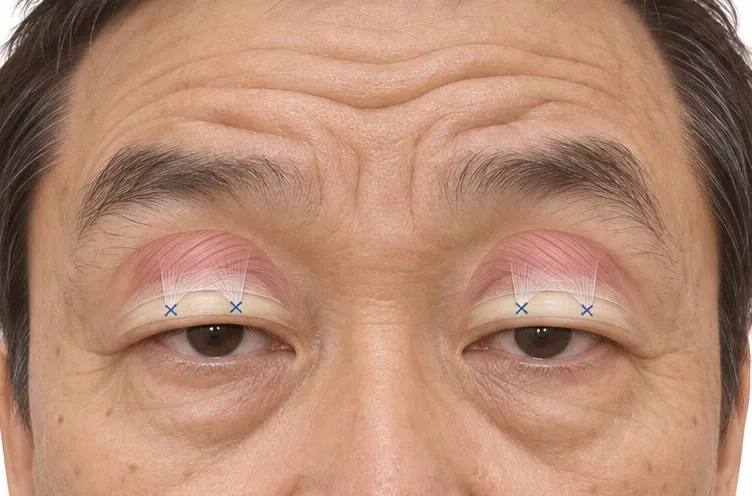 3
We remove excess skin and close the incision.
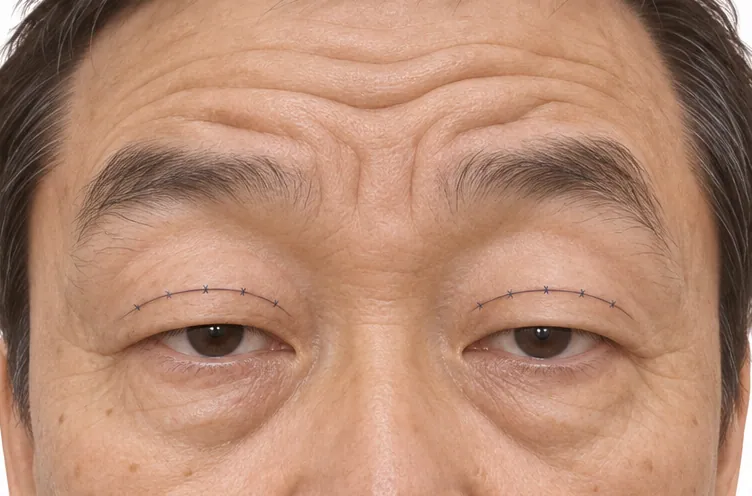 4
After recovery, we reassess eyebrow height and forehead wrinkles to determine whether a forehead procedure is needed.
Illustration for explanation · Not an actual patient. This is a simplified description of typical steps. The actual technique and extent of surgery are determined after examination.
DOCTOR’S NOTE
We remove only as much skin as needed, while preserving full eyelid closure.
We precisely measure the skin within functional limits and remove only a minimal amount. Excessive skin removal can cause lagophthalmos, or incomplete eyelid closure, and dry eyes. Our goal is to preserve your natural appearance while improving the hooding and shadows caused by drooping.
— Dr. Hyungwoo Yim
MYTH → FACT
“Does removing more skin make the eyes look more open?”
If the eyebrows have dropped, removing too much eyelid skin alone can narrow the space between the eyebrows and eyes and change your appearance.
IN HIS WORDS
We Do Not Change Your Overall Appearance
“What patients tell us most often is, ‘I don’t want my appearance to change.’ Our goal is to reduce only the hooding and shadows.”
THE DETAIL
Upper Blepharoplasty or Forehead Lift?
Distinguishing whether the drooping starts in the eyelids or the forehead · eyebrows determines how natural the results look.
RELATED RESEARCH
Aesthetic Plastic Surgery 2015 · Intraoral malarplasty with subperiosteal endoscopic forehead and midface lifting
VITAL PROTOCOL
How We Assess Drooping Upper Eyelids
STEP 01
Identify the Source of Drooping
We assess eyelid skin · eyebrow position · forehead muscle use separately.
STEP 04
Check Function
We check eyelid closure and dryness before and after surgery.
WHAT WE CHECK
We Assess the Eyelids and Eyebrows Together
Excess Skin
We measure the amount of overhanging skin.
Eyebrow Position
We check whether the eyebrows have dropped.
Forehead Muscle Use
We check whether the forehead muscles compensate when you open your eyes.
Eyelid Muscle Strength
We check for accompanying ptosis.
Eyelid Closure · Dryness
These guide how much skin can be removed.
Forehead Wrinkles · Between the Eyebrows
We assess whether a forehead lift is needed.

When
to consider a consultation
- When your eyes feel heavy and your eyebrows seem to have dropped
- When forehead wrinkles and drooping eyelids occur together
- When drooping upper eyelids make opening your eyes feel difficult
- When you are unsure whether upper blepharoplasty or a forehead lift is right for you
When
Surgery is not our first recommendation
- When eyelid muscle function needs to be corrected first
- When eyelid closure or dryness needs to be assessed first
- When health issues such as blood pressure or blood sugar need to be controlled first
- When scalp condition or hair density needs to be assessed first
WHEN WE WAIT
In These Cases
We do not recommend immediate surgery.
When ocular surface conditions, such as severe dry eye, need to be managed first
When it is difficult to allow enough time for recovery
When the changes you expect are beyond what is medically possible
When a more urgent health issue is identified
Preparing for surgery and
recovery by stage
- 3–4 days after surgery
Swelling and bruising are at their worst during this time. Sleep with your head elevated. Use cold compresses for 2–3 days after surgery, applying them gently without letting ice touch the skin or eyes directly, then use warm compresses starting on day 4. While your eyes do not close completely, use artificial tears frequently and apply eye ointment before bed. If you also had a forehead lift, sleep with your head elevated at least 30 degrees for one week.
- Days 5–7
If an incision was made, eye sutures are removed on days 5–7, and scalp sutures from a forehead lift are removed on days 10–14. Until then, keep water away from the surgical areas and wash your hair as instructed. Avoid eye makeup, eyelash extensions, and contact lenses for 2 weeks, and saunas and Korean bathhouses for 1–2 weeks. Wait 6 weeks before coloring or perming your hair. Light daily activities are possible after 2–3 days, although swelling and bruising may remain.
- 3 weeks–3 months
During this period, the tissue may feel firm and tight. This is part of the healing process, so decisions about revision surgery are not based solely on appearance at this stage. Avoid strenuous exercise, rubbing or tightly closing your eyes, and sleeping face down for 1 month after surgery.
- 3 months–1 year
The tissues soften, redness fades, and the two sides gradually become more balanced. We check your progress at 1 · 3 · 6 months · 1 year.
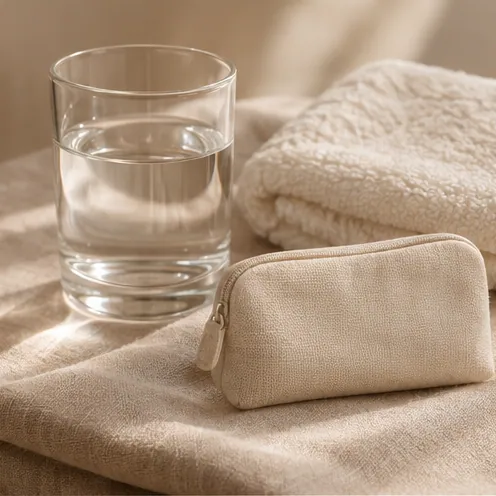
No smoking · No alcohol
You will receive instructions before surgery. Avoid alcohol and smoking for 2–4 weeks after surgery as well. For a forehead lift, stop smoking for 4 weeks before and 4 weeks after surgery because of the risk of skin necrosis; this includes avoiding secondhand smoke and nicotine patches. These can affect bleeding and wound healing.
Medications · Supplements
We recommend stopping herbal medicines and supplements such as omega-3 when possible because they may increase bleeding. Please tell us about every medication you take.
Medical history
Thyroid eye disease, glaucoma, severe dry eye, autoimmune disease, or anticoagulant use may be reasons to postpone or avoid surgery.
Eye care habits
Limit contact lens use as much as possible, use artificial tears frequently, and avoid rubbing your eyes. Tell us if you have used double eyelid tape or glue.
Recovery timelines are general estimates and vary by individual. Contact us immediately for sudden severe pain, decreased vision, bleeding that does not stop, or rapidly worsening swelling on one side.
LIMITS & RISKS
Along with possible improvements,
we explain the limitations and risks.
Asymmetry
Scarring
Difficulty Closing the Eyes
Dryness
Changes in Sensation
Undercorrection or Overcorrection
Do not wait if you have these symptoms
If you experience sudden severe pain, decreased vision · An obstructed field of vision, bleeding that does not stop, or rapidly worsening swelling on one side, contact us immediately instead of waiting for your appointment.
This is not a complete list of possible risks. Risks may vary depending on your health, previous treatments, and the technique and extent of surgery. Surgical results vary by individual.
Common questions
during consultations
Can I Have Upper Blepharoplasty First?
If skin is the main cause, upper blepharoplasty alone may be enough. However, removing skin when the eyebrows have dropped significantly can prevent the eyes from closing fully if the forehead is lifted later. We account for both procedures from the start when deciding which should come first.
Will a Forehead Lift Eliminate Forehead Wrinkles?
Raising the forehead and eyebrows may soften wrinkles, but it will not eliminate all of them. If the wrinkles result from the effort needed to open your eyes, the eyelids should be assessed first. Wrinkles in the skin itself may require separate skin treatments.
Can I Have Both Procedures on the Same Day?
We can consider performing both on the same day based on your health, total surgery duration, and recovery demands. The recovery periods do not simply add together, but swelling and aftercare demands may increase. We also explain when staging the procedures may be preferable.
Q & A
Before you decide,
frequently asked questions
Q
How Much Skin Is Removed? Will My Eye Shape Change Completely?
−
A
We measure within the functional limits that allow full eyelid closure and remove only a minimal amount. Our goal is to preserve your natural appearance while improving the hooding and shadows caused by drooping.
Q
Where Are Eyelid Surgery Incisions Made, and How Do the Scars Change?
−
A
Incisions are placed along less noticeable boundaries, such as a natural crease, just below the eyelashes, or the conjunctiva inside the eyelid. They may be red initially but gradually fade as the tissue settles.
Q
Can I Have Revision Surgery If I Have Had Surgery Before?
−
A
Yes, but adhesions and structural changes from the previous surgery must be assessed accurately. We consider your surgical records, current symptoms, and stage of tissue healing—at least 6 months to 1 year or longer after surgery—to honestly explain the limitations and expected benefits of additional surgery.
Q
What Symptoms Should Prompt Me to Contact the Clinic Immediately After Surgery?
−
A
If you experience sudden, severe pain in one eye, decreased vision, an obstructed field of vision, bleeding that will not stop, or rapidly increasing swelling, contact us immediately rather than waiting for your scheduled appointment.
AFTER SURGERY
After upper eyelid surgery · a forehead lift, care continues with VITAL LASTING CARE.
~ 1 WEEK
Check the wound · bleeding · infection · early function, remove sutures
1 MONTH
Early scar contracture: assess tightness · firmness and begin regenerative care if needed
3 MONTHS
Peak contracture · transition phase: assess remodeling and consider continued injections · laser treatment
6 MONTHS
Compare with initial photos and decide whether additional treatment is needed
1 YEAR
Check tissue maturation · long-term progress
IN HIS WORDS
Forehead wrinkles
can sometimes start with the eyes.
“
Surgery can be performed anywhere on the face, but areas where nerves run carry risks. Although surgery is possible, we need to discuss thoroughly with you how to manage scarring and protect the nerves.
Doctor Interview · 2026.10
Dr. Hyungwoo Yim, Medical Director · Based on the doctor's own answers. The actual scope of care is determined after an examination.
RELATED SURGERY
DOCTOR'S COLUMN DOCTOR'S COLUMN DOCTOR'S COLUMN
Must Read
Care Notes Written by the Doctor · Please Read Before Your First Visit
No.1
No.3
VIEW MORE →
RESERVATION
You do not need to decide the day of your consultation.
Organize questions about this page without entering your name, contact information, or medical history. This does not submit an appointment request.