PLASTIC SURGERY
Signature Procedures / Lower Eyelids · Midface
Lower Lid & Midface
Lower Blepharoplasty
Are under-eye bags only a fat problem? We assess the under-eye area and cheeks as one connected structure.
This may vary depending on your condition and the extent of surgery.
We do more than remove under-eye skin. We assess its connection to the cheeks.
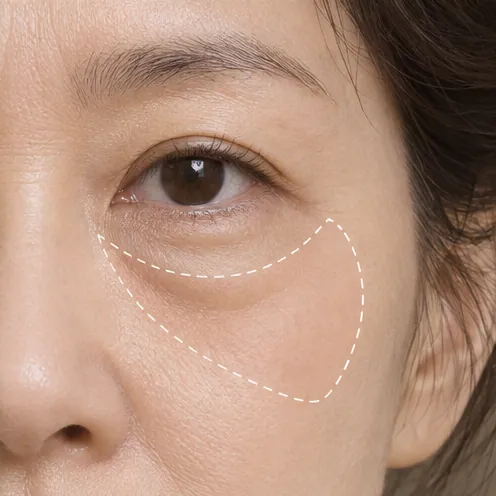
Key Questions Answered
Lower blepharoplasty: What do we check first?
Under-eye fat, excess skin, lower eyelid support, and cheek position are assessed as one connected structure. The extent of surgery depends on whether fat bulges, whether there is excess skin, and how the under-eye area transitions into the cheeks.
— Orbital fat
— Tear trough
— Cheek fat
— Retaining ligaments
YOUR CONCERN
Do any of these concerns
sound familiar?
“My under-eye bags make me look tired.”
“I have both under-eye wrinkles and sagging skin.”
“The groove between my under-eye area and cheek is deep.”
VITAL SIGNATURE 02 · LOWER LID + MIDFACE
Lower blepharoplasty considers the midface, not just the under-eye area.

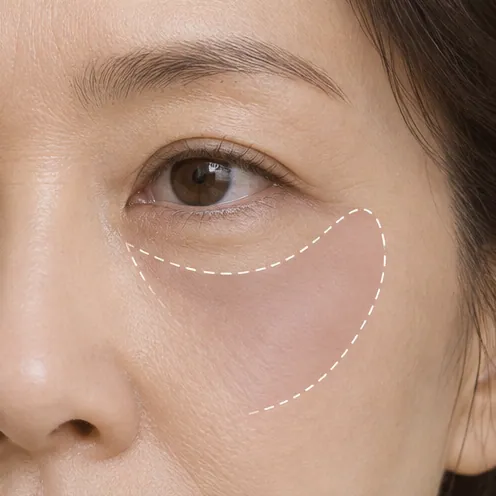
Under-eye bulging and hollowing often arise within the structures connected to the cheeks. Only as much skin as necessary is removed.
01
The Under-Eye–Cheek Connection
We check how the tear trough, the cheek junction, and the supporting structures have changed.
02
Treating fat based on the cause
Depending on the cause, protruding fat is either left in place while the septum is reinforced or moved into the hollow groove.
03
Minimal Skin Removal
We limit skin removal because excessive removal can increase the risk of lower eyelid drooping.
DOCTOR’S NOTE
The under-eye area and cheeks are not separate regions. They form one connected structure.
In lower blepharoplasty, we assess fat bulging and hollowing, excess skin, lower eyelid support, the transition from the under-eye area to the cheeks, and midface sagging together. Removing only under-eye fat without considering hollow grooves or sagging cheeks can make the junction more pronounced or leave the area looking hollow. When skin removal is needed, we explain both the reasons and the alternatives.
— Dr. Hyungwoo Yim
MYTH → FACT
“Does lower blepharoplasty require removing all the loose skin to make it tight?”
Excessive skin removal can cause ectropion, in which the eyelid turns outward, difficulty closing the eyes, or dryness. The key is to lift and secure the loosened orbicularis oculi muscle and supporting structures.
IN HIS WORDS
The Tent and Rope Analogy
“If a tent bulges because there is too much gear inside, will removing the gear smooth out the fabric? It will become more wrinkled. To make the tent taut, you need to tighten the ropes anchored to the ground. The same applies to the under-eye area.”
THE DETAIL
The Septum and Support Matter More Than Fat Volume
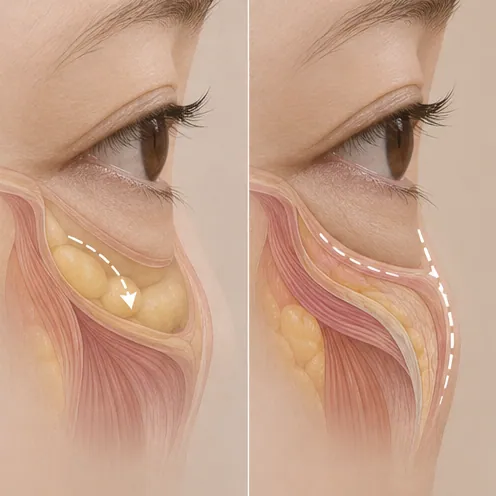
Bulging results from more than fat volume alone. Weakening of the septum that holds the fat back, hollowing of the groove, and descent of cheek fat all contribute. Whether the septum is reinforced and the supporting structures are restored makes a difference in the outcome.
RELATED RESEARCH
Semin Plast Surg 2015 · Volume Augmentation in the Lower Eyelid and Cheek Areas
KASTR 2014 · Dual Plane Intraoral Fat Graft for Midface Rejuvenation
Aesthetic Plastic Surgery 2015 · Intraoral malarplasty with endoscopic forehead and midface lifting
Lower blepharoplasty:
What does the surgery involve?
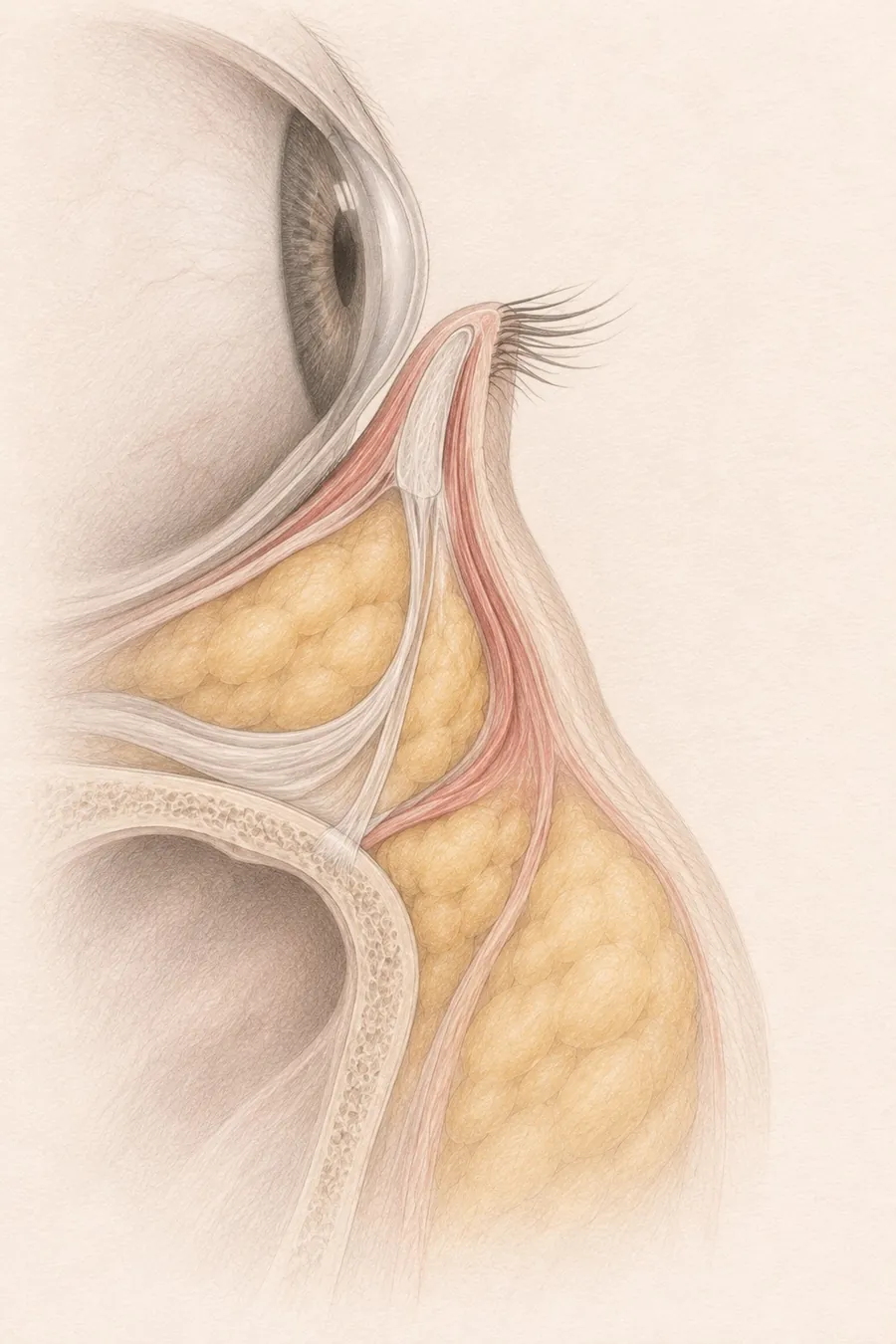
Lower blepharoplasty assesses and addresses under-eye bulging and hollowing, loose skin and muscle, and lower eyelid support together. One approach uses an incision through the conjunctiva inside the eyelid, leaving no skin incision. Another uses an incision just below the eyelashes to address the muscle and skin as well. The approach is chosen after assessing bulging, grooves, skin elasticity, and cheek position. If the cheeks are also sagging, a midface lift is considered.
- Transconjunctival Approach
- This approach uses an incision through the conjunctiva inside the lower eyelid. It leaves no incision on the skin.
- Orbital Septum
- A thin membrane that keeps the fat around the eyes from pushing forward. When it weakens, the fat becomes more prominent.
- Orbicularis Oculi Muscle
- The muscle that encircles the eye. When it loosens, the under-eye area sags and wrinkles increase.
- Tear Trough
- A groove extending from the inner corner of the eye toward the cheek. Ligaments, bone structure, and fat distribution all contribute to it.
What We Assess First
in Lower Blepharoplasty
Bulging is not caused by fat volume alone
Under-eye bulging involves both orbital fat and the condition of the tissues supporting it. When the septum holding back the fat weakens, the groove below becomes hollow, and cheek fat descends, the bulging becomes more noticeable. Removing fat alone can therefore leave the skin loose with fine wrinkles or make the junction with the cheek look more hollow. When bulging and hollowing occur together, we assess the protrusion, the junction, and the volume deficit together.
Whether to move under-eye fat depends on the cause
Removing fat from the membrane that surrounds it and moving it alters the normal anatomy. During revision surgery, the moved fat is often found attached to the tissue in front of it. The muscles that move the eye lie between the fat compartments, so the eye may also become uncomfortable. For these reasons, fat is not always repositioned. Depending on the cause, the fat may be left in place while the septum is reinforced, or it may be moved into the hollow groove.
Skin removal is limited to what allows the eyes to remain comfortable
It is easy to assume that removing more skin will make the area tighter. However, excessive removal can cause ectropion, in which the eyelid turns outward; lagophthalmos, in which the eyes cannot close completely; or dry eyes. An unstable tent does not become taut by removing its contents or cutting its fabric—you need to tighten the ropes. Similarly, we lift and secure the loosened orbicularis oculi muscle and supporting structures, addressing only as much skin as necessary.
The decision to make a skin incision is based on elasticity assessed by touch
During the examination, we directly assess the elasticity of the skin and orbicularis oculi muscle by touch. If Re2O or laser treatment can adequately address the skin, we use a transconjunctival approach and follow with that skin treatment. If those treatments appear insufficient, we either treat that area separately later or plan a skin incision. This decision is based on years of examination experience rather than a fixed numerical cutoff, and we explain the reasoning during your consultation.
For thin under-eye skin, we supplement the dermis instead of removing skin
The under-eye area has the thinnest skin on the body. According to the paper Dr. Yim is preparing, the amount of dermal tissue decreases by half when comparing people in their 20s with those in their 60s. Instead of removing skin with many fine wrinkles to smooth it, supplementing the dermis with Re2O can address the underlying tissue without increasing skin removal. For the under-eye area, we use a cannula to distribute Re2O Fine, a product designed for this area, in a sheet-like layer. Injections at individual points can appear as nodules through the thin skin.
We also assess the angle of the bone beneath the eyes in advance
People whose under-eye bones project forward show less aging, while those whose bones slope back experience earlier sagging because gravity has a greater effect on the tissues. Differences in the supporting bone affect what can be expected from the same surgery, and we discuss this in advance during consultation. For people with sagging cheeks, this also helps us determine whether to consider a midface lift.
A Word from the Doctor
Dr. Hyungwoo Yim’s own words from his blog and interviews.
01How I Approach Lower Eyelid Surgery
“My approach to lower eyelid surgery is to do less on the outside and make sufficient corrections on the inside. ”
After seeing depressed scars below the eyelashes from skin incisions, I switched to correcting the area through the conjunctiva.
02Swimming After Surgery
“Summer comes around every year, but Because you only get one result from this surgery.”
I recommend waiting about 4 weeks before swimming with goggles. Regular goggles press on the area below the eyes, so I recommend wearing large mask-style goggles slightly higher on your face.
03How My Thinking Has Changed
“Twenty years ago, the focus was on how much could be removed. Ten years ago, attention shifted to how well it could be repositioned. Now, I think more about how much tissue can be preserved and restored.”
These days, before addressing under-eye fat, I first consider reinforcing the orbital septum and restoring the midface support structures, while also planning for tissue regeneration after surgery.
Dr. Hyungwoo Yim, Medical Director
VIDEO
Videos with Dr. Yim
Whether hollowness under the eyes comes from the under-eye area alone, or also from sagging of the front of the cheek, changes the surgical approach. Dr. Yim explains how the cause is identified, through to orbital septum reinforcement.
YouTube · 10:26 · in KoreanThe Surgical Process Varies
Depending on Your Condition
When bulging and grooves are the main concerns
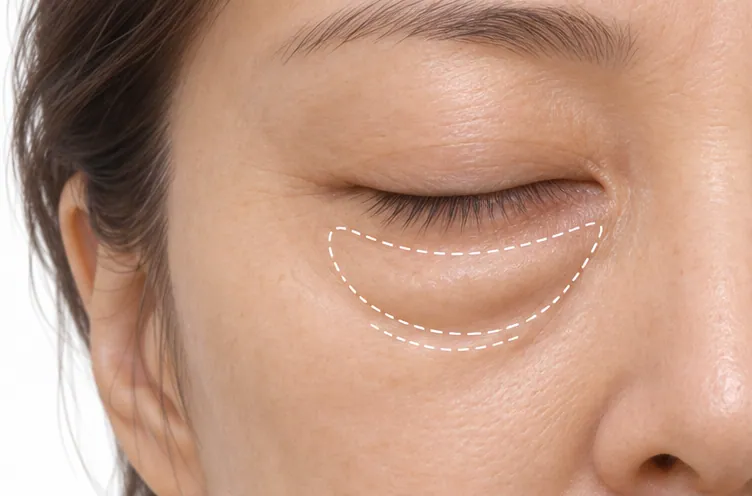 1
We mark the borders of the bulging and grooves while you are seated
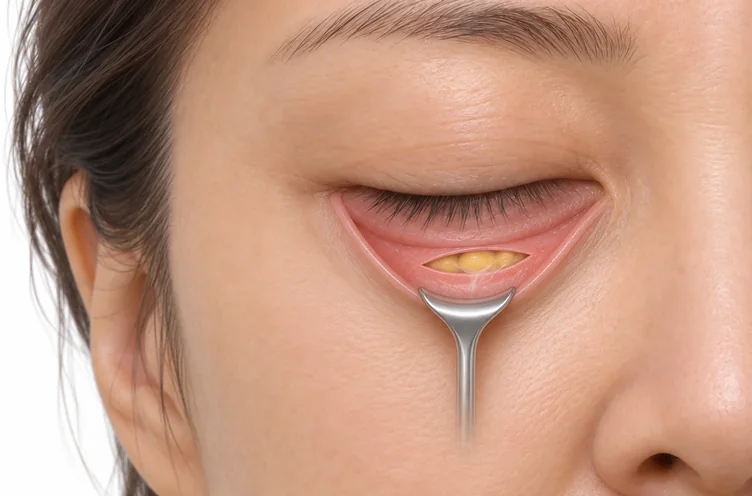 2
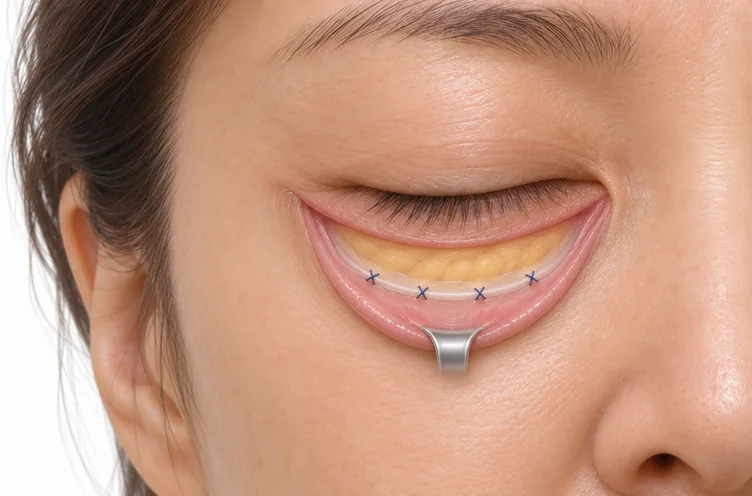
We access the area through the conjunctiva inside the lower eyelid
 3
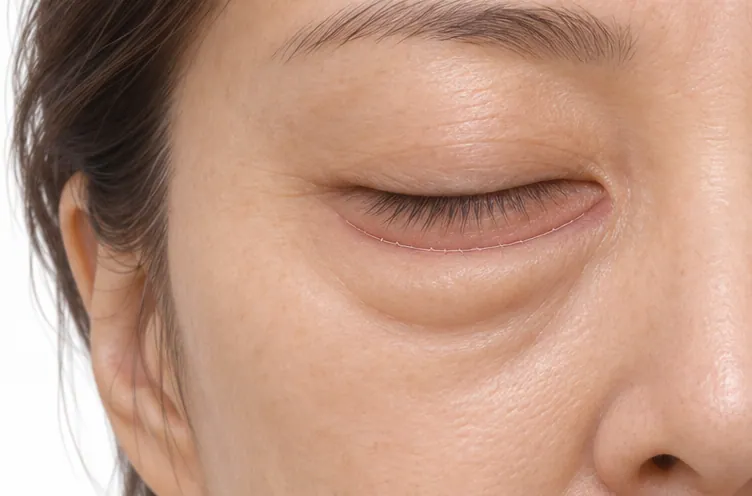
Depending on the cause, the fat is left in place while the septum is reinforced, or moved and secured in the hollow groove
 4
We finish on the conjunctival side. There is no skin incision
When skin and muscle sagging are also present
 1
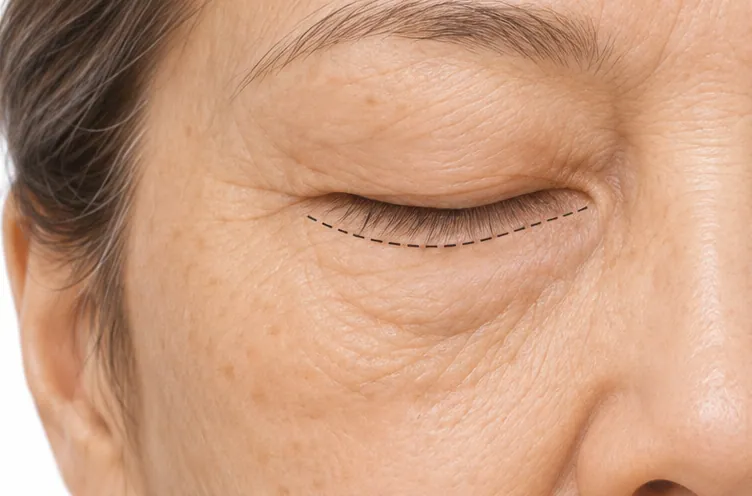
After assessing the skin and orbicularis oculi muscle by touch, we plan an incision below the eyelashes
 2
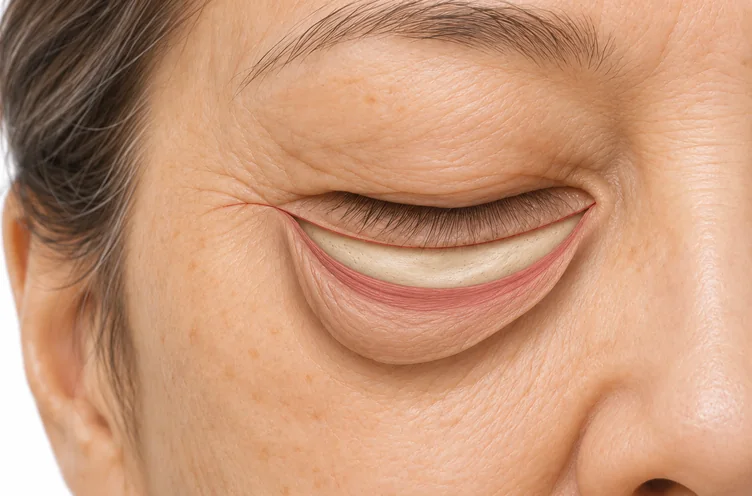
We make an incision just below the eyelashes and dissect beneath the muscle
 3
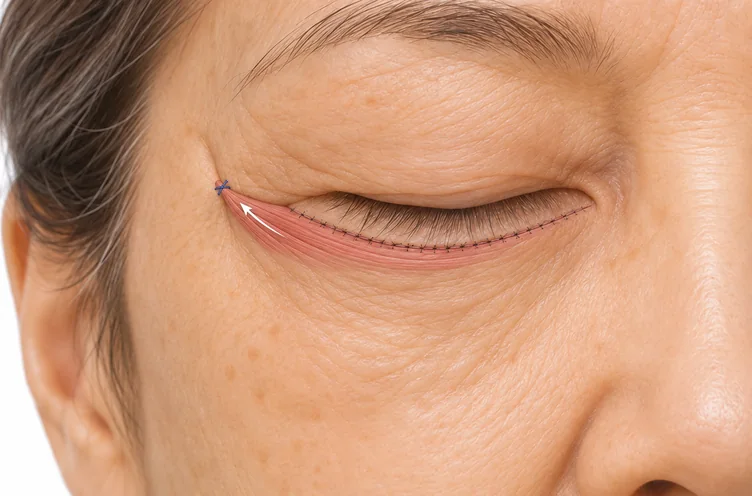
We lift the orbicularis oculi muscle and supporting structures upward and outward, then secure them near the outer corner of the eye
 4
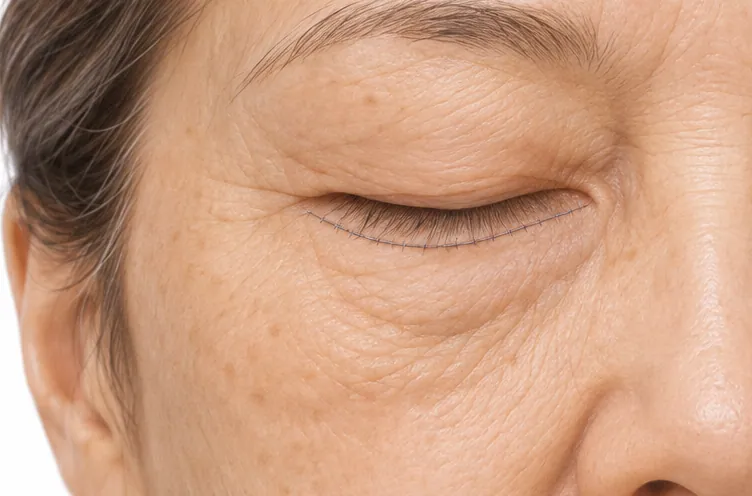
We remove only the excess skin and close the incision with fine sutures
When the cheeks are also sagging
 1
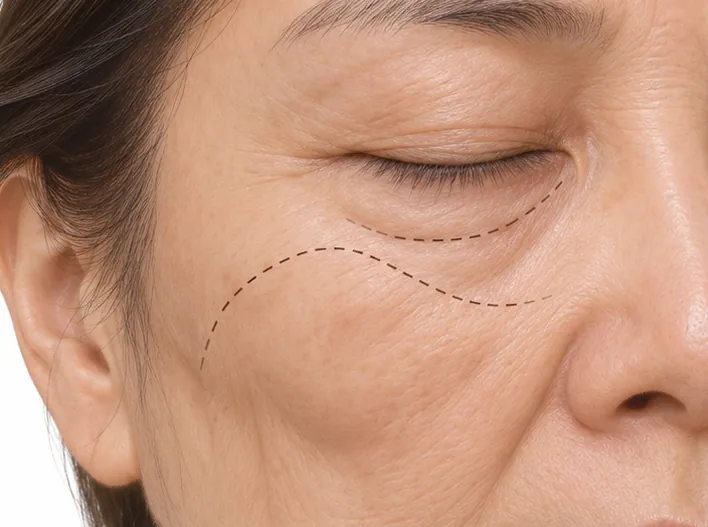
We mark the junction between the under-eye area and the sagging front of the cheek
 2
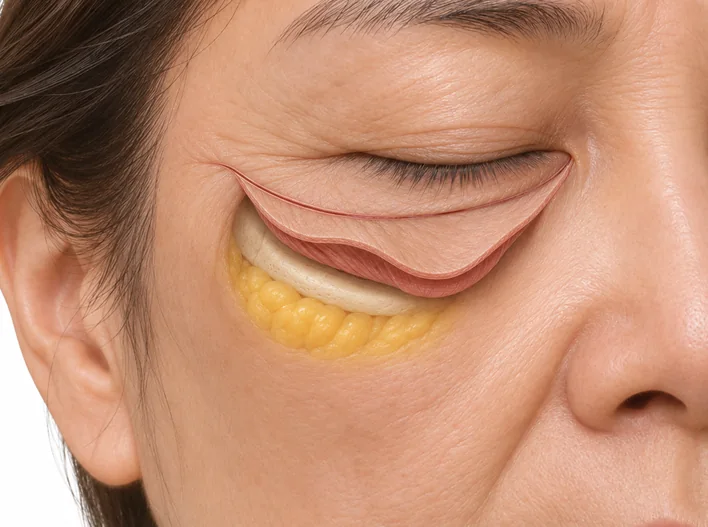
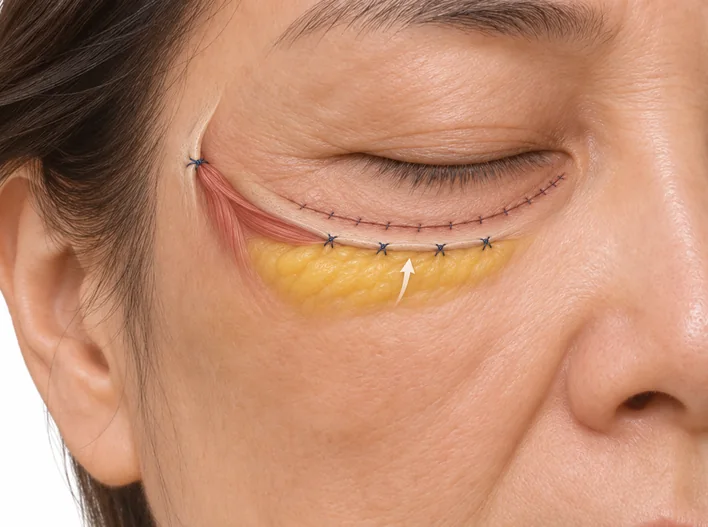
We make an incision just below the eyelashes and dissect beneath the skin and muscle to expose the upper cheek fat layer (SOOF)
 3
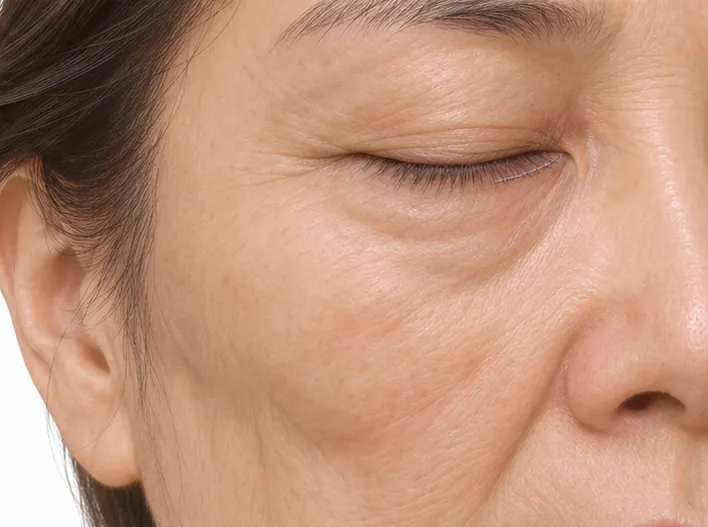
We release the retaining ligaments, lift and secure the cheek fat layer (SOOF), and suspend the orbicularis oculi muscle upward and outward
 4
We remove only the excess skin and close the incision with fine sutures
Illustration for explanation · Not an actual patient. This is a simplified description of typical steps. The actual technique and extent of surgery are determined after examination.
LOWER LID + MIDFACE
Treating the Under-Eye Area Alone vs. Including the Midface
A · SKIN-FOCUSED
Treating the Under-Eye Area Alone
1
2
3
01 Extensive skin removal can weaken lower eyelid support
02 Reducing only the bulging fat can make the groove more noticeable
03 Sagging cheeks (midface) remain
B · VITAL LOWER LID + MIDFACE
Including the Midface
2
1
3
01 Depending on the cause, protruding fat is treated by reinforcing the septum or repositioning the fat
02 We remove only as much skin as necessary
03 We lift the midface as well to connect the under-eye area and cheeks
This simplified diagram is intended to aid understanding and is not an exact anatomical illustration.
1
Under-Eye Fat Bulging
2
Tear Trough
3
Cheek (Midface) Position
4
Lifting the Midface as Well
Lower Lid + Midface
Under-eye bulging and hollowing arise within one connected structure.
The protruding orbital fat, the hollow tear trough below it, the descended cheek fat (SOOF), and the retaining ligaments that hold it in place form a single curve. Depending on the cause, the fat is held in place with the septum or moved into the hollow groove. We also consider removing only as much skin as necessary and lifting the sagging cheeks along with the midface.
Suture Removal
5–7 days
Return to Daily Activities
After 2–3 days
WHAT WE CHECK
Even when concerns look similar,
the factors to assess differ.
Fat and Grooves
The hollow beneath a bulge can contribute as much to shadowing as the bulge itself.
Excess Skin and Elasticity
The extent of skin removal is determined by the degree of wrinkling and skin sagging.
Lower Eyelid Support and Cheek Position
We assess eyelid support and midface position together.
DOCTOR'S DECISION
When choosing an approach, Dr. Hyungwoo Yim
looks at three things first.
If fat bulging is the main cause
The cause determines whether to reinforce the septum or reposition the fat into the groove.
If you also have loose skin
We limit skin removal to what is needed and explain whether additional support is appropriate.
If you also have sagging cheeks
We explain whether to combine surgery with a midface lift or perform it alone.
You do not need to decide on surgery the day of your consultation.

When
to consider a consultation
- When you have both under-eye bags and hollows
- When you have both fine under-eye wrinkles and loose skin
- When sagging extends to the front of the cheeks, making the transition between the lower eyelids and cheeks look longer
- When shadows appear to come from the underlying structure even after changing the lighting and gently pulling the skin
- When eye creams and skin care do not improve bulging or sagging
When
Surgery is not our first recommendation
- When increased pigmentation or visible blood vessels are the main cause of darkness
- When lack of sleep and puffiness are the main causes
- When remaining under-eye filler needs to be evaluated and dissolving it considered first
- When the eye surface or lower eyelid support needs to be assessed first
Preparing for surgery and
recovery by stage
- 3–4 days after surgery
This is when swelling and bruising are at their worst. Sleep with your head elevated. For the first 2–3 days after surgery, apply a cold compress gently, without letting ice touch your skin or eyes directly. Starting on day 4, use a warm compress. While you cannot close your eyes completely, use artificial tears frequently and apply eye ointment before bed.
- Days 5–7
If an incision was made, the stitches are removed; keep water away from the surgical area until then. Avoid eye makeup, eyelash extensions, and contact lenses for 2 weeks, and avoid saunas and Korean bathhouses for 1–2 weeks. Light daily activities can be resumed after 2–3 days, although swelling and bruising may remain. If instructed to use tape, keep it on for 2 weeks. Avoid pulling the lower eyelid or pressing under the eyes.
- 3 weeks–3 months
During this period, the tissue may feel firm and tight. This is part of the healing process, so decisions about revision surgery are not based solely on appearance at this stage. Avoid strenuous exercise, rubbing or tightly closing your eyes, and sleeping face down for 1 month after surgery.
- 3 months–1 year
The tissues soften, redness fades, and the two sides gradually become more balanced. We check your progress at 1 · 3 · 6 months · 1 year.

No smoking · No alcohol
You will be advised before surgery to avoid alcohol and smoking for 2–4 weeks afterward, as they can affect bleeding and wound healing.
Medications · Supplements
We recommend stopping herbal medicines and supplements such as omega-3 when possible because they may increase bleeding. Please tell us about every medication you take.
Medical history
Thyroid eye disease, glaucoma, severe dry eye, autoimmune disease, or anticoagulant use may be reasons to postpone or avoid surgery.
Eye care habits
Limit contact lens use as much as possible, use artificial tears frequently, and avoid rubbing your eyes. Tell us if you have used double eyelid tape or glue.
Recovery timelines are general estimates and vary by individual. Contact us immediately for sudden severe pain, decreased vision, bleeding that does not stop, or rapidly worsening swelling on one side.
FOLLOW THE CHANGE
We also document
and monitor changes after treatment.
01
STEP 01
Documenting your condition before treatment
We review previous treatments, your current condition, and the changes you hope to see.
02
STEP 02
Checking early responses · Wound healing
We explain precautions and symptoms that require contacting us.
03
STEP 03
Comparing appearance and function
Along with photos, we assess discomfort and changes in function.
04
STEP 04
Assessing additional care
We do not recommend the same additional treatments for everyone.
AFTER SURGERY
After lower eyelid surgery or a midface lift, care continues with VITAL LASTING CARE.
TREAT
Up to 3 months
Swelling · Bruising care, wound · Scar checks, and laser treatment for scars · Recovery when needed
ACTIVATE
After the recovery period
Consider regenerative care such as Re2O · PRP based on your individual condition
LAST
6 months–1 year
Scheduled follow-ups (1 week · 1 · 3 · 6 months · 1 year), skin · Firmness care
Care is determined after an examination based on the extent of surgery and your recovery. The same care is not recommended for everyone.
LIMITS & RISKS
Along with possible improvements,
we explain the limitations and risks.
Swelling
Bruising
Asymmetry
Lower eyelid drooping or ectropion
Scarring
Undercorrection
Do not wait if you have these symptoms
If you experience sudden severe pain, decreased vision · An obstructed field of vision, bleeding that does not stop, or rapidly worsening swelling on one side, contact us immediately instead of waiting for your appointment.
This is not a complete list of possible risks. Risks may vary depending on your health, previous treatments, and the technique and extent of surgery. Surgical results vary by individual.
IN HIS WORDS
Under-eye aging is also
related to the angle of the underlying bone.
“
People whose under-eye bones project forward may show less aging, while those whose bones slope backward may experience more tissue sagging from gravity and faster aging.
Doctor Interview · 2026.10
Dr. Hyungwoo Yim, Medical Director · Based on the doctor's own answers. The actual scope of care is determined after an examination.
RELATED SURGERY
Common questions
during consultations
Will surgery get rid of dark circles too?
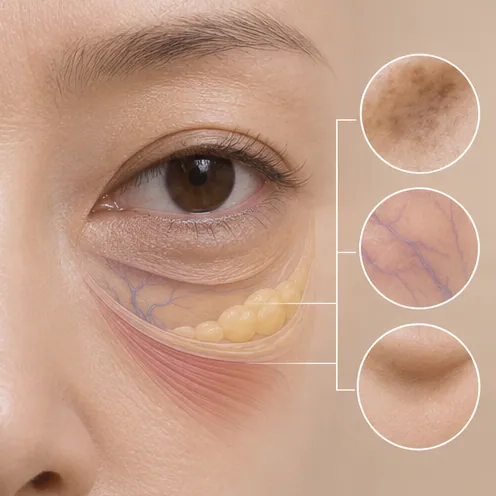
Dark circles describe a dark appearance rather than a specific disease. Causes include increased pigmentation, blood vessels and muscles showing through thin skin, or shadows created by hollows and bulging. Several causes may overlap. Surgery cannot remove the pigment itself, and pigmentation treatments have difficulty correcting structural shadows. We first identify the main cause by changing the lighting and gently pulling the skin.
Why do I have under-eye bags or hollows in my 20s or 30s?
Orbital fat and the tissues supporting it contribute to bulging, while ligaments, bone structure, and fat distribution contribute to tear troughs. These features may be visible at a young age because of your natural anatomy and may become more noticeable with age. Lack of sleep can worsen puffiness and discoloration, but lifestyle habits alone do not explain structural hollows.
What do you assess around the eyes at different ages?
In your 20s, we assess natural anatomy and eyelid-opening function. In your 30s, we assess early skin changes and hollows. In your 40s, we assess excess skin, upper and lower eyelid changes, and the connection to the midface. In your 50s, we check whether hollowness, sagging, and functional problems coexist. From your 60s onward, we pay closer attention to the eye surface, eyelid support, and overall health. This is not a list of treatments required at each age. Even among people of the same age, treatment is determined by examination findings.
Can eye creams or massage correct under-eye concerns?
Eye creams and moisturizers may help support the skin barrier and manage fine lines caused by dryness. However, they cannot reverse bulging fat, tissue loss, or significant sagging. Vigorous massage and devices used around the eyes carry risks of irritation, burns, and eye injury. Moisturizing, sun protection, and avoiding eye rubbing are the basics. Whether surgery is needed depends on the current anatomy and whether function is impaired.
Returning to your original concern
“My under-eye bags make me look tired.”
Even when bulging looks similar, the extent of surgery differs depending on whether protruding fat is the main cause or loose skin and sagging cheeks are also present.
Three things we check first during your consultation
- Whether protruding fat is the main cause
- Whether loose skin is also present
- Whether sagging cheeks are also present
When booking “Please assess both my under-eye fat and sagging cheeks.”Leave this brief note, and we can start your consultation with that concern.
These are our principles of care. The actual approach is determined after an examination. You do not need to decide the day of your consultation.
Related Reading
Q & A
Before you decide,
frequently asked questions
Q
How does lower eyelid surgery differ from under-eye fat repositioning or removal?
−
A
Under-eye fat repositioning moves protruding fat into hollow areas, under-eye fat removal reduces fat, and lower eyelid surgery also addresses the skin · Muscle · Supporting structures. The approach depends on excess skin and cheek sagging.
Q
Why shouldn't too much skin be removed?
−
A
Removing too much skin can increase the risk of lower eyelid drooping or outward turning (ectropion). We limit removal to what is needed and explain whether additional support is appropriate.
Q
Are the cost, number of treatments, and recovery period fixed?
−
A
They depend on the examination findings and the scope of treatment. Exact costs and scheduling are discussed during the consultation after your examination.
Q
Can a treatment plan be finalized through a photo consultation alone?
−
A
Photos serve as a reference. A treatment plan should be determined after an in-person assessment of function, tissue condition, and overall health, along with a thorough explanation.
Q
Is removing more skin better?
−
A
No. We determine how much to remove by considering lower eyelid support and eye closure. Excessive removal may cause functional discomfort.
Q
Do I need a midface lift at the same time?
−
A
Not everyone needs one. We consider the transition from the under-eye area to the cheeks, your desired changes, and the demands of surgery.
Q
Can surgery be finalized through a photo consultation alone?
−
A
Photos are only a reference. An in-person examination is needed to assess tissue condition and function, taking your current health and previous treatments into account.
Q
Are surgical results and recovery times the same for everyone?
−
A
No. Results and recovery speed vary depending on your individual condition and the extent of surgery. Risks include bleeding, infection, scarring, and asymmetry.
DOCTOR'S COLUMN DOCTOR'S COLUMN DOCTOR'S COLUMN
Must Read
Care Notes Written by the Doctor · Please Read Before Your First Visit
No.1
No.3
VIEW MORE →
RESERVATION
You do not need to decide the day of your consultation.
Organize questions about this page without entering your name, contact information, or medical history. This does not submit an appointment request.