PLASTIC SURGERY
MEDICAL COLUMN
Questions Answered Directly by the Doctor Before You Decide on Surgery
Lower Blepharoplasty
Articles
What Determines the Cost of Lower Blepharoplasty?
Lower blepharoplasty does not have one fixed price. The cost depends on what needs to be corrected under the eyes. The surgical scope varies depending on whether the surgeon works only through the conjunctiva inside the eyelid, makes an incision below the lashes to address muscle and skin, or also lifts sagging cheeks (the midface).
Medically reviewed by Dr. Hyungwoo Yim, Medical Director (board-certified plastic surgeon) · Published November 13, 2026 · Last reviewed November 13, 2026
SHORT ANSWER
First, the Short Answer
- Lower blepharoplasty does not have one fixed price. The cost depends on what needs to be corrected under the eyes. The surgical scope varies depending on whether the surgeon works only through the conjunctiva inside the eyelid, makes an incision below the lashes to address muscle and skin, or also lifts sagging cheeks (the midface).
- Other factors include anesthesia, operating time, combined treatments, previous surgery, and postoperative follow-up care. This is why procedures called lower blepharoplasty can involve different surgical steps depending on the condition of the under-eye area.
- VITAL Plastic Surgery first checks three factors to determine the scope: bulging fat, sagging skin, and sagging cheeks. Prices for individual procedures are published in our non-covered medical fee schedule (/ko/price.html), and the final cost is provided after an examination.
“Why does the quoted cost of lower blepharoplasty vary from person to person?”
This is a paraphrase of a question we often hear during consultations.
To answer this question, we first need to distinguish where your current concern comes from. We will explain each point below, then return to the original question at the end.
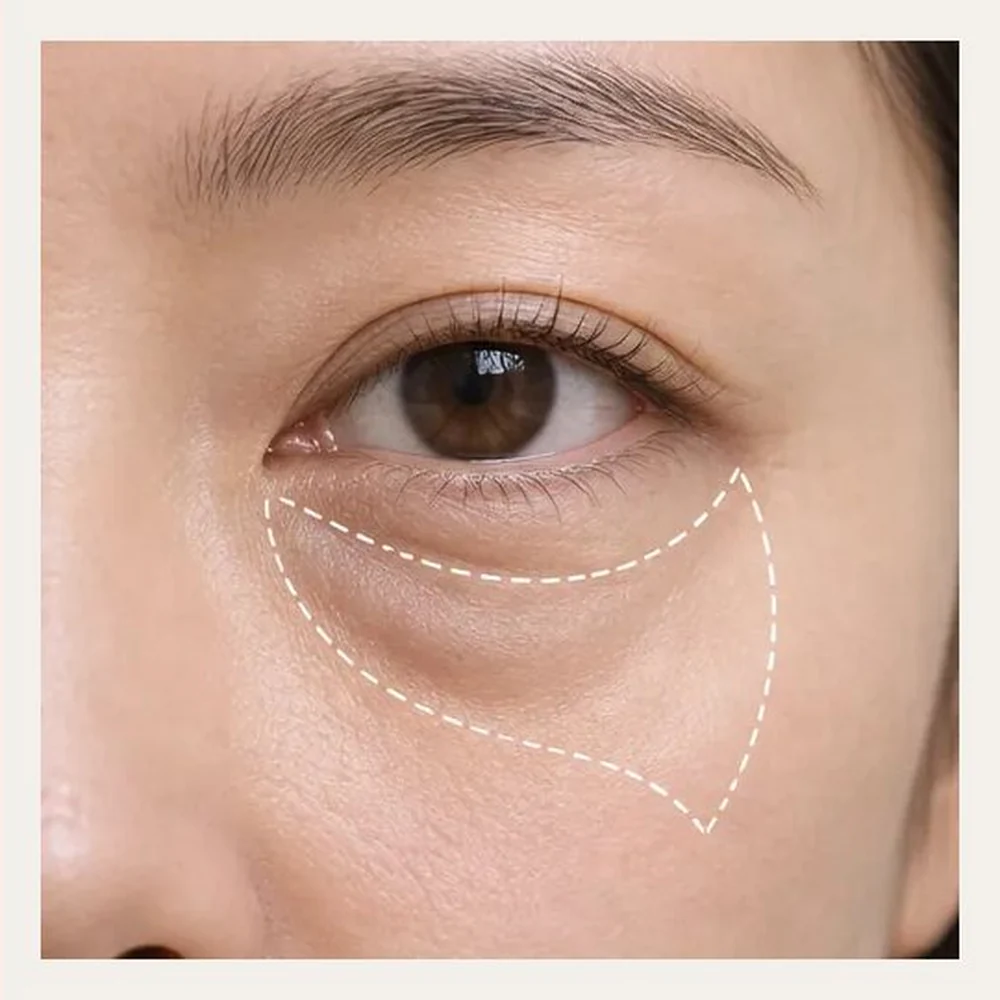
01What determines the cost of lower blepharoplasty?
Answer The main factors that determine cost are how much of the under-eye area is corrected (scope), how it is accessed (whether a skin incision is used), anesthesia and operating time, combined procedures, and postoperative follow-up care.
Although these procedures share the name lower blepharoplasty, the actual surgery can differ considerably depending on the condition of the under-eye area. Lower blepharoplasty assesses and corrects under-eye bulging and hollows, loose skin and muscle, and lower eyelid support together. The tissue layers and scope involved depend on which of these are causing the problem.
If bulging fat is the main issue, we first consider an approach through the conjunctiva inside the eyelid, without an incision in the skin. If the skin and muscle are also sagging, an incision just below the lashes allows us to address the muscle and supporting structures. If the cheeks are also sagging, we consider a midface lift as well. A broader surgical scope also means more operating time and a greater recovery burden.
When asked, “How much does lower blepharoplasty cost?” VITAL Plastic Surgery first shows patients the non-covered medical fee schedule (/ko/price.html), which lists prices by procedure. We explain which procedure applies after an examination. The fee schedule lists lower blepharoplasty alone, lower blepharoplasty combined with a midface lift, and revision lower blepharoplasty separately.
The table below summarizes the factors that determine cost and what we assess during consultation to determine each factor. The actual scope is decided after a direct examination.
| Cost factor | What varies | What we assess during a consultation |
|---|---|---|
| Surgical scope | Whether to treat only the under-eye area or also lift the cheeks | Bulging fat · sagging skin · sagging cheeks |
| Approach (whether a skin incision is used) | Transconjunctival approach or an incision below the lashes | Elasticity of the skin and orbicularis oculi muscle |
| Anesthesia · operating time | IV sedation; about 30 minutes for a transconjunctival approach · about 1 hour with a skin incision | Health status and combined procedures |
| Combined surgeries · treatments | Additional procedures such as a midface lift or Re2O | Desired changes and recovery schedule |
| Previous Treatments | Plan changes for revision surgery or remaining filler | Previous surgical records and current condition |
| Postoperative care | Follow-up assessments and additional care as needed | Recovery progress (varies by patient) |
In Simple Terms The cost of lower blepharoplasty is similar to an estimate for home repairs. Even when repairing the same wall, the scope and duration of the work depend on whether you are replacing only the wallpaper, repairing the supports inside the wall, or extending the repairs to the ceiling in the next room. A single photo is therefore not enough to finalize an estimate; an on-site inspection and tapping on the wall help reveal how much work is needed. Likewise, the scope of under-eye surgery is determined only after a hands-on assessment of the fat, skin and muscle, and cheek position.
How does lower blepharoplasty with a skin incision differ from surgery without one?
02How does lower blepharoplasty with a skin incision differ from surgery without one?
Answer The transconjunctival approach leaves no skin incision and takes about 30 minutes. An approach through an incision below the lashes also addresses muscle and skin and takes about 1 hour.
Transconjunctival lower blepharoplasty uses an incision through the conjunctiva inside the lower eyelid. When bulging and grooves are the main concerns, their boundaries are marked while you are sitting upright. The surgeon then accesses the area through the conjunctiva and reinforces the orbital septum (the thin membrane that keeps fat from bulging forward), leaving the fat in place. VITAL's estimated operating time is about 30 minutes, or around 15 minutes per side.
Suturing the orbital septum through the conjunctiva to keep fat in place has been described for many years. In a U.S. study of 78 patients with bulging under-eye fat, this technique reduced bulging in the central and inner fat compartments while maintaining eyelid height and shape. The report also noted that tear troughs improved substantially but often did not become completely smooth1. Because this report reviewed patients treated by a single surgeon, the same results cannot be expected for every under-eye condition.
Lower blepharoplasty with a skin incision is considered when both skin and muscle are sagging. The surgeon makes an incision just below the lashes and works beneath the muscle, then lifts the orbicularis oculi muscle (the muscle surrounding the eye) and supporting structures upward and outward, securing them near the outer corner of the eye. Only the excess skin is removed, and the incision is closed with fine sutures. These additional steps extend operating time to about 1 hour. Sutures are removed 5–7 days after surgery.
There is a reason outer-corner support is included with the skin-incision approach. A study reviewing 264 patients who underwent their first transcutaneous lower blepharoplasty over a 10-year period found that, when outer-corner support was routinely included, 9 patients (3.5%) developed eyelid malposition requiring surgical correction, and 31 patients (11.7%) underwent minor revisions for small cysts near the incision or inflammation at suture sites2. This illustrates why lower blepharoplasty with a skin incision also needs to address the supporting structures.
We do not use a fixed numerical cutoff to choose an approach. During the examination, we assess skin and orbicularis oculi muscle elasticity by hand. If Re2O or laser treatment appears sufficient for the skin concerns, we perform transconjunctival surgery and then treat the skin with those options. If those treatments appear insufficient, we plan either a separate treatment for that area later or a skin incision, and explain the reason during consultation.
| Method | When it is considered | VITAL's estimated timing |
|---|---|---|
| Transconjunctival Lower Blepharoplasty | When bulging and grooves are the main concerns | About 30 minutes, no skin incision |
| Transcutaneous Lower Blepharoplasty | When skin and muscle sagging are also present | About 1 hour, sutures removed after 5–7 days |
| Lower Blepharoplasty + Midface Lift | When the cheeks are also sagging | Determined after examination based on scope and health status |
Why does sagging in the cheeks increase the surgical scope?
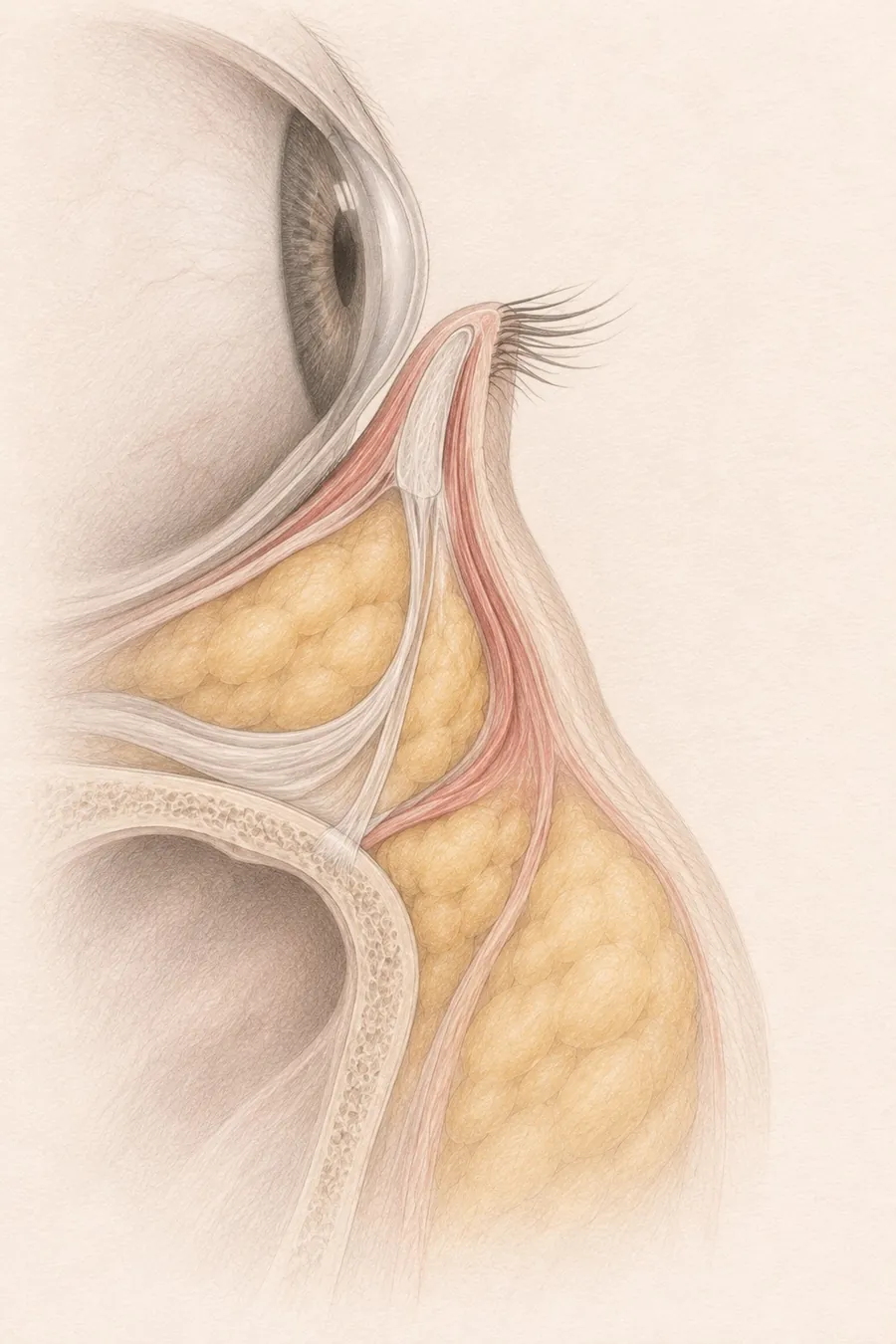
03Why does sagging in the cheeks increase the surgical scope?
Answer A midface lift addresses sagging cheek fat and its retaining ligaments in a deeper layer than lower blepharoplasty, so combining the procedures increases both the surgical scope and the recovery burden.
The under-eye area and cheeks are connected structures rather than two separate areas. Under-eye fat and cheek fat are connected through shared fibrous structures and fat layers. Treating only the under-eye area while leaving sagging cheeks in place may make the boundary more noticeable or create a hollow appearance after surgery.
A midface lift raises and secures the cheek fat layer and retaining ligaments that have descended from beneath the eyes toward the front of the cheeks. The ligaments must be released as needed to create room for the tissue to move upward, and the lifted tissue is secured to firm tissue around the eyes. This involves deeper layers than treating under-eye fat alone and may require more operating time depending on your health and any combined procedures.
A recent review from Germany reported that the transconjunctival approach has a very low rate of eyelid malposition, while the transcutaneous approach can address skin, muscle, and the orbital septum together. It also noted that a midface lift remains an important adjunct procedure when the cheeks have descended or the bone beneath the eyes sits behind the eyeballs3. This means each approach serves a different role.
However, we do not recommend combining these procedures for everyone. If the concern is clearly limited to the under-eye area, we do not extend surgery to the cheeks. A broader surgical area can also mean more swelling and a greater aftercare burden. We explain the differences to help determine whether to include a midface lift or perform lower eyelid surgery alone.
We also assess the angle of the bone beneath the eyes beforehand. People whose under-eye bones project forward tend to show less aging, while those whose bones slope backward experience more gravitational pull on the tissues, leading to earlier sagging. Differences in the supporting bone affect what the same surgery can achieve. We discuss this during consultation and use it to help determine whether to consider a midface lift as well.
What should you compare when considering other under-eye procedures?
04What should I compare when considering other under-eye procedures?
Answer Even when procedure names sound similar, differences in how fat is handled, how much skin is removed, and whether the cheeks are treated can make them difficult to compare as the same surgery.
Under-eye surgery includes several approaches: removing fat, taking fat out of its compartment and moving it into hollow areas, or leaving fat in place and reinforcing the orbital septum. At VITAL Plastic Surgery, we first consider leaving protruding fat in place and reinforcing the orbital septum rather than removing or repositioning it.
Taking fat out of the membrane surrounding it and moving it alters the normal anatomy. During revision surgery, we often find that repositioned fat has adhered to the tissues in front of it. The muscles that move the eyes also lie between the fat compartments, so eye discomfort may occur. We also explain that removing fat alone can leave the skin loose with fine wrinkles or make the transition between the under-eye area and the cheek look more hollow.
The amount of skin removed is another point to compare. It is easy to assume that removing more skin creates a tighter result, but excessive removal can cause ectropion, in which the eyelid turns outward; lagophthalmos, in which the eye does not close completely; and dry eye. We therefore remove skin only within a range that keeps the eyes comfortable, while lifting and securing the loosened orbicularis oculi muscle and supporting structures.
When comparing cost estimates, it is more accurate to check whether the following details match before comparing prices. If these details differ, the procedures are effectively different even if they share the same name.
- Transconjunctival approach or an incision below the lashes
- Whether fat is removed, repositioned, or left in place while the orbital septum is reinforced
- How much skin is removed and whether support at the outer corner of the eye is included
- Whether the cheeks (midface) are treated as well
- What postoperative follow-up and aftercare are provided
How does postoperative care affect the cost?
05How does postoperative follow-up care relate to cost?
Answer VITAL Plastic Surgery schedules follow-up visits at 1 week, 1, 3, and 6 months, and 1 year. Care needed between these visits is determined by your recovery, so the total cost may vary depending on which treatments are added.
After lower eyelid surgery, we continue monitoring recovery through VITAL LASTING CARE. From immediately after surgery through 3 months, we manage swelling and bruising, check wounds and scars, and consider laser treatments for scars and recovery if needed. After the recovery period, we consider regenerative treatments such as Re2O or PRP based on each person's condition. Between 6 months and 1 year, we provide routine follow-up assessments and consider care for skin quality and firmness.
Aftercare treatments are determined after an examination based on the extent of surgery and recovery progress; we do not recommend the same treatments for everyone. Our fee schedule also lists Re2O for surgical patients separately as an "add-on," so the total cost varies depending on which treatments are included.
Re2O is a material used to replenish the thinned dermis under the eyes. Because the skin under the eyes is the thinnest on the body, treating the underlying skin with Re2O instead of removing more skin to smooth fine lines allows the skin to be managed without increasing the amount removed. Treatments intended to support recovery are generally performed after surgical swelling has subsided, usually at least 4 weeks after surgery.
At follow-up visits, we assess discomfort and changes in function as well as photographs. Between 3 weeks and 3 months, tissues can become firm and feel tight, so we do not decide on revision surgery based solely on appearance during this period. We also monitor how the tissues soften, redness fades, and symmetry improves between 3 months and 1 year. The following is a general timeline; individual recovery varies.
| Timing | What Happens | What to Keep in Mind |
|---|---|---|
| 3–4 days after surgery | When swelling and bruising are most pronounced | Sleep with your head slightly elevated |
| Days 5–7 | Suture removal if an incision was made | Eye makeup · contact lenses after 2 weeks |
| 3 weeks–3 months | A period of tissue firmness and tightness | Sauna after 1–2 weeks; strenuous exercise after 1 month |
| 3 months–1 year | Tissue softens and the two sides gradually become more balanced | Follow-ups at 1, 3, and 6 months and 1 year |
Why is revision surgery priced separately?
06Why is revision surgery priced separately?
Answer Previous surgery leaves each person's tissues in a different condition, making it difficult to determine the necessary extent of treatment before an examination. The final cost of revision lower eyelid surgery is therefore determined after consultation based on its complexity.
Our fee schedule states that the final cost of revision lower eyelid surgery is "determined after consultation based on complexity," with separate categories based on complexity and whether a midface lift is included. Unlike first-time surgery, the steps needed for revision depend on what was previously treated and to what extent, as well as the degree of scarring and tissue adhesion.
An Italian study of 117 patients treated for lower eyelid retraction after cosmetic lower eyelid surgery used an approach through the temple to lift the orbicularis oculi muscle and cheeks again, along with fixation of the outer corners of the eyes and fat grafting, in every patient4. This means that several steps were needed together to correct eyelid position, illustrating why revision surgery often requires more complex planning than first-time surgery. The report describes one institution's approach and does not apply directly to every revision case.
For this reason, when planning the initial surgery, we limit skin removal to the necessary amount to help prevent lower eyelid retraction or ectropion, and explain whether additional support is needed. If you have already had surgery, bringing your previous surgical records and current photographs helps us assess the extent of treatment needed. If under-eye filler remains, evaluation and consideration of dissolving it may be needed first.
We also do not rush the timing of revision surgery. Tissue firmness and tightness between 3 weeks and 3 months after surgery are part of the healing response, so we do not decide on revision based solely on appearance during this period. However, please contact us immediately rather than waiting for your scheduled appointment if you experience sudden severe pain, decreased vision, bleeding that does not stop, or rapidly worsening swelling on only one side.
07Three things we check first during your consultation
What we assess first during consultation
- Whether protruding fat is the main cause
- Whether skin sagging is also present — elasticity of the skin and orbicularis oculi muscle
- Whether cheek sagging is also present — the transition between the under-eye area and the cheek
These are general care principles. The actual decision is made after an examination.
When other care is needed first When under-eye darkness is caused by increased pigmentation or visible blood vessels, or when lack of sleep and swelling are the main causes, care directed at the cause comes before surgery. We also do not recommend proceeding directly to surgery when remaining under-eye filler requires evaluation and consideration of dissolving first, or when issues involving the ocular surface or lower eyelid support need to be assessed first.
The answer to the original question, "Why does the cost of lower eyelid surgery vary from person to person?" is this: even within lower eyelid surgery, the extent of surgery, operating time, and recovery burden vary depending on whether the approach is through the conjunctiva alone, whether an incision below the eyelashes is used to address the muscle and supporting structures, and whether sagging cheeks are lifted as well. VITAL Plastic Surgery first assesses protruding fat, skin sagging, and cheek sagging to determine the extent of surgery. Individual fees are published in our fee schedule for services not covered by insurance, and the final cost is provided after an examination.
— VITAL Plastic Surgery
When booking, simply leave a note saying, "Please assess both my under-eye fat and cheek sagging," and we will begin the consultation by looking at those areas together. You do not need to make a decision on the day of your consultation.
Related ReadingLower Eyelid Surgery · Midface Lift Consultation Information
READ NEXT
Read Next

FAQ
Frequently Asked Questions
Can I get a price just by sending photos?
Photos serve as a reference. Whether a skin incision is needed depends on a hands-on assessment of skin and orbicularis oculi muscle elasticity, so the exact scope and cost are provided after an examination.
Is it covered by health insurance or private medical expense insurance?
We cannot give a definitive answer here. We explain whether coverage applies after examining your eyes. Cosmetic procedures listed in our non-covered medical fee schedule are subject to additional VAT.
What type of anesthesia is used?
The procedure is performed under local anesthesia or IV sedation, and you can go home the same day. The typical surgery time is about 30 minutes for a transconjunctival approach and about 1 hour for an incisional approach, although it may vary depending on your health and any procedures performed at the same time.
What if I have another procedure on the same day?
We can consider performing both on the same day based on your health, total surgery duration, and recovery demands. The recovery periods do not simply add together, but swelling and aftercare demands may increase. We also explain when staging the procedures may be preferable.
Do I have to decide on the day of my consultation?
No. Having a consultation does not mean you need to decide on surgery that day. You may take time to consider your options after hearing the proposed scope and cost.
BEFORE CONSULTATION
What to Prepare Before Your Consultation
- Previous Treatment RecordsPlease tell us about previous treatments, including under-eye surgery, fillers, and lasers, and provide any records. For revision surgery, these are essential to assess the extent of treatment needed.
- Medications and SupplementsWe recommend stopping herbal medicines and supplements such as omega-3 when possible because they may increase bleeding. Please tell us about every medication you take.
- Medical historyThyroid eye disease, glaucoma, severe dry eye, autoimmune disease, or anticoagulant use may be reasons to postpone or avoid surgery.
- Stop Smoking and Avoid AlcoholWe provide these essential instructions before surgery. Smoking and alcohol affect bleeding and wound healing.
- Clear Your SchedulePlan your schedule around the first 3–4 days, when swelling and bruising are at their worst, and days 5–7, when sutures are removed if an incision was made.
REFERENCES
References
- Sadove RC. Transconjunctival septal suture repair for lower lid blepharoplasty. Plastic and Reconstructive Surgery. 2007. doi:10.1097/01.prs.0000275182.34994.dd (View abstract)
- Codner MA, Wolfli JN, Anzarut A. Primary transcutaneous lower blepharoplasty with routine lateral canthal support: a comprehensive 10-year review. Plastic and Reconstructive Surgery. 2008. doi:10.1097/01.prs.0000295377.03279.8d (View abstract)
- Schwaiger-Hessel N. Lower eyelid blepharoplasty: A comparison of transconjunctival, transcutaneous, and combined blepharoplasty techniques (German-language review). HNO. 2026. doi:10.1007/s00106-026-01764-y (View English abstract)
- Pascali M, Savani L, Gratteri M, et al. Temporal Modified Orbicularis Repositioning for Correction of Lower Eyelid Displacement following Cosmetic Blepharoplasty: A Prospective Study of 117 Patients. Plastic and Reconstructive Surgery. 2026. doi:10.1097/PRS.0000000000012699 (View abstract)
The findings in these papers reflect the participants and conditions of each study and do not mean that every individual will have the same results.
This article provides general medical information and does not replace diagnosis or treatment. Surgical results and recovery vary by individual, and complications such as bleeding, infection, scarring, and asymmetry may occur.
More articlesVITAL Plastic Surgery Medical Articles
RESERVATION
You do not need to decide the day of your consultation.
Organize questions about this page without entering your name, contact information, or medical history. This does not submit an appointment request.