PLASTIC SURGERY
MEDICAL COLUMN
Questions Answered Directly by the Doctor Before You Decide on Surgery
Lower Blepharoplasty
Doctor’s Notes
Lower Blepharoplasty vs. Fat Repositioning: What's the Difference?
Under-eye fat, excess skin, lower eyelid support, and cheek position. We examine them as one connected structure.
Medically reviewed · Dr. Hyungwoo Yim, Medical Director (Board-Certified Plastic Surgeon)
SHORT ANSWER
First, the Short Answer
- Lower blepharoplasty is surgery in which the approach is determined by evaluating the skin, fat, muscle, and supporting structures of the lower eyelid together.
- Under-eye fat is enclosed by a membrane and held in place, so we first consider preserving its structure rather than removing and relocating it.
- After assessing excess skin and eyelid support, we consider whether a limited approach, such as fat repositioning, is appropriate. Removing large amounts of skin is not the goal.
- We check for accompanying midface sagging, but do not recommend combined surgery for everyone.
“Doctor, the bags under my eyes make me look tired. Would removing the fat alone help?”
This is a paraphrase of a question we often hear during consultations.
This article walks through the structures behind under-eye bags, why similar-looking bags may require different procedures, how much skin to remove, and how the surgical steps vary by condition. In 03, we show why removing fat alone can make the junction between the lower eyelid and cheek look more hollow.
01Removing the gear alone won't straighten the tent.
Answer We first consider reinforcing the orbital septum while leaving under-eye fat in place, rather than removing and relocating it. This is because under-eye fat is enclosed by a membrane and held in place, and the muscles that move the eye run between the fat compartments, so the eyes may become uncomfortable.

Under-eye fat, excess skin, lower eyelid support, and cheek position. We examine them as one connected structure.
Under-eye fat is a structure held in place within a membrane. I always consider whether taking it out and repositioning it is truly consistent with normal anatomy. During revision surgery, I sometimes find that the repositioned fat has adhered to the tissues in front of it, so I first consider preserving the existing structures.
The muscles that move the eye run between the fat compartments, so the eyes may become uncomfortable. That is why we first consider reinforcing the orbital septum while leaving the fat in place, rather than removing and relocating it.
Dr. Hyungwoo Yim explains this using a tent analogy. “If a tent bulges because there is too much gear inside, will removing the gear alone smooth out the fabric? It will become more wrinkled. To make the tent taut, you need to tighten the ropes anchored to the ground. The same applies under the eyes.” (Doctor interview, October 2026) Under the eyes, we also lift and secure the loosened orbicularis oculi muscle and supporting structures, addressing only as much skin as needed.
Key point We lift and secure the loosened orbicularis oculi muscle and supporting structures, addressing only as much skin as needed.
Then why might similar-looking under-eye bags require different procedures?
02Similar-looking under-eye bags may require different procedures.
Answer The extent of treatment depends on whether fat is prominent, whether there is excess skin, and how the lower eyelid transitions into the cheek. This is because lower blepharoplasty involves evaluating the skin, fat, muscle, and supporting structures of the lower eyelid together to determine the approach.
Lower blepharoplasty is surgery in which the approach is determined by evaluating the skin, fat, muscle, and supporting structures of the lower eyelid together. The extent of treatment depends on whether fat is prominent, whether there is excess skin, and how the lower eyelid transitions into the cheek.
- Fat and tear troughs: The hollow beneath a bulge can contribute to shadowing just as the bulge itself does. We assess the amount and position of fat together with the depth of the trough.
- Excess skin and support: The amount and elasticity of excess skin, along with lower eyelid support, can call for different approaches even when considering the same procedure.
- Cheek (midface) position: We check for accompanying midface sagging. We consider the under-eye area in relation to surrounding structures, but do not recommend combined surgery for everyone.
After assessing excess skin and eyelid support, we consider whether a limited approach, such as fat repositioning, is appropriate. We determine the extent of correction based on eyelid closure and lower eyelid position. Removing large amounts of skin is not the goal. We evaluate the connection to the midface to determine whether lower blepharoplasty alone is appropriate or whether midface correction is needed.
The table summarizes these four factors.
| What we check | How we assess it | What can happen if overlooked |
|---|---|---|
| Fat and Grooves | We assess the amount and position of fat together with the depth of the trough beneath it. | Reducing only the protruding fat can make the groove more visible. |
| Excess Skin and Elasticity | During the examination, we manually assess the elasticity of the skin and orbicularis oculi muscle. | Removing too much skin can cause ectropion (outward turning of the eyelid), lagophthalmos (incomplete eyelid closure), and dry eyes. |
| Lower Eyelid Support | We determine the extent of correction based on eyelid support and closure. | Extensive skin removal can weaken lower eyelid support. |
| Cheek (Midface) Position | We check for accompanying midface sagging. We do not recommend combined surgery for everyone. | If sagging cheeks are not taken into account, the junction between the lower eyelid and cheek may become more noticeable or look more hollow. |
This general explanation is based on questionnaire responses from Medical Director Dr. Hyungwoo Yim. It does not replace an individual diagnosis.
At your consultation, you can say, “I read the lower blepharoplasty article. Please explain what you would assess first in my case,” and we will walk you through the points in the same order as this article.
Key point We consider the under-eye area in relation to surrounding structures, but do not recommend combined surgery for everyone.
What exactly causes under-eye bags?
03Bulging is not caused by fat volume alone
Answer Under-eye bags are not caused by the amount of fat alone. When the septum that holds the fat back weakens, the trough below becomes hollow, and cheek fat descends, the bulging can look more pronounced.
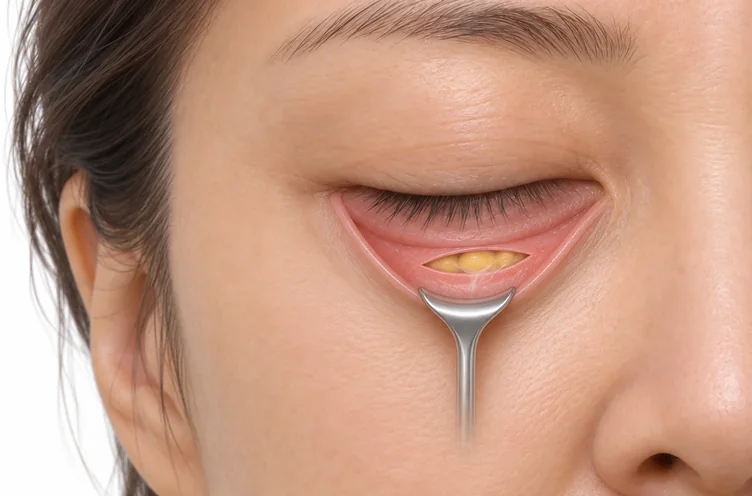
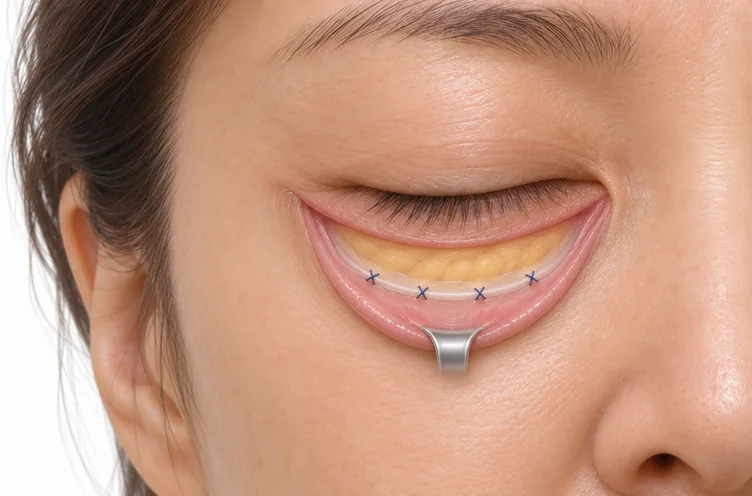
Lower blepharoplasty assesses and addresses under-eye bulging and hollowing, loose skin and muscle, and lower eyelid support together. One approach uses an incision through the conjunctiva inside the eyelid, leaving no skin incision. Another uses an incision just below the eyelashes to address the muscle and skin as well. The approach is chosen after assessing bulging, grooves, skin elasticity, and cheek position. If the cheeks are also sagging, a midface lift is considered.
Under-eye bulging involves both orbital fat and the condition of the tissues supporting it. When the septum that holds the fat back weakens, the trough below becomes hollow, and cheek fat descends, the bulging looks more pronounced. Removing fat alone can therefore leave the skin sagging with fine wrinkles or make the junction with the cheek look more hollow.
We also assess the angle of the bone beneath the eyes beforehand. People whose under-eye bone projects forward show less aging, while those whose bone slopes backward experience greater effects of gravity on the tissues, leading to earlier sagging. Differences in the supporting bone affect what can be expected from the same procedure, so we explain this during the consultation.
Key point Removing fat alone can leave the skin sagging with fine wrinkles or make the junction with the cheek look more hollow.
How much loose skin should be removed?
04Skin removal is limited to what allows the eyes to remain comfortable
Answer We remove skin only to the extent that the eyes remain comfortable. Removing too much can cause ectropion (outward turning of the eyelid), lagophthalmos (incomplete eyelid closure), and dry eyes.
It is easy to assume that removing more skin will make the area tighter, but removing too much can cause ectropion (outward turning of the eyelid), lagophthalmos (incomplete eyelid closure), and dry eyes.
Whether to make a skin incision depends on the elasticity assessed by touch. During the examination, we manually assess the elasticity of the skin and orbicularis oculi muscle. If Re2O or laser treatment would be sufficient to address the skin, we operate through the conjunctiva and then treat the skin with those treatments. If those treatments appear insufficient, we either treat that area separately later or plan a skin incision.
This decision is based on extensive clinical examination experience rather than a fixed numerical cutoff, so we explain the reasoning during the consultation. If skin removal is needed, we explain why and discuss the alternatives.
Key point Removing large amounts of skin is not the goal.
How do the actual surgical steps vary by condition?
05The Surgical Process Varies Depending on Your Condition
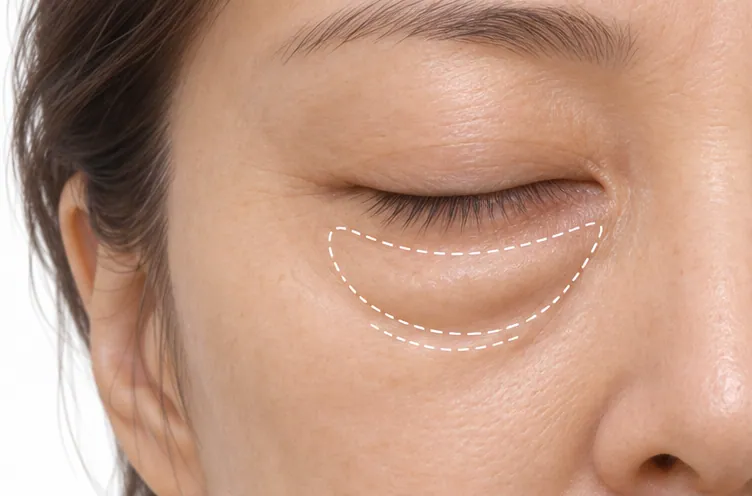
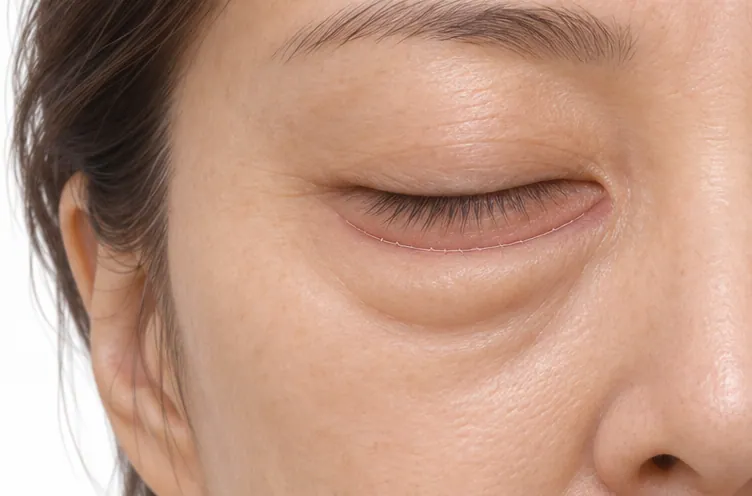
Answer The surgical steps differ depending on whether the main concerns are bulging and tear troughs, accompanying skin and muscle sagging, or sagging cheeks as well. This is because we assess the troughs, cheek position, and lower eyelid support together, rather than simply removing under-eye fat.
We do more than remove under-eye fat. We also assess the troughs, cheek position, and lower eyelid support.
When bulging and grooves are the main concerns
When skin and muscle sagging are also present
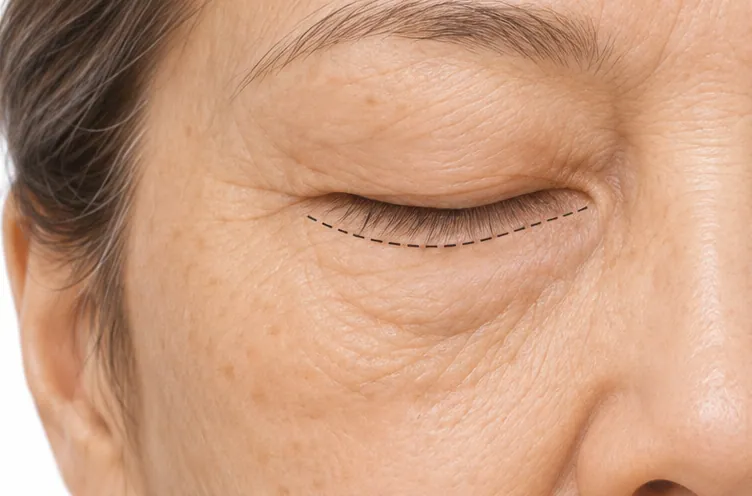
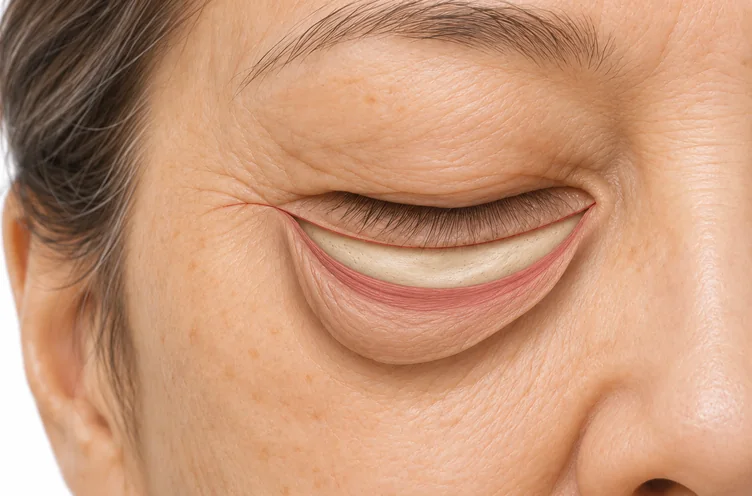
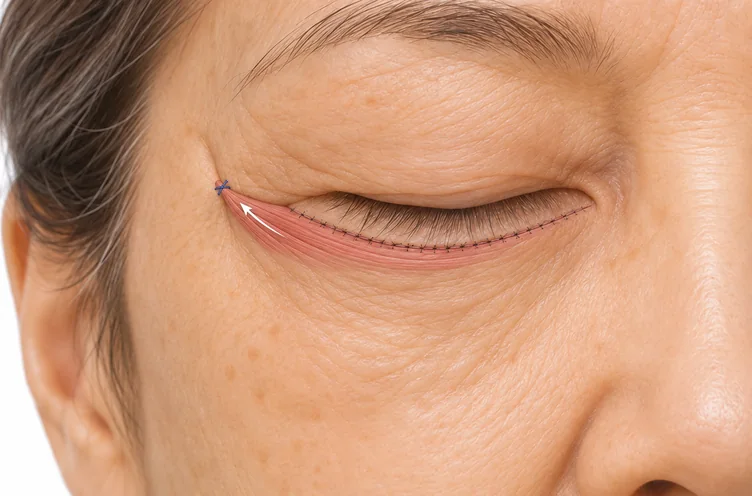
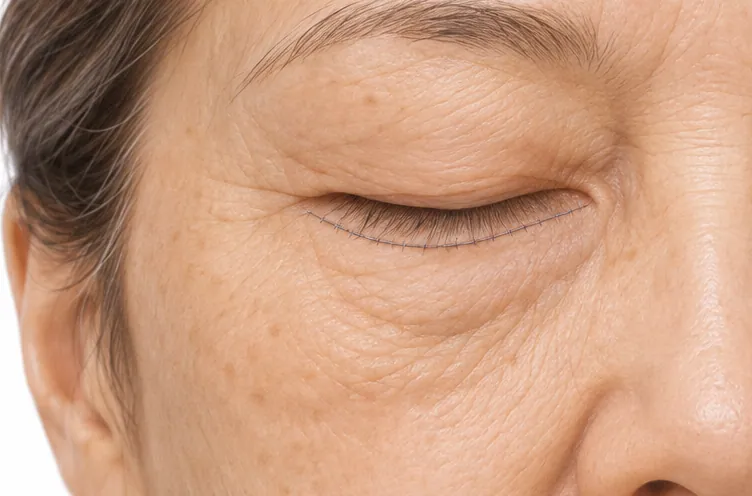
When the cheeks are also sagging
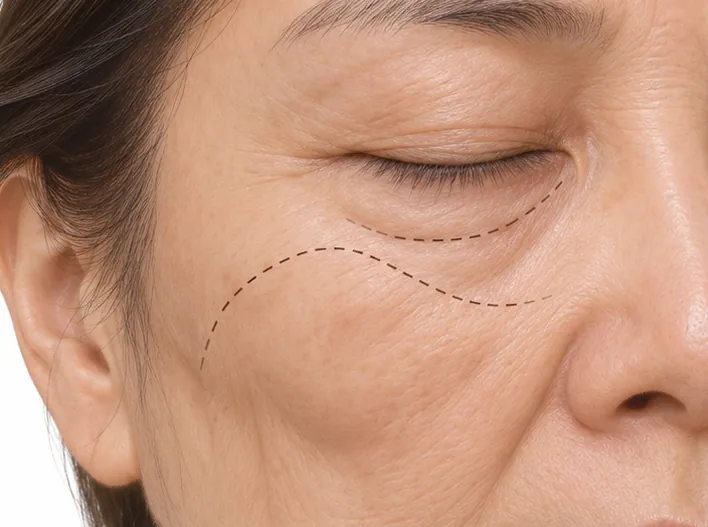
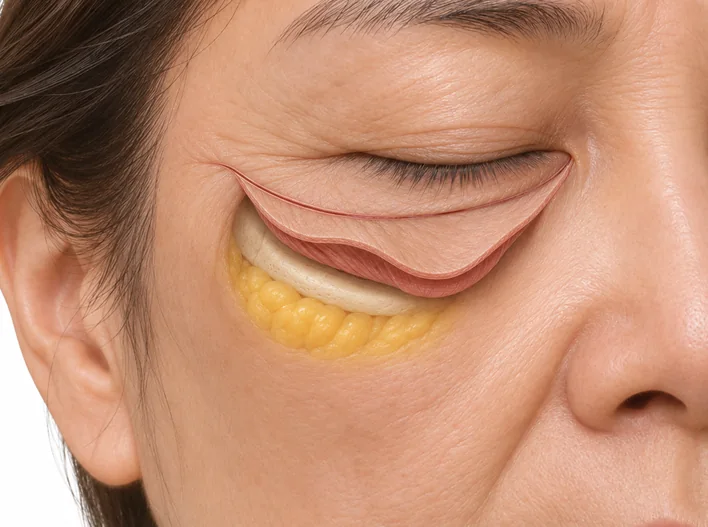
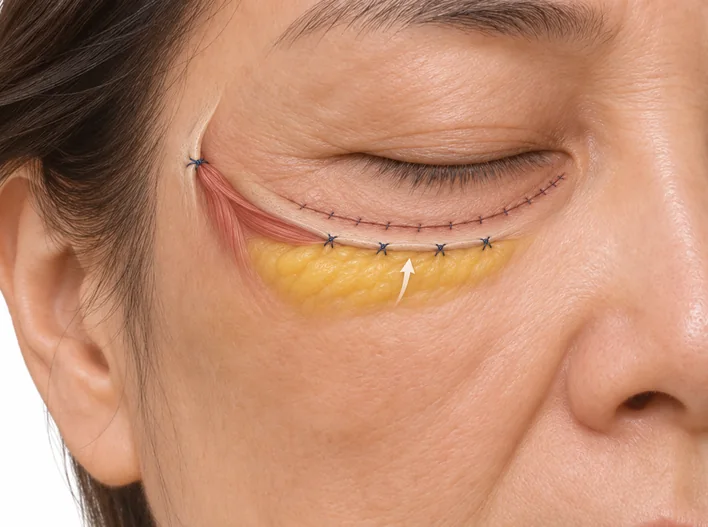
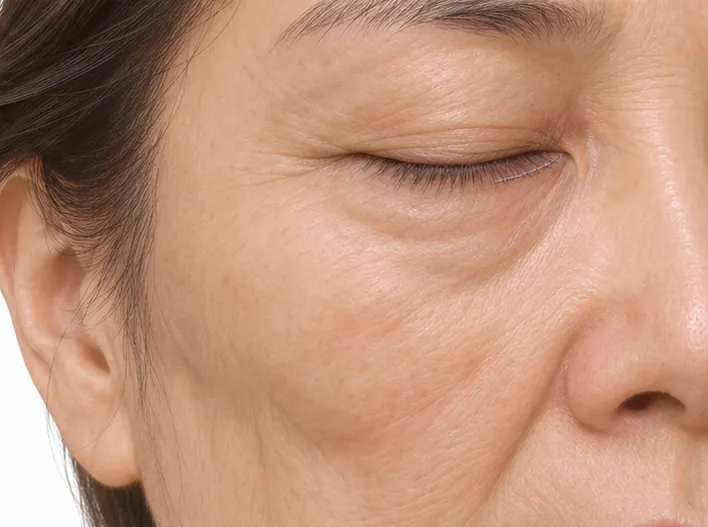
This is a simplified explanation of the typical steps. The actual technique and extent of treatment are determined after an examination.
Key point The actual technique and extent of surgery are determined after an examination.
What do we assess to determine which approach is appropriate?
06Three Things We Assess First When Choosing an Approach
Answer The approach depends on which concerns occur together: bulging fat, sagging skin, or sagging cheeks. Based on these findings, we consider reinforcing the orbital septum, limiting the extent of tissue removal, and whether to include a midface lift.
These are the three things I assess first when choosing an approach.
- If protruding fat is the main cause: We first assess whether reinforcing the orbital septum can address both the bulging and the hollows.
- If sagging skin is also present: We limit skin removal to what is needed and explain whether additional support is needed.
- If sagging cheeks are also present: We explain whether to include a midface lift or whether lower blepharoplasty alone is appropriate.
These are general care principles. The actual decision is made after an examination.
You do not need to decide on surgery the day of your consultation.
Key point You do not need to decide on surgery the day of your consultation.
Here is my answer to the initial question, “The bags under my eyes make me look tired. Will removing the fat alone help?” Bulging is not caused solely by the amount of fat. When the orbital septum weakens, the grooves become hollow, and cheek fat descends, the bulging can look more pronounced. Removing fat alone may therefore make the transition to the cheeks look more hollow. When evaluating patients for lower blepharoplasty, I consider protruding fat and hollows, excess skin, lower eyelid support, the contour from the under-eye area to the cheeks, and midface sagging together. If skin removal is needed, I explain why and discuss the alternatives.
— Dr. Hyungwoo Yim
During your consultation, you can say, “I read your article on lower blepharoplasty. Please assess whether my under-eye concerns are related to fat, skin, or cheeks.” We will walk through the assessment in the same order as this article.
FAQ
Frequently Asked Questions
How does fat repositioning differ from lower blepharoplasty?
Fat repositioning primarily moves protruding fat into hollow areas, while lower blepharoplasty also addresses the skin · muscle · supporting structures. The appropriate approach depends on the amount of excess skin and the degree of cheek sagging.
Do I need a midface lift at the same time?
Not everyone needs one. We consider the transition from the under-eye area to the cheeks, your desired changes, and the demands of surgery.
Will surgery get rid of dark circles too?
Dark circles describe a dark appearance rather than a specific disease. Causes include increased pigmentation, blood vessels and muscles showing through thin skin, or shadows created by hollows and bulging. Several causes may overlap. Surgery cannot remove the pigment itself, and pigmentation treatments have difficulty correcting structural shadows. We first identify the main cause by changing the lighting and gently pulling the skin.
BEFORE CONSULTATION
What to Prepare Before Your Consultation
- Front-view photo · Eyes openPlease bring recent photos and, if available, photos taken before the changes appeared. They help us compare when the changes began.
- Records of previous eye surgery · TreatmentsWrite down when, where, and how you were treated, including whether you received filler or fat injections.
- Contact lenses · Eye drops · Daily habitsTell us how long you have worn contact lenses and what type, which eye drops you use, and whether you rub your eyes frequently.
- Discomfort when opening your eyesWrite down what you usually notice, such as whether you tense your forehead, your eyelids feel heavy, or your vision is obstructed.
- The one thing that concerns you mostMake it your first question at your consultation.
More articlesVITAL Plastic Surgery Medical Articles
RESERVATION
You do not need to decide the day of your consultation.
Organize questions about this page without entering your name, contact information, or medical history. This does not submit an appointment request.