PLASTIC SURGERY
Breast fat grafting
Breast Fat Transfer
We assess the volume needed and whether the tissue can support fat grafting.
This may vary depending on your condition and the extent of surgery.
SHORT ANSWER
What is assessed first for breast fat transfer and volume reconstruction?
We assess the volume needed and whether the tissue can support fat grafting. During your consultation, we review the fat available for harvesting · skin and scars at the recipient site · your current breast condition and screening history.
01 · START WITH YOUR CONCERN
Do any of these concerns
sound familiar?
What brings you in?
1
Chest width · Body proportions
2
Location of sagging
3
Differences between sides
“I'm concerned about volume after implant removal.”
“I'd like to use my own tissue.”
“I'd like to fill in localized hollows.”
We assess the volume needed and whether the tissue can support fat grafting.
We assess body proportions, excess skin, differences between sides, and your current discomfort. We discuss plans for childbirth and breastfeeding, along with any previous breast examinations or surgeries, in advance.
Breast fat transfer and volume reconstruction,
What does the surgery involve?
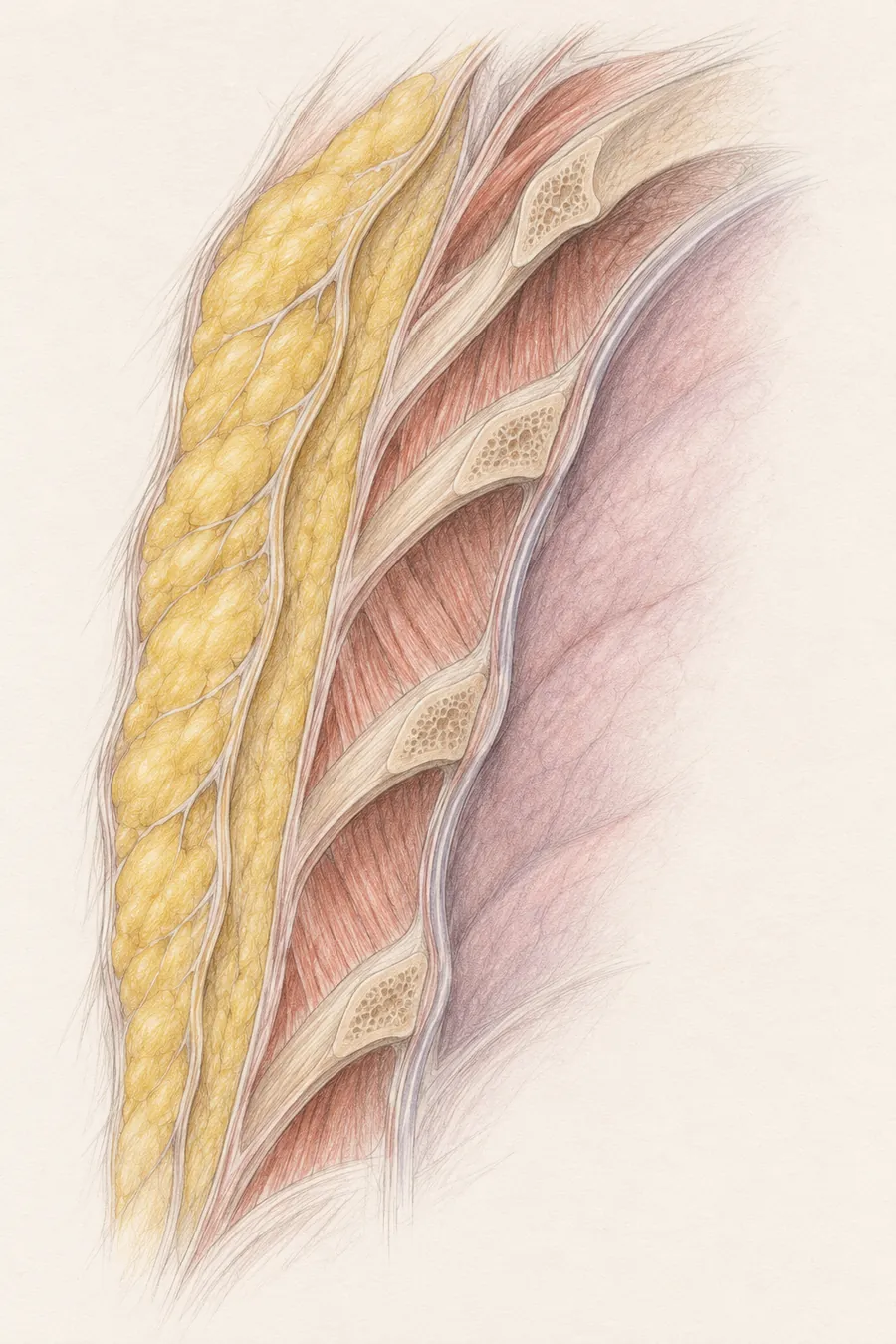
Breast fat transfer is surgery that adds volume to the breasts using your own fat, harvested from areas such as the abdomen or thighs and then purified. It may be considered when you want volume without implants, have insufficient volume after implant removal, or want to fill localized hollows. Transferred fat needs to establish a blood supply to survive, so the amount of change possible depends on the skin and tissue at the recipient site and the amount of fat available for harvesting.
- Graft survival
- This is when transferred fat establishes a blood supply from the surrounding tissue and survives. Some fat may be absorbed, and results vary by individual.
- Fat necrosis · Calcification
- Fat that does not survive may remain as lumps or calcium deposits. Tell your provider about the surgery when you have breast exams.
- Contour irregularities
- An uneven or bumpy appearance caused by fat settling unevenly.
In breast fat transfer and volume reconstruction,
in Lower Blepharoplasty
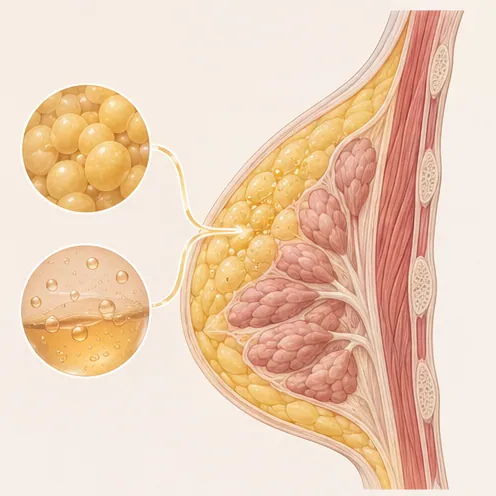
Fat needs a blood supply to survive
Any tissue needs blood vessels to grow into it to become stably integrated. For this reason, fat is grafted in small amounts, spread thinly across multiple layers, rather than placed in one large mass. If fat collects in one spot, blood vessels may have difficulty reaching the center, so the fat may be absorbed or remain as a lump. This is why we consider how the fat is placed before how much is placed.
Adding more fat does not mean more will remain
There is a limit to how much fat the skin and tissue at the recipient site can accommodate. Adding too much can increase pressure, impair fat graft survival, and raise the risk of fat necrosis. If your goal is a large increase in volume, we first explain that fat transfer alone may not achieve it. When needed, we discuss treatment in stages or compare it with implants.
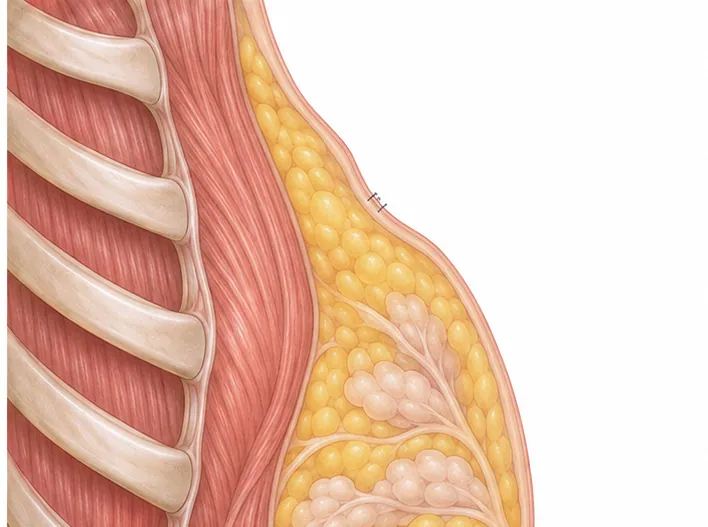
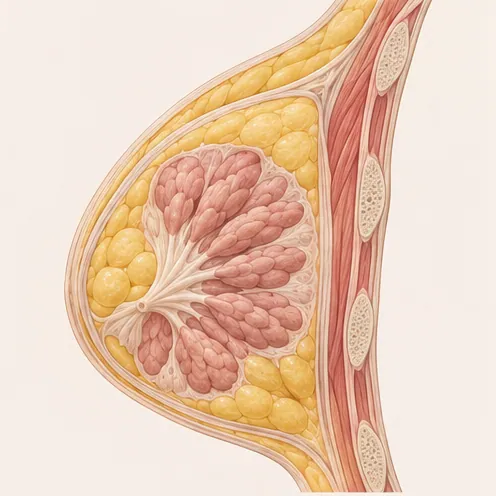
Fat is grafted in separate layers, avoiding glandular breast tissue
As a general rule, fat is placed in separate areas beneath the skin (subcutaneously) and around the breast gland, not inside the glandular tissue. Changes within the breast gland can make imaging results harder to interpret and may also place stress on the tissue. Areas where the skin is thin or scar tissue has hardened are assessed in advance because they can hold less fat.
We identify donor sites together
The starting point is whether there is enough fat to harvest from areas such as the abdomen and thighs. People with a lean body type may have difficulty obtaining enough volume. Harvesting can also cause bruising, swelling, and contour changes at the donor sites, so we decide together where and how much fat to remove. When planning fat transfer along with liposuction, we also assess body contours.
We review your breast screening history first
We review your preoperative breast exam results and family history, then plan continued screening after surgery. Lumps or calcifications that may develop after fat transfer can appear on imaging, so it is important to tell the physician interpreting the images about your surgery. If you feel an abnormality, we evaluate it without assuming it is due to the surgery.
Your own fat and large-volume fillers are different
Some patients ask about enlarging their breasts with fillers without surgery. Blood vessels have difficulty growing into the center of large filler deposits. Large-volume fillers carry risks of migration, chronic inflammation, granulomas, and infection, and may interfere with breast exams, making this one of the procedures of greatest concern to the surgeon. If problems develop, removal often requires an incision.
The Surgical Process Varies
Depending on Your Condition
When adding a small amount of volume
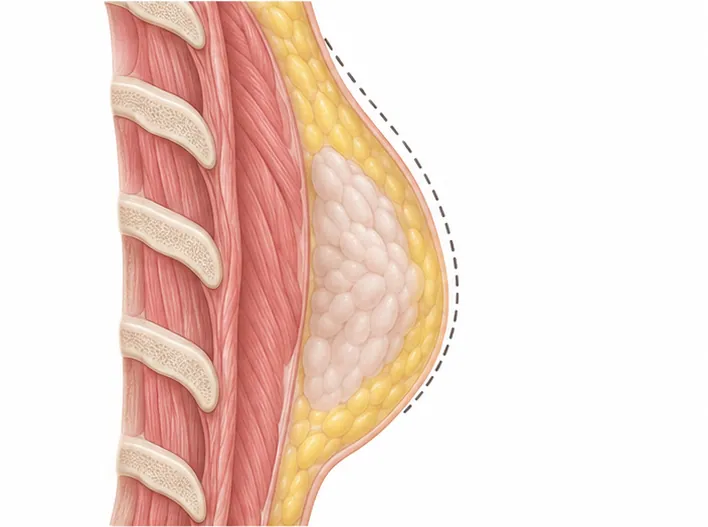 1
We determine the amount needed and the donor sites, then plan the grafting area
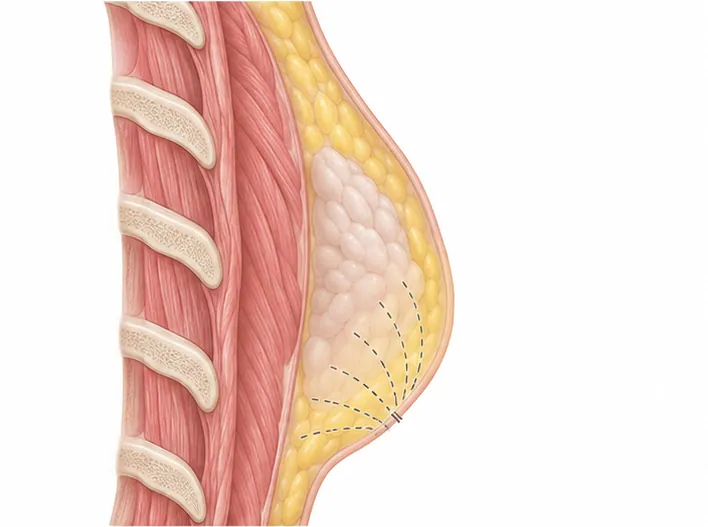 2
Fat is harvested from the abdomen or thighs through small incisions and purified
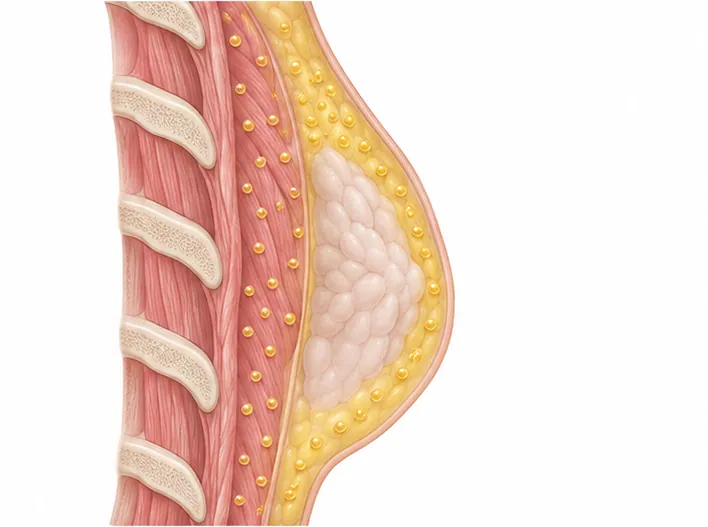 3
Fat is placed beneath the skin and around the breast gland through a thin cannula.
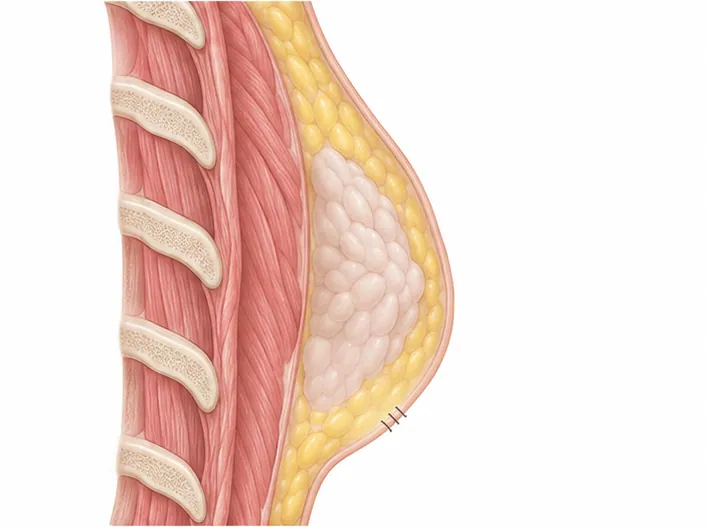 4
The donor-site and injection-site incisions are closed with sutures
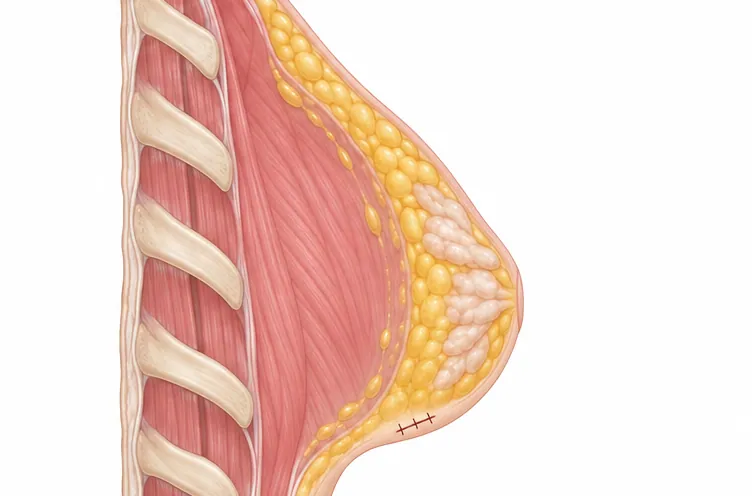
When reconstructing volume after implant removal
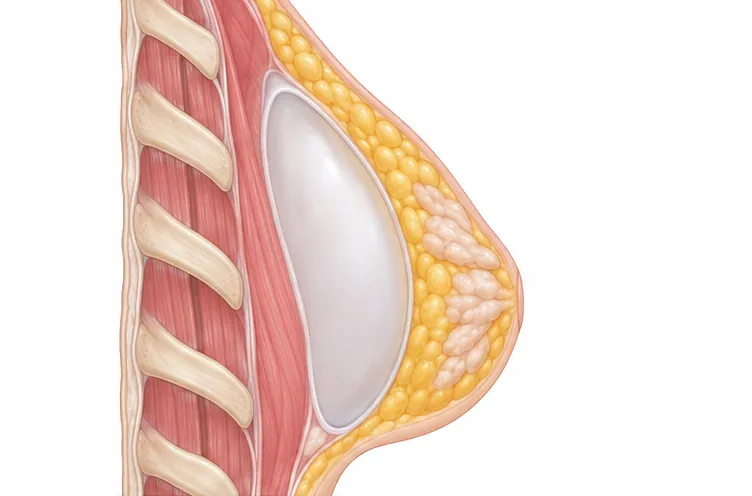 1
We assess the capsule and remaining tissue and decide whether to perform fat transfer at the same time
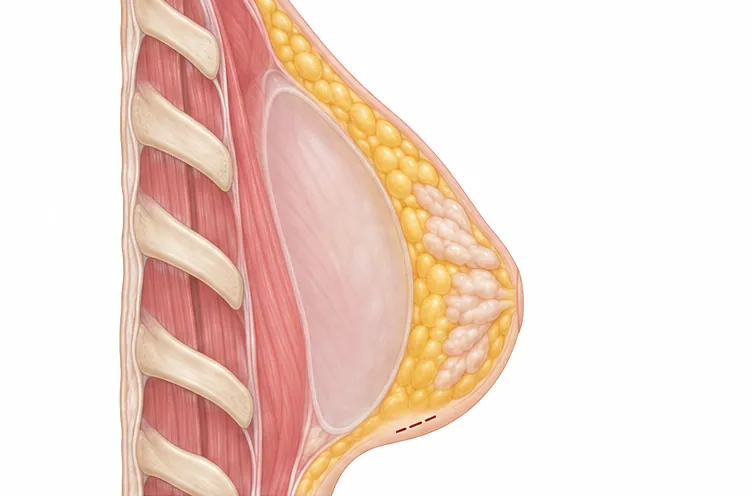 2
An incision is made to remove the implants and as much of the capsule as needed
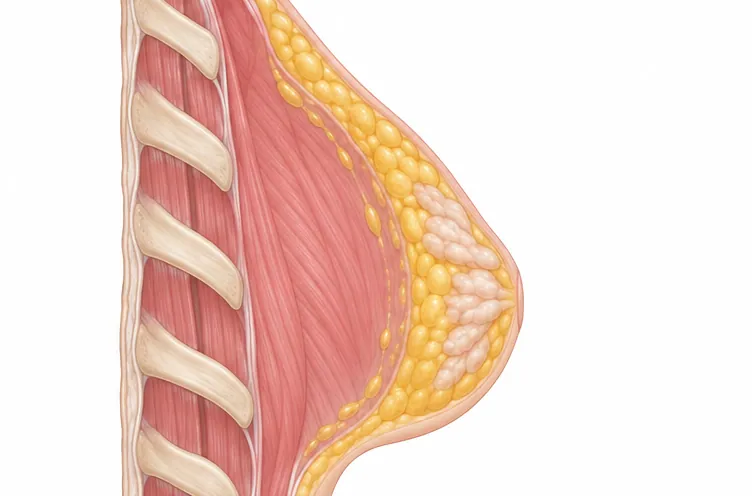 3
If the tissue condition allows, fat is grafted in separate layers; otherwise, the procedures are staged
 4
The incision is closed in layers
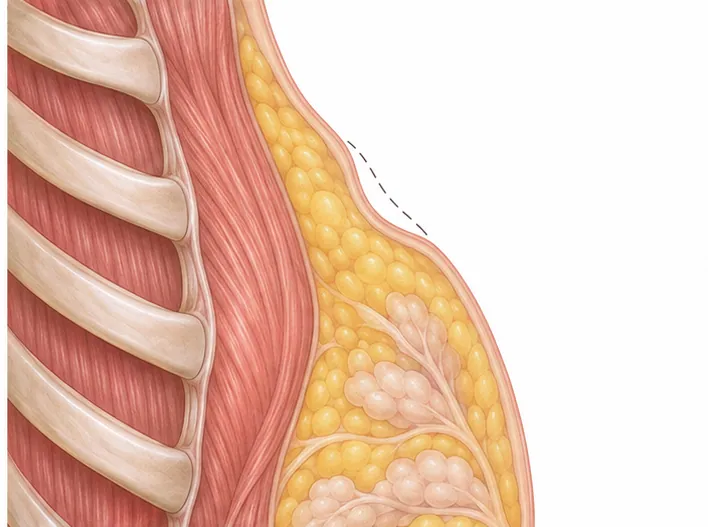
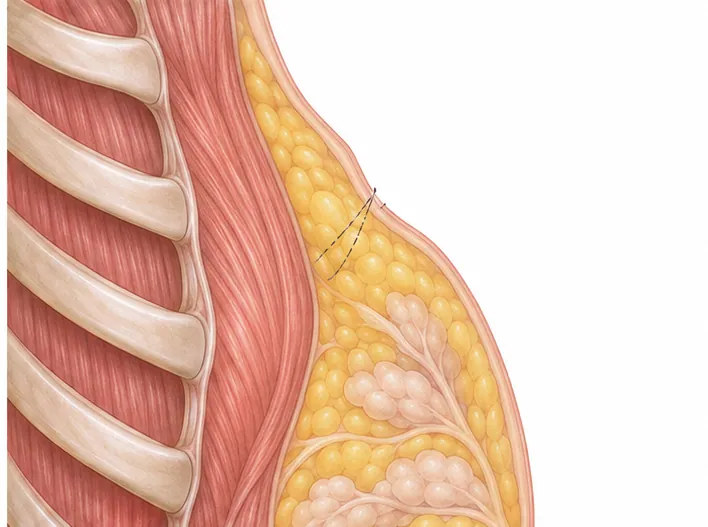
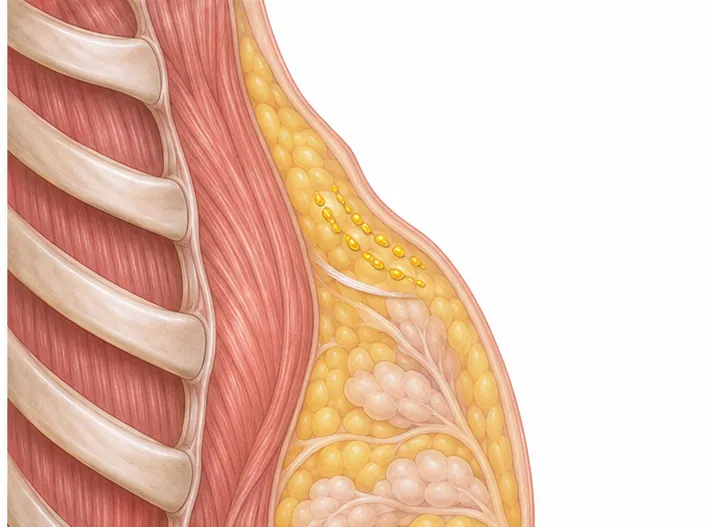
When correcting asymmetry or filling localized hollows
 1
We mark the hollow areas and the extent of scar firmness
 2
Fat is harvested and purified, and small incisions are made
 3
Firm scar tissue is released first, then fat is placed in thin layers
 4
The injection-site incisions are closed with sutures
Illustration for explanation · Not an actual patient. This is a simplified description of typical steps. The actual technique and extent of surgery are determined after examination.
02 · WHAT WE LOOK AT
Even when concerns look similar,
the factors to assess differ.
Fat available for harvesting
We assess body proportions, excess skin, differences between sides, and your current discomfort.
Skin and scars at the recipient site
We discuss plans for childbirth and breastfeeding, along with any previous breast examinations or surgeries, in advance.
Current breast condition and screening history
We compare your desired shape with the extent of correction possible, considering scarring and effects on function.
03 · DOCTOR'S DECISION
When choosing an approach, Dr. Hyungwoo Yim
looks at three things first.
Breast assessment and treatment goals
Using your medical history and examination findings, we distinguish your current condition from your desired changes. At this stage, we identify the necessary conditions before choosing a treatment.
Discussion of graft volume and variability in fat survival
When comparing available methods, we explain the expected changes, the burden on the tissues, recovery, and potential remaining problems.
Follow-up exams and consideration of staged treatment
We give you time to understand the explanation and ask questions. We may not recommend immediate treatment if its burden is greater or if you cannot allow enough time for recovery.
VITAL Plastic Surgery's principle is to recommend necessary treatment at the appropriate time. Having a consultation does not mean you need to decide on a procedure or surgery that day.

When
to consider a consultation
- When you want volume without implants
- When volume is insufficient after implant removal
- When you want to fill localized hollows
- When you want to improve symmetry with a small amount of added volume
- When you have fat available to harvest from the abdomen or thighs
When
Surgery is not our first recommendation
- When there is not enough fat to harvest
- When a breast examination is needed first
- When you want a large volume change in one procedure
- When you plan to become pregnant or breastfeed soon
04 · LIMITS & RISKS
Along with possible improvements,
we explain the limitations and risks.
Your desired changes — First, tell us what bothers you most and which aspects of your appearance you want to keep. We do not promise changes identical to photos or someone else's results.
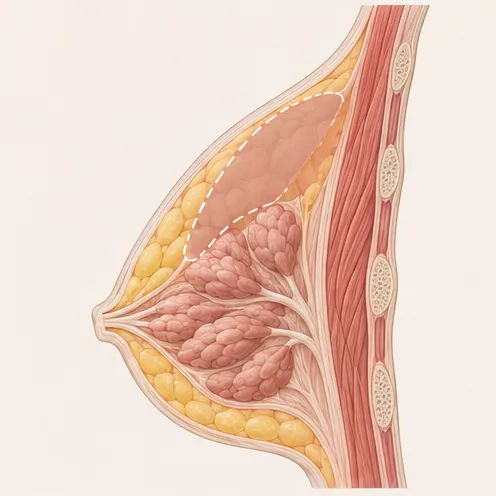
Fat necrosis
Calcification
Lumps
Infection
Asymmetry
Previous Treatments
Do not wait if you have these symptoms
If you experience sudden severe pain, bleeding that does not stop, rapidly worsening swelling on one side, or signs of possible infection such as a high fever or pus, contact us immediately rather than waiting for your appointment.
Conditions to address first — We first assess your health, inflammation and stage of recovery, and the range of feasible treatments. If needed, testing, observation, or other medical care may take priority.
Risks and limitations to discuss during consultation — fat necrosis, calcification, lumps, infection, asymmetry, and fat absorption. This is not a complete list of possible risks. Risks may vary depending on your health, previous treatments, and the technique and extent of treatment. These will be explained in detail during your examination and the informed consent process.
Preparing for surgery and
recovery by stage
- 3–4 days after surgery
Swelling is at its worst during this time. Apply cold compresses for 3 days without pressing hard. Gentle walking and drinking plenty of water are recommended.
- Early After Surgery
Do not press or massage the grafted area for 2 weeks. Because pressure can interfere with fat survival, wear a non-compressive sports bra for 4 weeks, and avoid underwire bras and sleeping on your stomach. Wear a compression garment over the fat removal sites for 2–4 weeks. Stitches are removed after 5–7 days.
- Several Months
Some of the transferred fat is naturally absorbed. Final fat survival is assessed after 3–6 months, and the need for a second fat transfer is discussed at that time. Avoid rapid weight loss and strenuous aerobic exercise for 1–3 months. For 4 weeks, avoid warm compresses, saunas, Korean bathhouses, and soaking in a bath up to the waist.
- Up to 1 Year
Have a breast ultrasound after 6 months to 1 year, and let your provider know about the fat transfer at future breast screenings.
No smoking · No alcohol
This is essential information provided before surgery. Smoking greatly reduces fat survival, so please stop smoking.
Medications · Supplements
We recommend stopping herbal medicines and supplements such as omega-3 when possible because they may increase bleeding. Please tell us about every medication you take.
Planning
If you plan to become pregnant or breastfeed soon, we adjust the timing. Please also tell us about any planned weight changes.
Medical History · Screening
We review your medications and chronic medical conditions, as well as your preoperative breast ultrasound and mammogram results. The procedure is performed under sedation (intravenous anesthesia) and local (tumescent) anesthesia. General anesthesia may be used if the treatment area is extensive.
Recovery times are averages and vary from person to person. Contact us immediately if the injection area suddenly becomes severely swollen and red, feels warm, or has pain or pus, or if the skin turns white or dark red.
05 · FOLLOW THE CHANGE
We also document
and monitor changes after treatment.
01
STEP 01
Documenting your condition before treatment
We review previous treatments, your current condition, and the changes you hope to see.
02
STEP 02
Check Early Reactions · Wound Healing
We explain treatment-specific precautions and symptoms that require contacting us.
03
STEP 03
Comparing appearance and function
Along with photos, we assess discomfort and changes in function.
04
STEP 04
Assessing additional care
We explain additional treatment based on your condition rather than recommending the same treatment to everyone.
This is a general overview, not an actual patient case. Specific follow-up schedules vary by treatment method and recovery. If you experience sudden severe pain, persistent bleeding, or signs of possible infection, contact a medical facility immediately rather than waiting for your appointment.
Common questions
during consultations
Does adding platelet-rich plasma help more fat survive?
Platelet-rich plasma (PRP) can be discussed as an optional addition, but we do not state definitively that it improves fat retention. Its effects vary depending on how it is prepared and its intended purpose, so we explain whether it is needed and decide together.
What if I feel a lump after fat transfer?
Fat that does not survive may remain as a lump, but we do not assume a lump is due to the surgery. If you notice a change you can feel, we evaluate it with an examination and any necessary tests.
Can fat transfer and a breast lift be done together?
If both sagging and volume are concerns, the procedures can be planned for the same day or in stages. We decide based on recovery demands and blood supply.
How much of the fat injected into the breasts is reported to remain in studies?
A systematic review of 35 studies on breast augmentation (3,757 women) reported an average retention rate of 58% (44–83% across studies). A 2026 meta-analysis combining 47 studies (4,425 patients) found an average fat survival rate of 53.26% and a repeat grafting rate of 11.83%. The authors recommended discussing in advance that multiple procedures may be needed. At VITAL Plastic Surgery, we assess your progress over 3–6 months and discuss whether a second procedure is needed.
Source: Seth et al., Plast Reconstr Surg 2024 · Giannas et al., J Plast Reconstr Aesthet Surg 2026
BEFORE YOU DECIDE
Before you decide,
frequently asked questions
Questions to review together before deciding.
Based on questionnaire responses from Dr. Hyungwoo Yim · Last updated October 2026 Specific methods and their scope are discussed individually after an examination.
Q
Will one procedure provide lasting volume at the level I want?
−
A
Fat survival and absorption vary from person to person, and there is a limit to how much volume can be added in one session. Final fat survival is assessed after 3–6 months, and the need for a second fat transfer is discussed at that time.
Q
Are the cost, number of treatments, and recovery period fixed?
+
Q
Can a treatment plan be finalized through a photo consultation alone?
+
DOCTOR'S COLUMN DOCTOR'S COLUMN DOCTOR'S COLUMN
Must Read
Care Notes Written by the Doctor · Please Read Before Your First Visit
No.1
No.3
VIEW MORE →
RESERVATION
You do not need to decide the day of your consultation.
Organize questions about this page without entering your name, contact information, or medical history. This does not submit an appointment request.