PLASTIC SURGERY
All Treatments / Surgery
Philtrum reduction
Lip Lift Surgery
We assess lip and facial expression proportions, not just philtrum length.
This may vary depending on your condition and the extent of surgery.
SHORT ANSWER
What do we assess first for a lip lift?
We assess lip and facial expression proportions, not just philtrum length. During your consultation, we examine philtrum length, nose-to-lip proportions, lip movement, skin characteristics, and scarring tendency.
01 · START WITH YOUR CONCERN
Do any of these concerns
sound familiar?
What brings you in?
1
Philtrum Length
2
Upper Lip Show
3
Mouth Corner Angle
“My philtrum looks long.”
“I'm concerned about how much of my lip shows.”
“I'm worried my facial expressions might look unnatural.”
We assess lip and facial expression proportions, not just philtrum length.
We assess proportions from the front and side, along with movement during facial expressions. Before surgery, we explain the extent of the incision needed and where the scar will be.
Lip Lift,
What does the surgery involve?
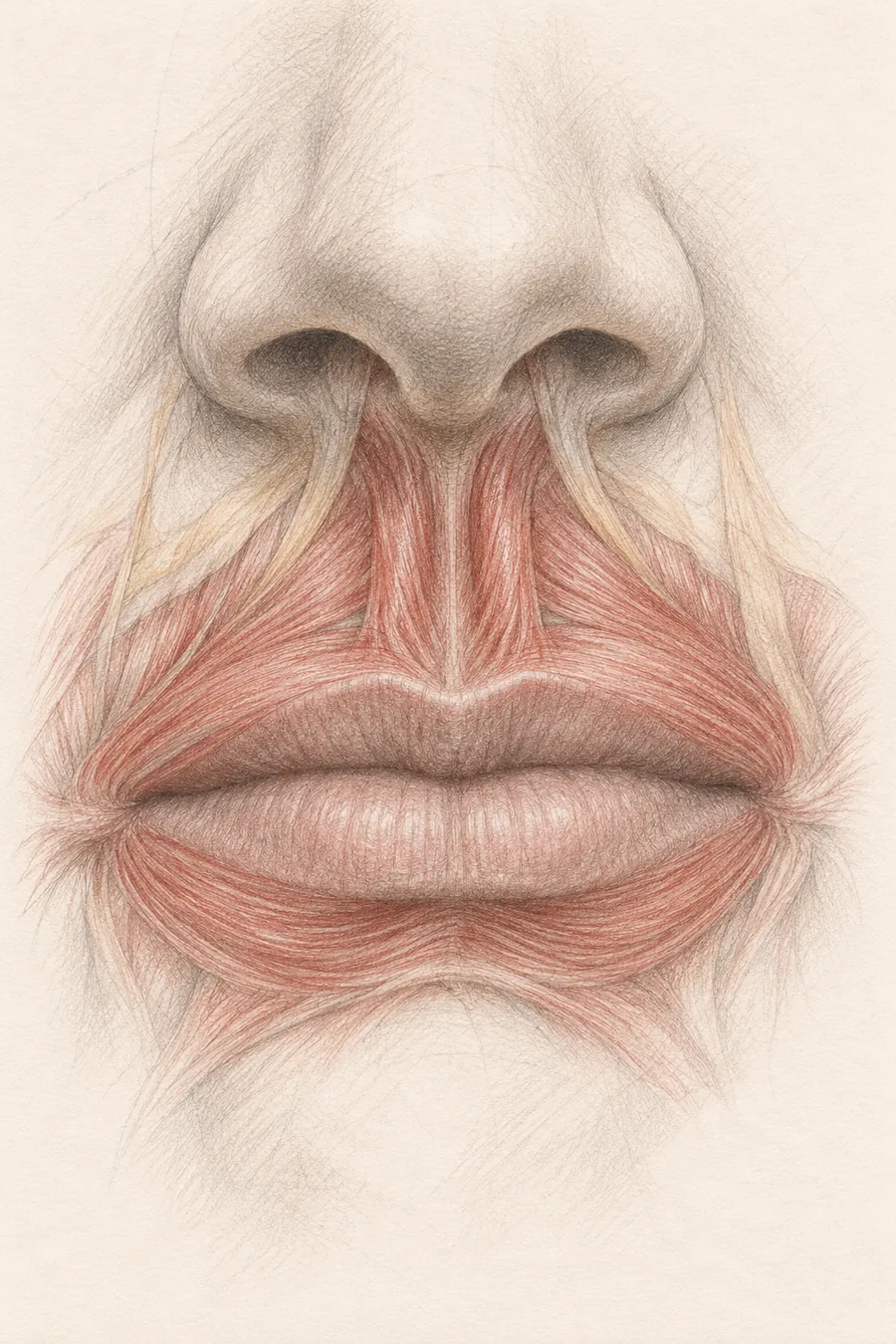
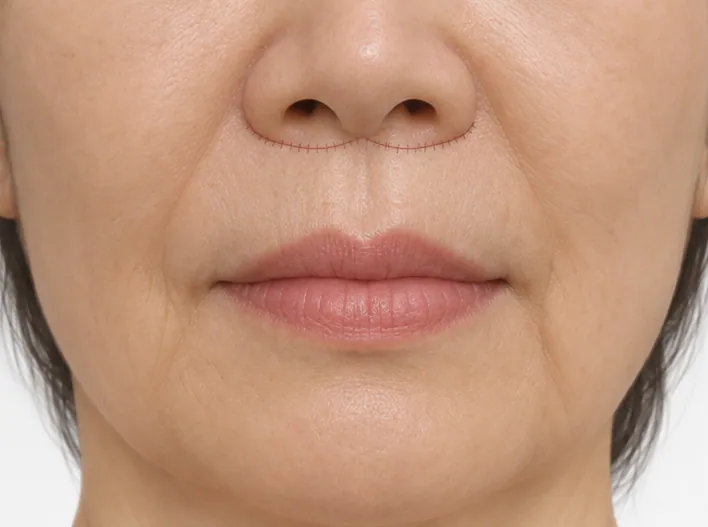
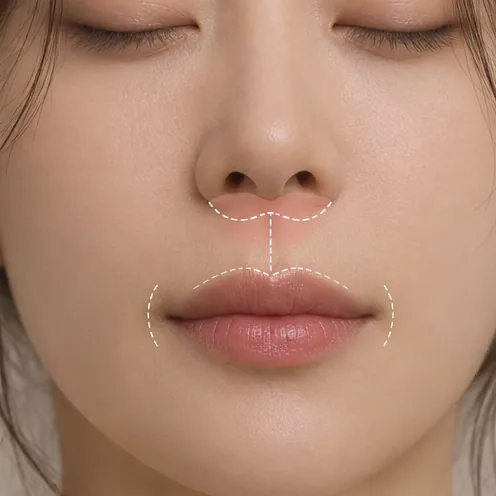
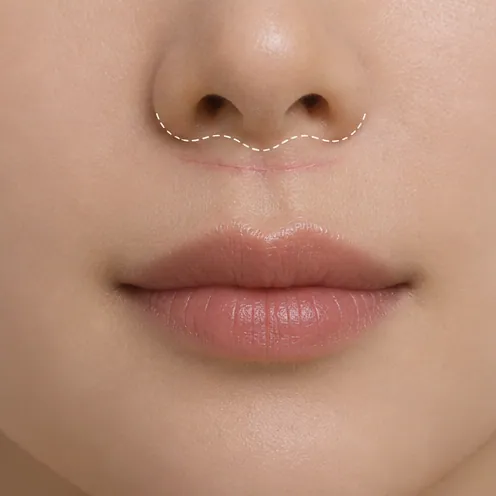
A lip lift is a procedure that shortens the distance between the base of the nose and the upper lip, raising the position of the upper lip. There are two approaches, depending on the incision site. An inner lip lift removes skin along the border between the red portion of the upper lip and the surrounding skin, leaving a scar at the lip border. An outer lip lift (bullhorn lip lift) removes a bullhorn-shaped strip of skin beneath the nose, along the base of the nostrils and the lower border of the columella, leaving a scar in the shadow beneath the nose. Combining the two leaves scars in both locations. The choice is based on more than the measured length alone: the proportions of the nose and lips, tooth show, effort needed to close the mouth, and tendency to scar are also considered.
- Central Lip Lift
- This approach is performed at the lip (Lip lift). Skin is removed along the border between the red portion of the upper lip (the vermilion) and the skin to lift the upper lip and shorten the philtrum. The scar remains along the lip border, and the shape of the lip line (Cupid's bow) changes.
- Lateral Lip Lift
- This approach is performed beneath the nose (Bullhorn lip lift). Skin is removed in a bullhorn shape along the base of the nostrils and the lower border of the columella to shorten the philtrum and lift the upper lip. The scar remains in the shadow beneath the nose, and the shape of the nostrils and position of the nasal alae may change slightly.
- Philtral Columns
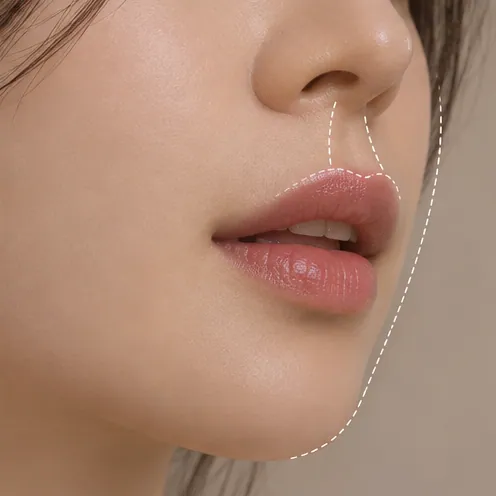
- These are the two raised vertical ridges on either side of the philtrum. They extend from the base of the nose to the Cupid's bow and give the upper lip dimension.
- Orbicularis Oris Muscle
- This muscle surrounds the mouth. It is used to close and purse the lips and contributes to upper lip thickness and movement.
In Lip Lift Surgery,
in Lower Blepharoplasty
Inner and outer approaches use different incision sites
The inner approach removes skin along the border between the red portion of the upper lip and the surrounding skin. The scar lies at the lip border, and the shape of the lip line (Cupid’s bow) also changes. The outer approach removes a bullhorn-shaped strip of skin beneath the nose, along the base of the nostrils and the lower border of the columella. The scar lies in the shadow beneath the nose, and the shape of the nostrils or position of the sides of the nose may change slightly. Combining the two can shorten the philtrum further, but it leaves scars in both locations and places greater strain on blood flow to the upper lip. The approach is therefore chosen by considering both scar placement and how much shortening is needed.
We First Identify Why the Philtrum Looks Long
The concern a patient describes during consultation is often a result rather than the underlying cause. A philtrum may look long because of its actual length, because a thin upper lip rolls inward, or because of the position of the upper jaw and teeth. If the teeth and jaw are major contributing factors, shortening the philtrum may not change the appearance of the mouth as much as expected. We therefore first assess the front and side views and how much of the front teeth shows.
Pulling Only the Skin Places Tension on the Scar
If only the skin is cut, pulled, and sutured, the full weight of the upper lip and the forces of facial expressions act on the suture line. Tension on the wound is one cause of scar widening. For the approach beneath the nose, one method is to first secure the tissue beneath the skin to the base of the nose to reduce tension on the skin. The method and extent of fixation are determined after an examination of the structure at the base of the nose and the amount of shortening needed.
Shorter Is Not Always Better
Shortening the philtrum too much can expose the front teeth excessively, make it take effort to close the mouth, or cause the upper lip to look lifted. With the approach beneath the nose (outer), the shape of the nostrils or position of the sides of the nose may change slightly. With the approach at the lip (inner), the amount of skin that can be removed is limited to around 3–5 mm. Because skin is difficult to restore once removed, the amount of shortening is determined by examining the mouth both at rest with the lips closed and while smiling. The first step is to establish a range that preserves the patient’s original appearance.
We Plan Ahead for Persistent Scar Redness
Philtrum reduction scars do not disappear; they fade over time, and some may remain red even after a year. Redness and firmness can continue to change for several months or longer, so we begin injection and laser treatments one month after surgery and continue them consistently for at least six months. If a scar remains, options include scar revision or removal. Because a prolonged recovery can be emotionally tiring, we make this plan together before surgery.
Scarring Depends on More Than Your Natural Tendency
Scarring is affected not only by your natural tendency to scar, but also by the location, wound tension, blood flow, infection, smoking, diabetes, and postoperative care. The area under the nose and the lip border are subject to tension whenever you move your mouth. Before surgery, we ask how scars from previous surgeries healed, whether you have developed raised scars, and whether you smoke. If a raised scar appears, we evaluate it early rather than waiting.
The Surgical Process Varies
Depending on Your Condition
Approach from under the nose (external)
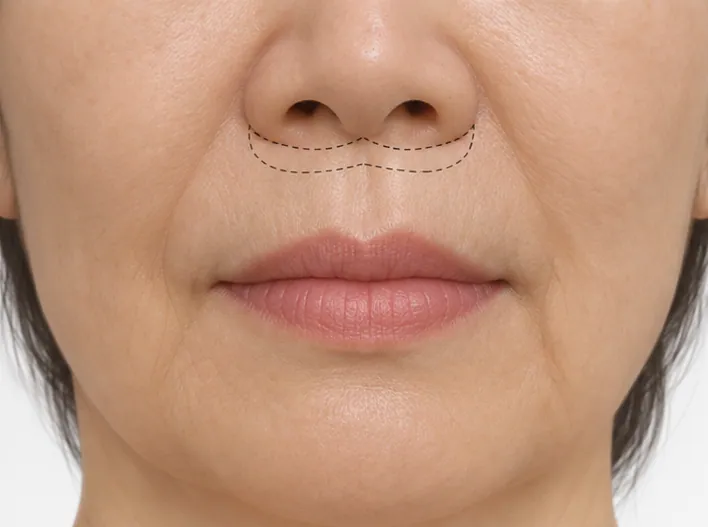 1
With the mouth closed, we measure philtrum length and front tooth show, then mark the amount of skin to remove along the base of the nose.
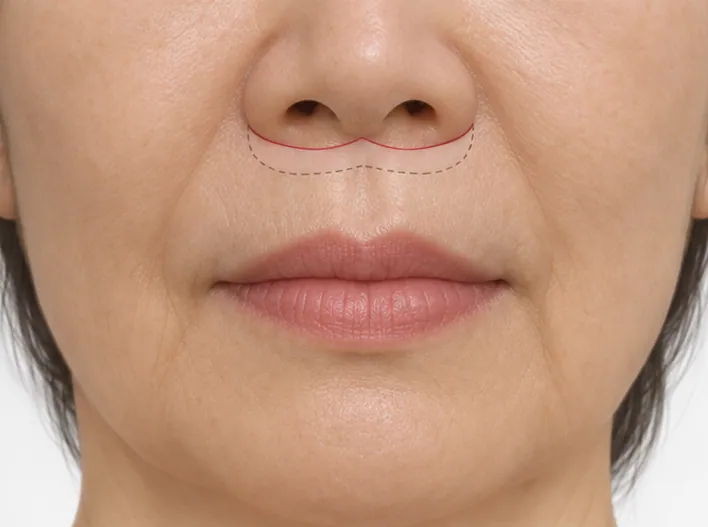 2
A bullhorn-shaped incision is made along the border beneath the nose, connecting the base of the columella to the floors of the nostrils, and skin is removed.
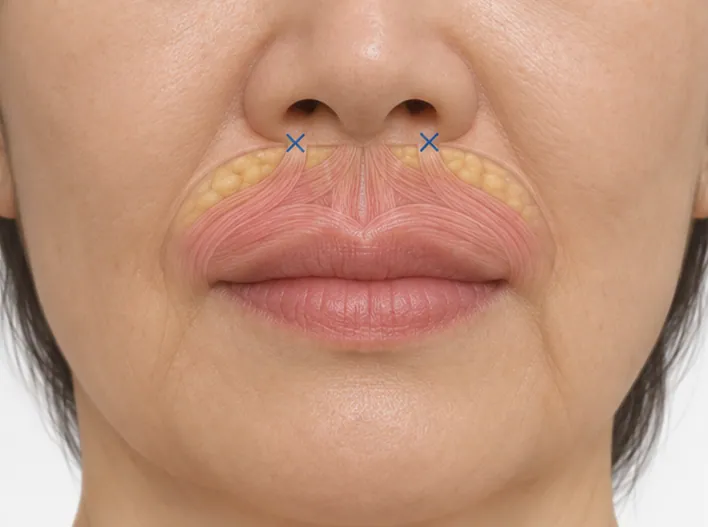 3
We anchor the tissue beneath the skin toward the nasal base to reduce tension on the suture line.
 4
The incision is closed in layers so the scar lies in the shadow beneath the nose, and the nostrils and nasal wings are checked for differences between the two sides.
Approach from the lip (internal)
 1
With the mouth closed, the amount of front tooth show is measured, and the width to be reduced is marked along the border between the red part of the upper lip and the skin.
 2
An incision is made along the lip border, and a narrow strip of skin is removed.
 3
The upper lip is lifted, and the shape of the lip line (Cupid’s bow) and the height of both sides are adjusted.
 4
The incision is closed in layers so the scar lies along the lip border.
Reducing both the lip side and the area under the nose (internal + external)
 1
The widths to be reduced at the lip border and under the nose are measured and determined separately.
 2
Incisions are made at both the lip border and under the nose to remove skin. Scars will remain in both places.
 3
Because this places greater strain on blood flow to the upper lip, the incisions are closed in layers while taking into account both the width of skin removed and the tension on the suture lines.
Illustration for explanation · Not an actual patient. This is a simplified description of typical steps. The actual technique and extent of surgery are determined after examination.
02 · WHAT WE LOOK AT
Even when concerns look similar,
the factors to assess differ.
Philtrum Length and Nose-to-Lip Proportions
We assess proportions from the front and side, along with movement during facial expressions.
Lip Movement
Before surgery, we explain the extent of the incision needed and where the scar will be.
Skin Characteristics and Scarring Tendency
Evaluating the philtrum, mouth corners, and lips together does not mean combining every procedure.
03 · DOCTOR'S DECISION
When choosing an approach, Dr. Hyungwoo Yim
looks at three things first.
Discuss Desired Proportions and the Possible Amount of Shortening
Using your medical history and examination findings, we distinguish your current condition from your desired changes. At this stage, we identify the necessary conditions before choosing a treatment.
Explain Incision Placement and Scarring
When comparing available methods, we explain the expected changes, the burden on the tissues, recovery, and potential remaining problems.
Assess Changes in Facial Expression and Mouth Closure
We give you time to understand the explanation and ask questions. We may not recommend immediate treatment if its burden is greater or if you cannot allow enough time for recovery.
VITAL Plastic Surgery's principle is to recommend necessary treatment at the appropriate time. Having a consultation does not mean you need to decide on a procedure or surgery that day.

When
to consider a consultation
- When the distance from the base of the nose to the Cupid's bow looks long relative to facial proportions
- When the front teeth are barely visible with the mouth closed and the upper lip appears covered
- When the outer lip border turns downward, making the resting expression look heavy
- When you are concerned about the upper lip becoming thinner and looking longer with age
- When you want to decide whether to address the philtrum and mouth corners together or separately
When
Surgery is not our first recommendation
- When the front teeth already show prominently or closing the mouth requires effort
- When the position of the upper jaw and teeth appears to be the main cause of the mouth's appearance
- When you have a history of raised scars or find it difficult to stop smoking
- When health issues such as diabetes or high blood pressure need attention first, or you cannot allow enough recovery time
04 · LIMITS & RISKS
Along with possible improvements,
we explain the limitations and risks.
Your desired changes — First, tell us what bothers you most and which aspects of your appearance you want to keep. We do not promise changes identical to photos or someone else's results.
Scarring
Asymmetry
Changes in Facial Expression
Lip Tightness
Previous Treatments
Do not wait if you have these symptoms
If you experience sudden severe pain, bleeding that does not stop, rapidly worsening swelling on one side, or signs of possible infection such as a high fever or pus, contact us immediately rather than waiting for your appointment.
Conditions to address first — We first assess your health, inflammation and stage of recovery, and the range of feasible treatments. If needed, testing, observation, or other medical care may take priority.
Risks and limitations to discuss during consultation — scarring, asymmetry, changes in facial expression, lip tightness, and overcorrection. This is not a complete list of possible risks. Risks may vary depending on your health, previous treatments, and the technique and extent of the procedure. These will be explained in detail during the examination and informed consent process.
Preparing for surgery and
recovery by stage
- Early After Surgery
Apply cold compresses for three days. Stitches are removed after 5–7 days. For two weeks, avoid opening your mouth wide, such as when yawning, laughing broadly, or taking large bites. Cut food into small pieces and eat with a spoon.
- Starting at One Month
Injection and laser treatments begin depending on the condition of the scar. Consistent care is needed for at least 6 months.
- 3 weeks–3 months
This is a period when the incision may become red and firm. This can be part of healing, and raised scars are evaluated early.
- 3 months–1 year
Redness and firmness gradually decrease. The degree of scarring varies with individual healing tendencies, location, and wound tension.

No smoking · No alcohol
We provide these essential instructions before surgery. Smoking and alcohol affect bleeding and wound healing.
Medications · Supplements
We recommend stopping herbal medicines and supplements such as omega-3 when possible because they may increase bleeding. Please tell us about every medication you take.
Scar History
Please tell us how scars elsewhere on your body have healed. This helps with the assessment.
Dental · Lip Treatments
Please tell us about any orthodontic treatment or lip fillers you have had.
Recovery times are averages and vary by individual. Please contact us immediately if you experience sudden severe pain, bleeding that does not stop, rapidly worsening swelling on one side, warmth, pus, or a fever of 38°C or higher.
05 · FOLLOW THE CHANGE
We also document
and monitor changes after treatment.
01
STEP 01
Documenting your condition before treatment
We review previous treatments, your current condition, and the changes you hope to see.
02
STEP 02
Check Early Reactions · Wound Healing
We explain treatment-specific precautions and symptoms that require contacting us.
03
STEP 03
Comparing appearance and function
Along with photos, we assess discomfort and changes in function.
04
STEP 04
Assessing additional care
We explain additional treatment based on your condition rather than recommending the same treatment to everyone.
This is a general overview, not an actual patient case. Specific follow-up schedules vary by treatment method and recovery. If you experience sudden severe pain, persistent bleeding, or signs of possible infection, contact a medical facility immediately rather than waiting for your appointment.
Common questions
during consultations
Are there options if my scar is still red a year after surgery?
Options include scar reduction or scar excision procedures. However, we do not use the same laser at the same time for every red scar; we first assess the stage of healing and the condition of the tissue. Because a prolonged recovery can be tiring, we plan the sequence and timing of care together.
I don't want to change my overall appearance. How much will I look different?
The mouth plays a major role in your overall appearance, so even a small amount of shortening can produce a noticeable change. We first ask what you want to preserve, then determine the extent of surgery within your current facial proportions rather than using someone else's photos as a guide. During consultation, we use photos to explain the degree of change.
Can I also have Re2O injections around my mouth?
The area around the mouth is well suited for Re2O. When used to support recovery after surgery, it is usually administered in the third week, and an add-on option is available for surgical patients. Because this area has many blood vessels, careful injection is important to avoid bruising or hematoma.
BEFORE YOU DECIDE
Before you decide,
frequently asked questions
Questions to review together before deciding.
Based on questionnaire responses from Dr. Hyungwoo Yim · Last updated October 2026 Specific methods and their scope are discussed individually after an examination.
Q
Does a shorter philtrum make you look younger?
−
A
Overall facial proportions and lip movement matter. Results are not judged by the amount of shortening alone, and excessive correction should be avoided.
Q
Are the cost, number of treatments, and recovery period fixed?
+
Q
Can a treatment plan be finalized through a photo consultation alone?
+
DOCTOR'S COLUMN DOCTOR'S COLUMN DOCTOR'S COLUMN
Must Read
Care Notes Written by the Doctor · Please Read Before Your First Visit
No.1
No.3
VIEW MORE →
RESERVATION
You do not need to decide the day of your consultation.
Organize questions about this page without entering your name, contact information, or medical history. This does not submit an appointment request.