PLASTIC SURGERY
MEDICAL COLUMN
Questions Answered Directly by the Doctor Before You Decide on Surgery
Eyes
Articles
Ptosis Repair vs. Double Eyelid Surgery: Will a Crease Alone Make Your Eyes Look Bigger?
Double eyelid surgery creates a fold in the upper eyelid when the eyes open, while ptosis repair adjusts the eyelid lifting muscles and aponeurosis to raise the eyelid. Neither procedure is inherently better; they suit different eyelid conditions.
Medically reviewed by Dr. Hyungwoo Yim, Medical Director (board-certified plastic surgeon) · Published November 15, 2026 · Last reviewed November 15, 2026
SHORT ANSWER
First, the Short Answer
- Double eyelid surgery creates a fold in the upper eyelid when the eyes open, while ptosis repair adjusts the eyelid lifting muscles and aponeurosis to raise the eyelid. Neither procedure is inherently better; they suit different eyelid conditions.
- The key distinction is how much of the eye is exposed. At VITAL Plastic Surgery, we measure MRD1, the distance from the center of the pupil to the upper eyelid margin. If it is within the normal range of approximately 4 mm, we do not perform ptosis surgery.
- At VITAL Plastic Surgery, we first assess eyelid position and movement, whether the eyebrows are compensating, excess skin, and eyelid closure. Before considering the shape of the crease, we identify what is covering it.
“My eyes look small. Will creating a double eyelid crease make them look bigger, or do I also need ptosis repair?”
This is a paraphrase of a question we often hear during consultations.
To answer this question, we first need to distinguish where your current concern comes from. We will explain each point below, then return to the original question at the end.
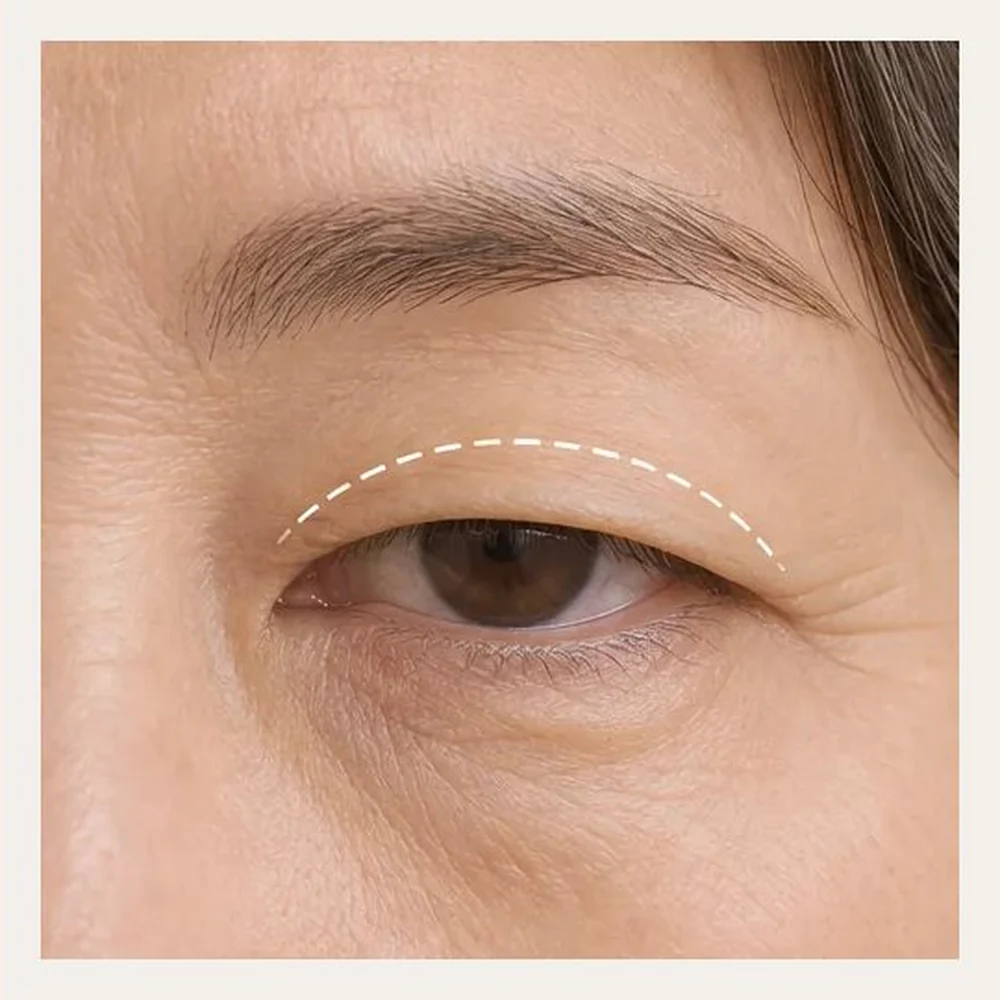
01How do double eyelid surgery and ptosis repair differ?
Answer Double eyelid surgery creates a fold; ptosis repair adjusts eyelid lifting function.
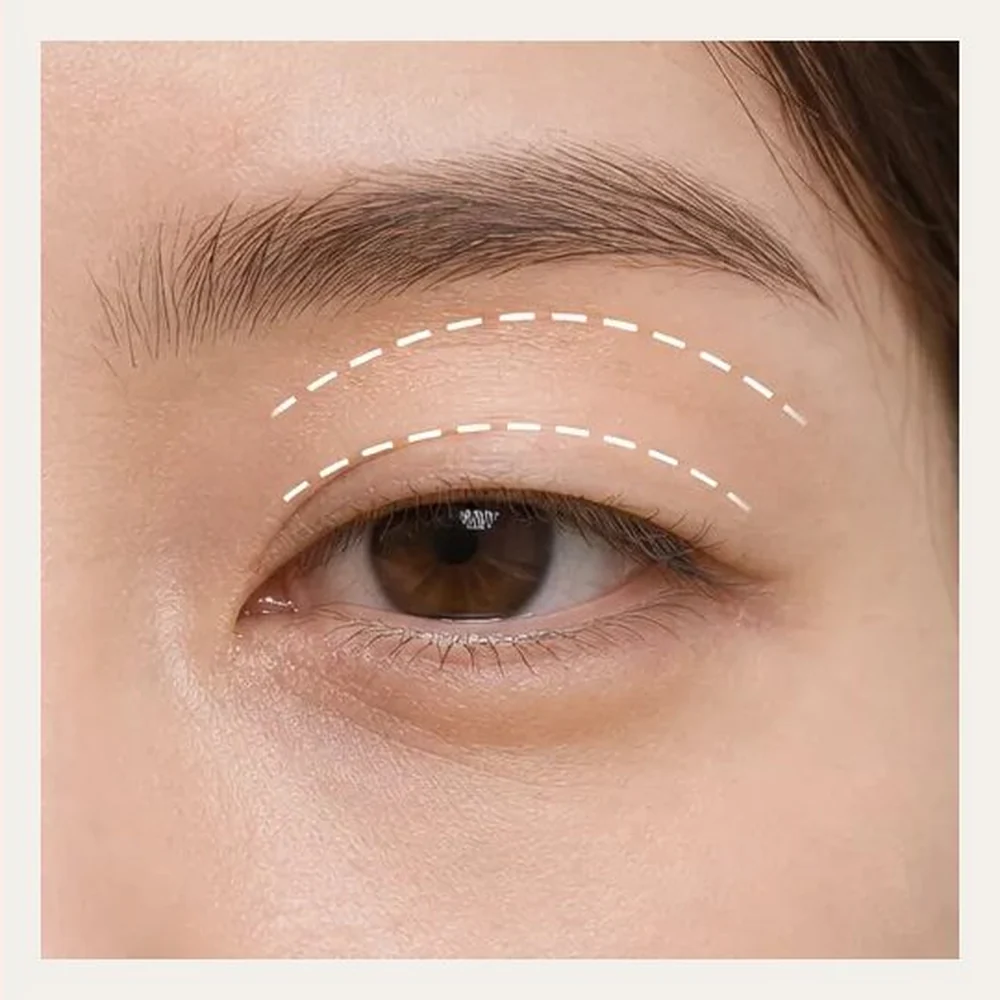
Double eyelid surgery creates a fold in the upper eyelid when the eyes open. Although it may seem to be simply a matter of choosing the crease height and shape, the appropriate technique depends on skin thickness, the amount of excess skin, fat thickness, eyelid lifting strength, and eyebrow position. These factors guide the choice among buried-suture, partial-incision, and incisional techniques.
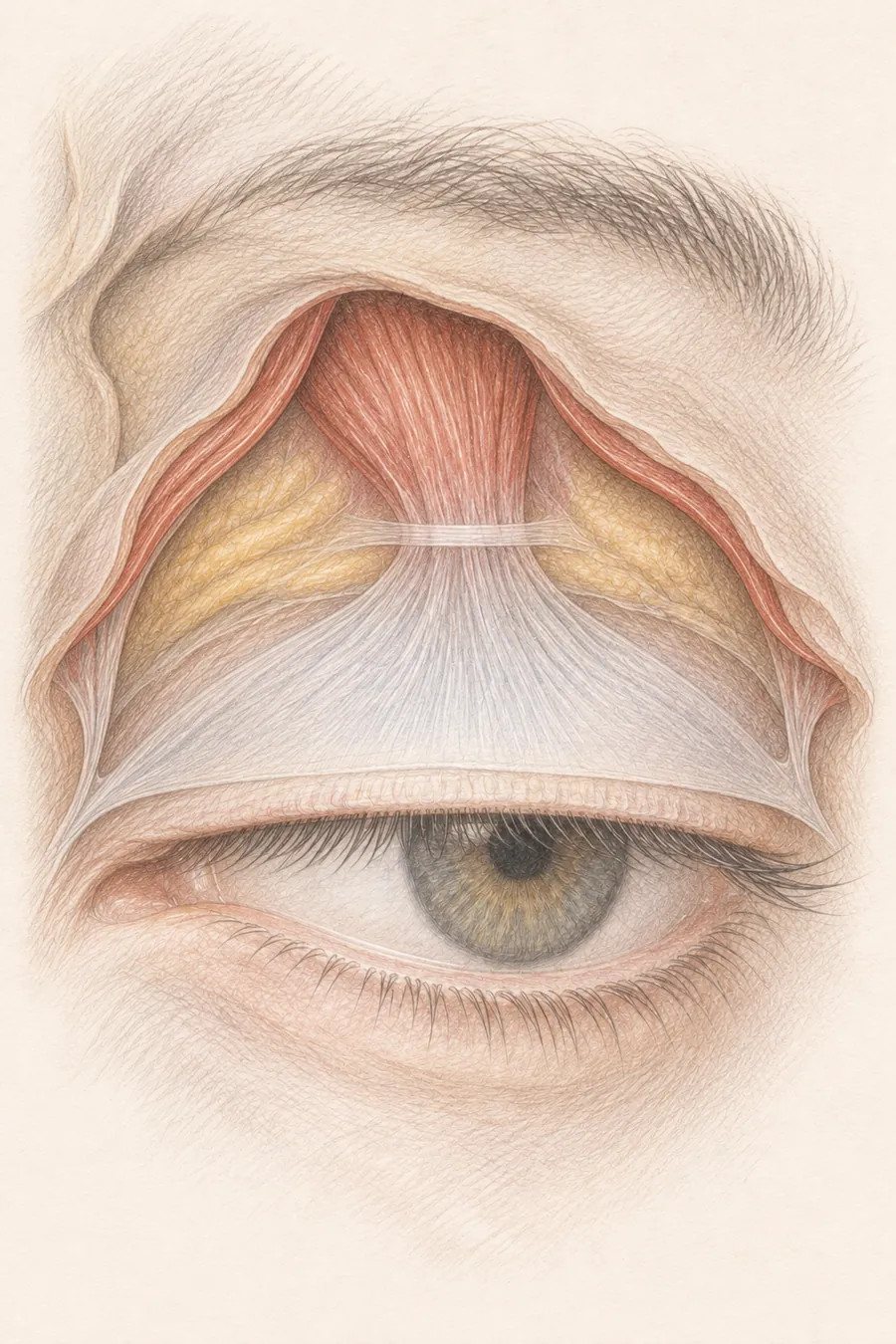
Ptosis repair corrects a drooping upper eyelid. Ptosis is a condition in which weakness in the eyelid lifting muscles and aponeurosis—a thin sheet connecting the end of the lifting muscle to the firm plate inside the eyelid—allows the upper eyelid to cover part of the eye. If the aponeurosis stretches or detaches, muscle force is not effectively transmitted to the eyelid. Ptosis repair restores this transmission of force, so unlike surgery that only creates a crease, it directly affects eyelid opening function and eyelid height.
This is why the same concern—“my eyes look small”—can lead to different procedures. If the eyes look small because they lack a crease, creating one can reduce shadowing. If the eyelid covers part of the eye, creating a new crease alone leaves that coverage in place. Neither surgery is inherently better; the answer depends on what is covering the eye.
In Simple Terms It is similar to looking at a window's curtain and frame separately. Double eyelid surgery defines the folds in the curtain, while ptosis repair adjusts a stiff connection in the window frame when the window itself does not rise fully. If the window is halfway down, neatly arranging the curtain folds does not change how much light enters the room. Conversely, if the window opens well and only the curtain is sagging, there is no reason to take apart the frame. During consultation, we therefore begin by measuring and determining whether the obstruction comes from the curtain or the window.
So which category do my eyes fall into?
02Which category do my eyes fall into?
Answer We first measure eye exposure to distinguish true ptosis from pseudoptosis.
Not all sleepy-looking eyes have ptosis. Some have true ptosis, in which the eyelid lifting muscles are actually weak. Others have pseudoptosis, in which muscle strength is normal but sagging eyelid skin covers part of the eye. True ptosis requires adjustment of muscle function through ptosis repair, while pseudoptosis may improve by removing excess skin or creating a crease alone.
At VITAL Plastic Surgery, we do not recommend ptosis repair based solely on a sleepy appearance. We measure MRD1, the distance from the light reflex at the center of the pupil to the upper eyelid margin. If it is within the normal range of approximately 4 mm, we do not perform ptosis surgery. In these cases, we consider pseudoptosis caused by skin covering the eye and first assess whether removing excess skin can address it. We take measurements to avoid unnecessary muscle surgery.
We follow the same assessment process when someone comes in because one eyelid crease looks larger. Often, the issue is not the crease itself: that eye opens less fully, causing the person to raise the eyebrow. The appearance that concerns them is therefore a result rather than the cause. Changing only the crease may allow the asymmetry to reappear, so we measure eye exposure first. Still, we do not simply prioritize ptosis repair. We first listen to what bothers the patient most, then explain the cause.
| Category | How it looks | What we look at first |
|---|---|---|
| True Ptosis | Weakness in the eyelid lifting muscles themselves causes the eyelid to cover part of the eye | MRD1, eyelid lifting muscle function, eyelid closure |
| Pseudoptosis | Muscle strength is normal, but sagging skin covers part of the eye | Excess skin and skin thickness, degree of eyelash coverage |
| Eyes with no crease or a shallow crease | Eye exposure is normal, but the absence of a crease creates a shadowed appearance | Skin thickness, hollowing, eyebrow position |
So why does eyelid lifting strength weaken?
03Why does eyelid lifting strength weaken?
Answer In addition to aging, repeated irritation from contact lenses and eye rubbing can contribute.
The eyelid lifting muscle inside the eyelid is like a thin rubber band: rubbing forcibly stretches it each time. Contact lens wear alone can also weaken eyelid lifting function. During surgery, damage to the inner tissues can be readily visible in people with a long history of eye rubbing. That is why VITAL Plastic Surgery also advises patients to avoid rubbing their eyes, reduce contact lens wear, and use artificial tears frequently after surgery.
Research has also examined the relationship between contact lenses and eyelid drooping. A study comparing photographs of 96 pairs of genetically identical twins, totaling 192 people, found that body mass, smoking, sun exposure, alcohol use, work-related stress, and sleep were not associated with eyelid drooping; only contact lens wear was associated. Average drooping measured 1.0 mm in nonwearers, 1.41 mm in soft contact lens wearers, and 1.84 mm in hard contact lens wearers1.
A systematic review of five studies on contact lenses also found a higher risk of eyelid drooping among hard contact lens wearers than nonwearers (7,426 participants; odds ratio, 17.38)2. However, these figures describe groups and do not mean that an individual's eyelids will droop by those amounts. During consultation, we use this information to help narrow down the cause by asking how long the patient has worn contact lenses and whether they rub their eyes, rather than focusing on the numbers.
We also often hear that rubbing your eyes can create a double eyelid crease. Instead, it may cause an existing crease to loosen and lead to ptosis that was not previously present. When your eyes itch, briefly closing them and using artificial tears instead of rubbing puts less strain on the eyelids.
So why might my eyes still look hooded after crease creation alone?
04Why might my eyes still look hooded after crease creation alone?
Answer Because weak eyelid lifting function remains behind the crease.
Creating a new crease alone may leave the cause of hollowing unaddressed. If eyelid lifting strength is weak, the crease may appear to loosen, and multiple folds may recur. This is why VITAL Plastic Surgery describes its approach to double eyelid surgery as focusing on structure beyond the crease. We set crease height according to the available skin, assess whether hollowing needs to be addressed, and evaluate eyelid opening function to determine whether correction is needed.
Some cases are difficult to recognize before surgery. In a study that closely examined eyelid and eyebrow positions in 2,530 people seeking upper eyelid surgery, 13.7% had ptosis they were unaware of. Most of these cases—85.5%—were mild, and ptosis was found much more often in people with uneven eyebrow positions3.
Some clinicians also consider a separate condition in which the forehead muscles engage when opening the eyes even though iris exposure is close to normal. A study of 192 eyes in 97 Asian patients defined these cases as eyes with an MRD1 of at least 3.5 mm and forehead muscle engagement, and included correction of eyelid-opening function in the surgical plan4. However, opinions differ on this criterion. When MRD1 is within the normal range, VITAL Plastic Surgery first considers addressing the skin without operating on the muscles, and evaluates forehead muscle use along with the measurements.
Study findings are only reference points for a consultation, not answers for your eyes. Photos alone are not enough to make a decision. An in-person examination is needed to assess eyelid movement and function, as well as compensatory eyebrow lifting.
- Creating only a new crease: The cause of hollowing remains, and weak eyelid-opening function may make the crease look less defined
- Considering the underlying structures together: Crease height is chosen based on the available skin, with hollowing and function addressed in the same plan
- Clues to previously unrecognized ptosis: Uneven eyebrow positions and forehead muscle engagement when opening the eyes3
- We do not finalize surgery based on a photo consultation alone
Why are the forehead and eyebrows evaluated together?
05Why are the forehead and eyebrows evaluated together?
Answer Because the forehead muscles compensate by lifting the eyelids when the eyes do not open easily.
When the eyes do not open easily, the forehead muscles help lift the eyelids. Over time, this habit can leave forehead wrinkles and raised eyebrows. That is why VITAL Plastic Surgery checks eyelid-opening function before treating deep forehead wrinkles. If the cause lies in the eyelids, lifting only the forehead may make things worse.
Conversely, after eyelid surgery, the eyebrows may move downward as the forehead muscles stop compensating. An analysis of 17 studies on upper eyelid surgery and eyebrow position found that eyebrow height decreased by an average of 1.45 mm after surgery. By procedure, the decrease was 0.67 mm after upper blepharoplasty alone, 2.52 mm after double eyelid surgery, and 2.10 mm after ptosis repair5. This downward movement of the eyebrows is less a sign of a problem than a result of the forehead relaxing after having worked to hold them up.
During a consultation, we therefore assess not only the eyes but also the current eyebrow positions and whether the forehead moves when the eyes open. If eyelid skin is the main cause, we consider upper blepharoplasty or a subbrow lift. If the forehead and eyebrows have also descended, we consider a forehead lift. Removing only skin without distinguishing the cause may leave a feeling of heaviness.
How do recovery and the extent of surgery differ?
06How do recovery and the physical burden differ?
Answer Ptosis repair involves more eyelid tissue, resulting in more swelling and bruising.
Ptosis repair involves more eyelid tissue than surgery that only creates a crease, so it causes more swelling and bruising. If ptosis is present, both eyelid-opening function and facial appearance may change, but dry eyes and incomplete eyelid closure may occur after surgery. Dryness may last 1–2 months, but usually improves with artificial tears. If symptoms persist, we reassess based on the course of recovery.
The recovery timeline is generally similar for both procedures. Swelling and bruising are at their worst 3–4 days after surgery. If an incision was made, stitches are removed after 5–7 days. Avoid eye makeup, eyelash extensions, and contact lenses for 2 weeks. Light daily activities can usually be resumed after 2–3 days, though swelling and bruising may remain.
From 3 weeks to 3 months, the tissue may feel firm and tight. This is part of the healing process, so a decision about revision surgery is not made based on appearance during this period alone. You can use a sauna after 1–2 weeks and resume strenuous exercise after 1 month. Between 3 months and 1 year, the tissue softens, redness fades, and the two sides gradually become more balanced. Follow-up visits are scheduled at 1, 3, and 6 months and at 1 year.
Both procedures use the same criteria for deciding how much skin to remove. We measure and remove the minimum amount that allows the eyes to close properly. Excessive removal can cause lagophthalmos, or incomplete eyelid closure, and dryness.
| Category | Double Eyelid Surgery | Ptosis repair |
|---|---|---|
| Areas addressed | The eyelid crease and excess skin and fat | The eyelid-lifting muscles and aponeurosis, and eyelid height |
| When it may be appropriate | Iris exposure is normal, and the main concerns are the crease and skin | The eyelid covers the iris, restricting the field of vision and engaging the forehead muscles |
| Recovery burden | Relatively less tissue is involved | More tissue is involved, which may cause more swelling and bruising |
When is surgery not recommended right away?
07When is surgery not performed right away?
Answer We do not recommend surgery as the first step when MRD1 is normal or when a medical history needs to be reviewed first.
We do not recommend proceeding right away when MRD1 is within the normal range and addressing the skin is sufficient; when a history of thyroid eye disease, glaucoma, or an autoimmune disease needs to be reviewed first; when a patient takes anticoagulants or has uncontrolled high blood pressure or diabetes; or when an adequate examination and explanation are difficult to complete. The same applies when inflammation, such as eyelid eczema or a stye, needs treatment first.
We also wait when symptoms require an ophthalmologic evaluation first, when the ocular surface needs to be stabilized because of conditions such as severe dry eye, when tissues are still healing from previous surgery, or when the expected changes exceed what is medically possible. Problems with vision itself require a separate ophthalmologic evaluation.
For those concerned about changes in their appearance, we explain two points. Eyelid-opening function can be corrected while keeping the double eyelid crease low and mostly hidden, and if the eyelid covers the iris, there is a reason for correction even if swelling lasts longer than expected during recovery. We view the double eyelid crease as a structure that protects the eye, with improved appearance as an additional change.
Observation is an option when there is no functional problem, discomfort is minor, and the condition is stable. VITAL Plastic Surgery does not recommend rushing into surgery before you get older. However, if the eyelid covers the iris and affects the field of vision, or if pain and functional problems persist, we evaluate without delay.
- When MRD1 is within the normal range and removing excess skin is sufficient
- When a history of thyroid eye disease, glaucoma, or an autoimmune disease needs to be reviewed first
- When ocular surface conditions, such as severe dry eye, need to be managed first
- When tissue is still recovering from previous surgery
- When the changes you expect are beyond what is medically possible
08Three things we check first during your consultation
What we assess first during consultation
- Eyelid position and movement
- Whether the brow muscles are compensating
- Excess skin and eyelid closure
These are general care principles. The actual decision is made after an examination.
When other care is needed first We do not recommend ptosis repair right away when MRD1 is within the normal range and addressing the skin is sufficient; when a history of thyroid eye disease, glaucoma, or an autoimmune disease needs to be reviewed first; when the ocular surface needs to be stabilized because of conditions such as severe dry eye; or when tissues are still healing from previous surgery. Inflammation such as eyelid eczema or a stye also needs to be treated first.
The answer to the original question, “Will creating a double eyelid crease alone make my eyes look bigger?” is this: If the eyelid does not cover the iris, creating a crease alone may reduce shadowing. But if weak eyelid-opening function causes the eyelid to cover the iris, creating a new crease will leave that coverage in place. We distinguish between these situations by measuring iris exposure, not by judging appearance. VITAL Plastic Surgery takes that step before discussing crease height and shape.
— VITAL Plastic Surgery
When booking, simply leave a note saying, “Please assess my eyelid-opening function first,” and we will start there during your consultation. Having a consultation does not mean you need to decide that day.
Related ReadingPtosis repair consultation information
READ NEXT
Read Next
FAQ
Frequently Asked Questions
Does everyone with sleepy-looking eyes have ptosis?
No. We distinguish true ptosis, in which the eyelid lifting muscles are actually weak, from pseudoptosis, in which muscle strength is normal but sagging skin covers part of the eye. Because treatment differs, we measure how much of the eye is exposed to tell them apart.
Can double eyelid surgery and ptosis repair be performed together?
We evaluate excess skin, eyelid lifting strength, and hollowing together and address them within the same surgical plan if needed. However, we explain beforehand that working on more tissue may cause additional swelling and bruising.
Will ptosis repair change my appearance significantly?
Eyelid lifting function can be corrected while keeping the crease low and mostly hidden. Creating a larger crease is not the only goal of correction. We consider function, skin condition, and your desired appearance together.
Can you diagnose ptosis from photos alone?
Photos serve only as a reference. An in-person examination is needed to assess eyelid movement and function, brow compensation, and other factors.
I've heard that the eyebrows can drop after surgery.
Studies also report that eyebrow position may move downward as the forehead muscles stop compensating to lift the eyelids5. This is more a result of reduced compensation than a sign of a problem, and the extent varies from person to person.
Do I need surgery now, or can it wait?
Observation may be appropriate if there is no functional problem, discomfort is mild, and the changes are stable. If the eyelid obstructs vision or functional problems persist, we evaluate without delay.
BEFORE CONSULTATION
What to Prepare Before Your Consultation
- Your main concernWrite down whether your main concern is the crease shape or the heaviness of eyes that do not open fully.
- Contact lens use and eye habitsTell us how long you have worn contact lenses, whether you rub your eyes, and whether you have used double eyelid tape or glue.
- Previous eye surgery historyIf you have had double eyelid surgery or ptosis repair, share what you know about when it was performed and the technique used.
- Health conditions and medicationsTell us whether you have thyroid eye disease, glaucoma, severe dry eye, or an autoimmune disease, or take anticoagulants.
- Past photosA front-facing photo from a few years ago can help us assess when your eyelid-opening function began to change.
REFERENCES
References
- Satariano N, Brown MS, Zwiebel S, Guyuron B. Environmental factors that contribute to upper eyelid ptosis: a study of identical twins. Aesthetic Surgery Journal. 2015. doi:10.1093/asj/sju070 (View abstract)
- Hwang K, Kim JH. The risk of blepharoptosis in contact lens wearers. Journal of Craniofacial Surgery. 2015. doi:10.1097/SCS.0000000000001876 (View abstract)
- Eshraghi B, Pourazizi M, Taghian A, et al. The prevalence of undiagnosed ptosis among candidates for upper eyelid blepharoplasty. Aesthetic Surgery Journal Open Forum. 2023. doi:10.1093/asjof/ojad079 (View abstract)
- Wong CH, Hsieh MKH, Mendelson B. Subclinical upper eyelid ptosis in Asian patients: the role of levator advancement in optimizing outcomes in cosmetic upper blepharoplasty. Aesthetic Plastic Surgery. 2024. doi:10.1007/s00266-023-03697-1 (View abstract)
- Liu R, Sun Y, Huang J, Long X. Brow position change and its potential risk factors following upper blepharoplasty: a systematic review and meta-analysis. Aesthetic Plastic Surgery. 2023. doi:10.1007/s00266-023-03288-0 (View abstract)
The findings in these papers reflect the participants and conditions of each study and do not mean that every individual will have the same results.
This article provides general medical information and does not replace diagnosis or treatment. Surgical results and recovery vary by individual, and complications such as bleeding, infection, scarring, and asymmetry may occur.
More articlesVITAL Plastic Surgery Medical Articles
RESERVATION
You do not need to decide the day of your consultation.
Organize questions about this page without entering your name, contact information, or medical history. This does not submit an appointment request.