PLASTIC SURGERY
MEDICAL COLUMN
Questions Answered Directly by the Doctor Before You Decide on Surgery
Eyes
Articles
Subbrow lift scars: How visible will the line below the eyebrow be?
A subbrow lift scar does not disappear; the incision is planned to follow the lower border of the eyebrow. It may initially be red and firm, then gradually fade as the tissue settles.
Medically reviewed by Dr. Hyungwoo Yim, Medical Director (Board-Certified Plastic Surgeon) · Published November 8, 2026 · Last reviewed November 11, 2026
SHORT ANSWER
First, the Short Answer
- A subbrow lift scar does not disappear; the incision is planned to follow the lower border of the eyebrow. It may initially be red and firm, then gradually fade as the tissue settles.
- Redness and firmness may change over several months or longer. We therefore assess the scar at each stage rather than judging it by how it looks just a few weeks after surgery.
- At VITAL Plastic Surgery, an incision is made below the eyebrow, and the orbicularis oculi and muscle layer are lifted toward the frontalis muscle and secured. Instead of simply pulling and suturing the skin, this approach places the load on the muscle layer to reduce tension on the incision. We first assess skin thickness, eyebrow position, and the strength of the muscles that open the eyes to determine whether this approach is suitable.
“Will an incision below my eyebrow leave a noticeable scar?”
This is a paraphrase of a question we often hear during consultations.
To answer this question, we first need to distinguish where your current concern comes from. We will explain each point below, then return to the original question at the end.
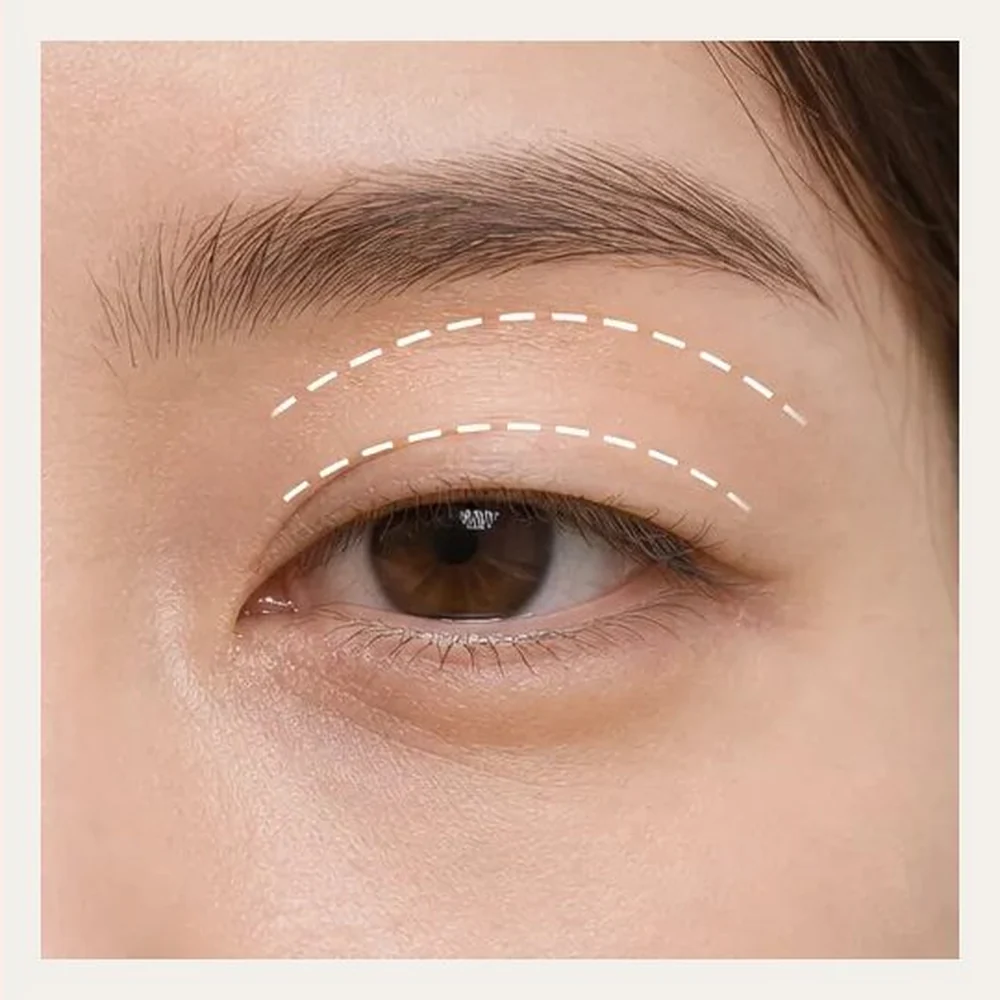
01Where is the scar after a subbrow lift?
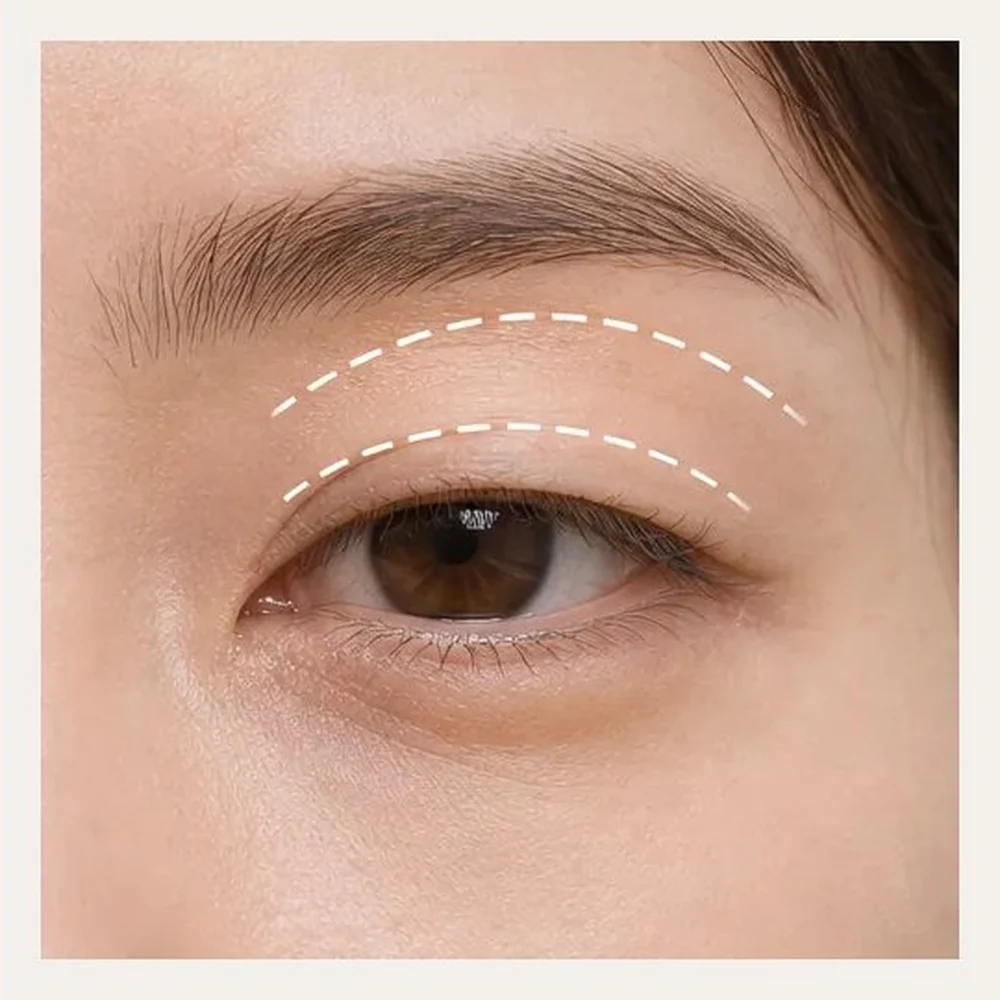
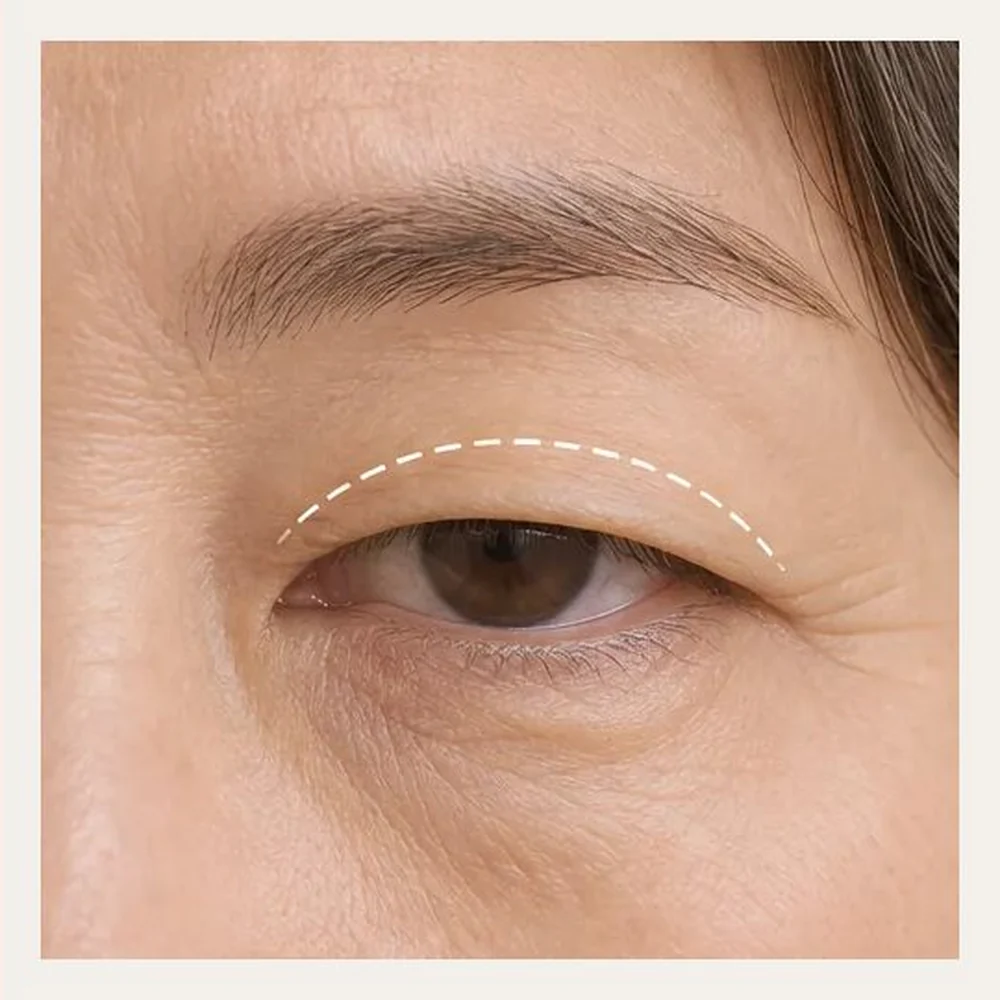
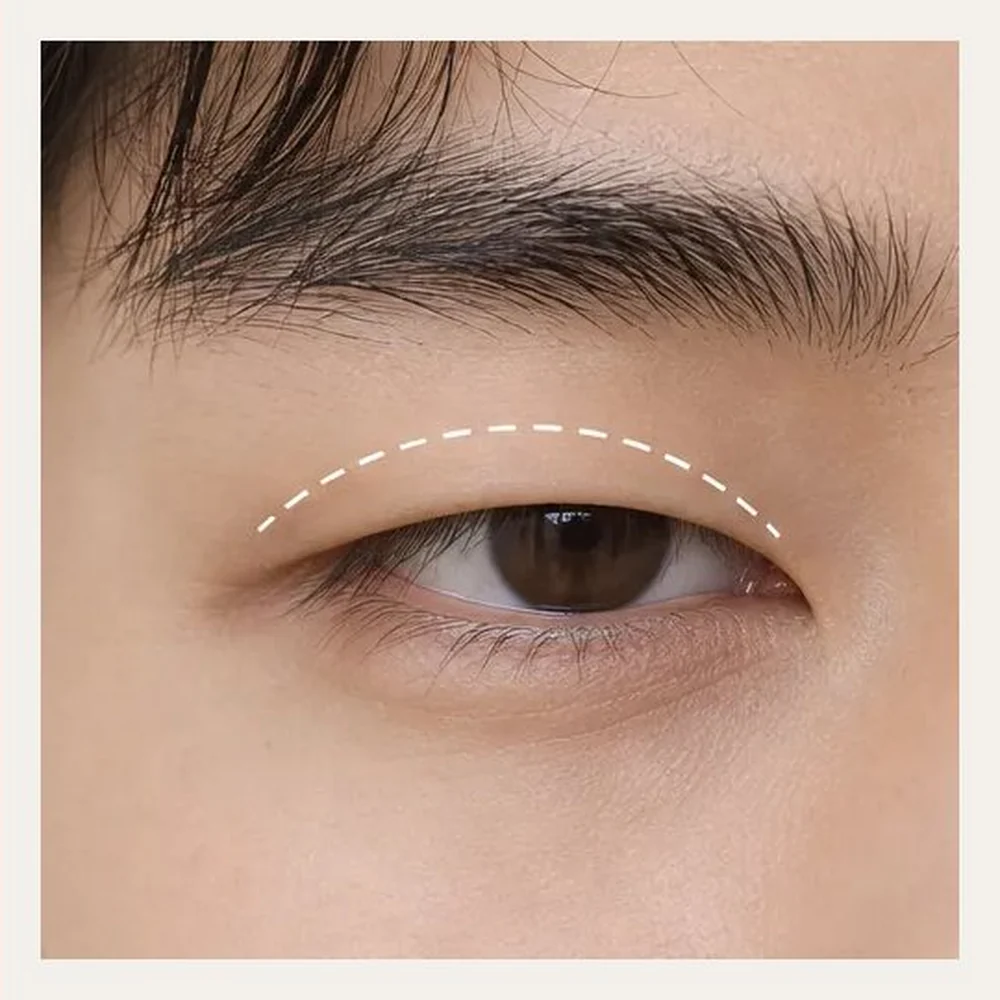
Answer The scar follows the border directly below the eyebrow. Instead of creating a new upper eyelid crease, this approach places the scar near the eyebrow.
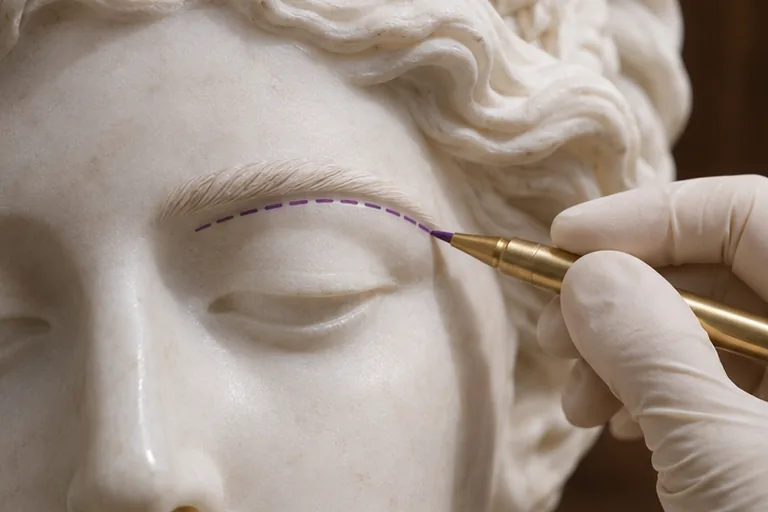
Incisions used to address upper eyelid drooping are generally placed either in the upper eyelid crease or directly below the eyebrow. A subbrow lift uses an incision directly below the eyebrow to lift sagging skin and the muscle layer, without needing to create a new upper eyelid crease. This is why it may be considered for people who do not want a major change in the appearance of their eyes.
The tradeoff is that a scar remains along the eyebrow border. At VITAL Plastic Surgery, the skin edges are matched in thickness and closed in layers so the incision lies along that border. The goal is for the scar to be less noticeable along the border, rather than to disappear.
If the forehead and eyebrows themselves have descended significantly, we compare a forehead lift. This surgery lifts the forehead and eyebrows through incisions within the hair or along the hairline, without making an incision directly in the eyelids. An incision within the hair conceals the scar but may slightly lengthen the forehead. An incision along the hairline can help maintain forehead length, but scar care becomes more important.
A subbrow lift is also considered when the skin and tissue below the eyebrows are thick, as is often the case in men. Heaviness may remain even after skin is removed through an incision in the upper eyelid crease. The choice still involves weighing the scar along the eyebrow border against the ability to avoid creating an upper eyelid crease. Scar location is one of the criteria for choosing a procedure, rather than something to consider afterward.
| Method | Scar location | What we look at first |
|---|---|---|
| Upper blepharoplasty through an eyelid crease incision | Within the upper eyelid crease | Available skin, desired eyelid crease shape, eyelid closure |
| Subbrow Lift | Along the border directly below the eyebrow | Skin thickness, preference to avoid an eyelid crease, eyebrow position |
| Forehead Lift | Within the hair or along the hairline | Degree of brow descent, forehead length, hair density |
In Simple Terms A subbrow lift is similar to rehanging a heavy curtain. If you shorten the fabric and pin only the fabric to the upper rail, its weight concentrates at the pins, causing the fabric to tear or sag again. To keep the curtain hanging straight over time, the rail and hooks need to bear the weight. In a subbrow lift, the frontalis muscle and muscle layer serve as that rail and those hooks. The principle behind reducing scarring is to leave the skin closure as a seam that bears less weight.
So what matters during surgery to make the scar less visible?
02What matters during surgery to make the scar less visible?
Answer It is important to secure the muscle layer first, rather than simply pulling the skin, to reduce tension on the incision.
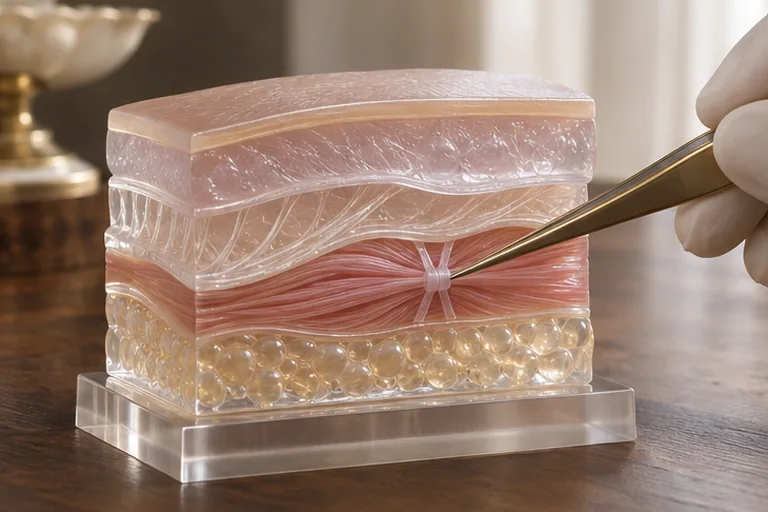
If only the skin is pulled and sutured, the weight of the sagging tissue is placed directly on the suture line. This can increase both the downward pull on the eyebrows and tension on the incision. At VITAL Plastic Surgery, we therefore lift the orbicularis oculi, the muscle surrounding the eyes that pulls the eyebrows downward, toward the frontalis, the forehead muscle that raises the eyebrows, and secure it. With the muscle layer bearing the load, the skin edges can be brought together and sutured without tension.
The surgery proceeds in five steps. First, we assess eyebrow position, upper eyelid skin drooping, and the strength of the muscles that open the eyes to determine the incision area. We then make an incision along the lower eyebrow border to expose the muscle layer, lift the orbicularis oculi and secure it toward the frontalis muscle, and match the skin edges in thickness before closing them in layers so the incision lies along the eyebrow border.
The amount of skin removed affects both scarring and function. Eyelid skin is thin and covers the eyes to protect them, so removing more does not necessarily improve the result. Excessive removal can cause lagophthalmos, or incomplete eyelid closure, and dryness. We take measurements with the eyes closed and open to determine the width of skin to remove.
- Incision area: Determined by assessing eyebrow position, skin drooping, and the strength of the muscles that open the eyes.
- Fixation: The orbicularis oculi and muscle layer are lifted toward the frontalis muscle and secured.
- Closure: Skin edges are matched in thickness and sutured in layers to place the incision along the eyebrow border.
- Amount removed: Only as much as needed is removed while preserving proper eyelid closure.
So how does the scar change over time?
03How does the scar change over time?
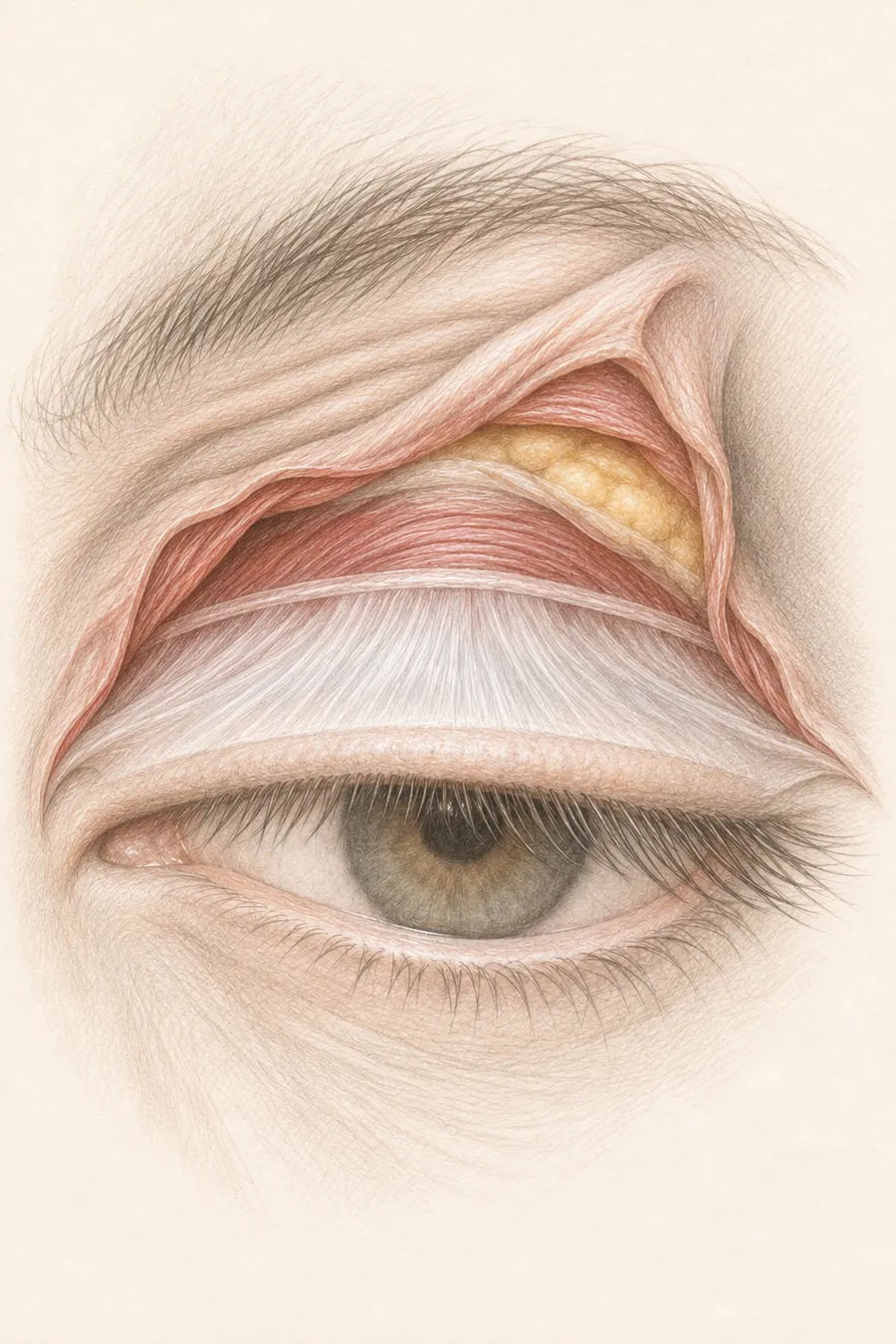
Answer The scar is red and firm during the first few weeks, with tightness most pronounced between 3 weeks and 3 months. It then softens over several months to a year.
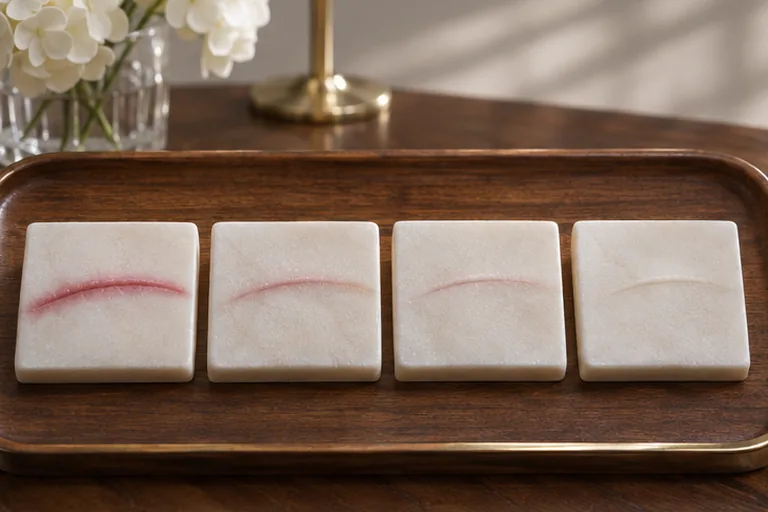
Swelling and bruising peak 3–4 days after surgery, and sutures are removed after 5–7 days. Between 3 weeks and 3 months, tissue thickens and tightens, so the scar may look firmer and more prominent. This is a response during healing, so we do not judge the scar as abnormal based on its appearance at this stage alone.
Between 3 months and 1 year, the tissue softens, redness decreases, and the two sides become more symmetrical. VITAL Plastic Surgery schedules follow-up visits at 1 week, 1 month, 3 months, 6 months, and 1 year. Around 1 month, we assess tightness and firmness. Around 3 months, we consider the scar to be entering a transitional stage and decide whether to continue care. At 6 months, we compare the results with early photographs to determine whether additional treatment is needed.
| Timing | Changes in the scar and eyelids | What to Keep in Mind |
|---|---|---|
| 3–4 days after surgery | Swelling and bruising are at their worst | Sleep with your head slightly elevated and gently apply cold compresses |
| Days 5–7 | Suture Removal | Eye makeup · contact lenses after 2 weeks |
| 3 weeks–3 months | The scar feels firm and tight | At this point, appearance alone is not enough to judge. Saunas after 1–2 weeks; strenuous exercise after 1 month. |
| 3 months–1 year | The scar softens and redness decreases | Follow-ups at 1, 3, and 6 months and 1 year |
So what does scar care involve?
04What does scar care involve?
Answer We do not use the same care at the same time for every scar. Care is determined by the stage of redness and firmness.
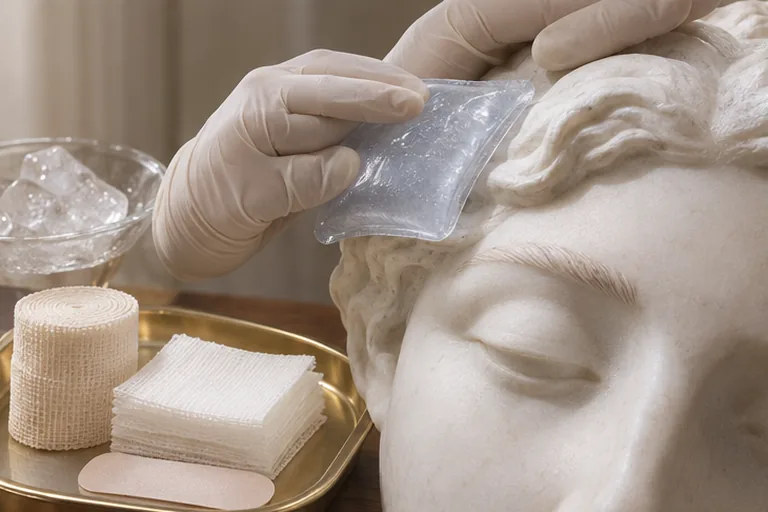
Scar care is an ongoing process. VITAL Plastic Surgery advises consistent scar care for at least 6 months and considers sunscreen the most important part of care after procedures or surgery. Around 1 month, we assess tightness and firmness and begin treatments to support tissue repair if needed. Around 3 months, we review whether to continue injections and laser treatments.
Research findings are mixed on whether commonly used silicone gel also helps eyelid scars. In a double-blind study conducted at multiple U.S. institutions, 96 people (192 eyelids) who underwent surgery on both upper eyelids or ptosis surgery applied silicone gel to one side and petrolatum ointment to the other. No significant differences were found in any measure from 1 week through 6 months3. A study using the same comparison in 12 people (24 scars) who underwent a direct brow lift with incisions above the eyebrows also found no difference4.
Both studies reported that scars generally improved over time.34. This suggests that, for the thin skin around the eyes, the basics are follow-up checks at appropriate stages, sun protection, and habits that avoid irritating the wound, rather than the effects of any particular ointment. The skin below the eyebrows tends to be thicker than eyelid skin, so these results cannot be applied directly.
For an existing scar, the stage of healing and tissue condition are assessed to decide whether scar care or surgical revision is appropriate. Redness and firmness can last several months or longer, and the same laser is not used at the same time for every scar. Injections and laser treatments are generally considered starting one month after surgery. Once started, treatment needs to continue consistently for at least six months before changes can be assessed.
What do studies report about subbrow lift scars?
05What do studies report about subbrow lift scars?
Answer Small studies report that noticeable scars are uncommon, but their limited populations and follow-up periods mean they cannot predict an individual's results.

A study in Turkey followed 33 patients ages 47–71 for six months after skin below the eyebrows was removed to address mild to moderate brow drooping and hooding of the outer eyelids. Early complications were mainly temporary redness and swelling, and noticeable scars were uncommon at six months1. No reduced sensation, lagophthalmos (incomplete eye closure), or pronounced lowering of the eyebrows was reported1.
A study in China enrolled 64 patients who underwent a subbrow lift. Of these, 49 completed six-month follow-up (a follow-up rate of 76.56%), and no postoperative complications were reported2. However, these were records from a single institution where one surgeon performed the procedures. With a substantial number of patients lost to follow-up, the results are difficult to generalize broadly.
Research shows the potential of the procedure itself; it does not promise how your scar will look. Results vary from person to person depending on skin thickness, a tendency to develop scars, tension at the incision, and postoperative care.
When might a subbrow lift be unsuitable?
06When might a subbrow lift be unsuitable?
Answer Other options are compared if the eyelid-lifting muscles are weak, the forehead and eyebrows have drooped significantly, or skin thickness makes this approach unsuitable.

If removing excess skin still does not expose enough of the iris, the eyes may continue to look hooded. Before surgery, MRD1 (the distance from the center of the pupil to the upper eyelid margin) is measured to distinguish excess skin coverage from weak eyelid-lifting muscles. If these muscles are weak, a subbrow lift alone may be insufficient, and ptosis repair may be planned as well.
The position of the eyebrows is also checked. During the examination, the eyebrows are lifted to their normal position and the eyelids are reassessed. In some cases, excess skin remains; in others, lifting the eyebrows alone makes the eyes look more open. In the latter case, a forehead lift may be considered first. Some people with deep forehead wrinkles use their forehead muscles to lift their eyelids because their eyelid-lifting muscles are weak. In these cases, correcting the eyelids first is considered.
If you also want a defined double eyelid crease, an incision along the eyelid crease may be more appropriate. If you want to preserve your current eye appearance while removing only sagging skin, a subbrow lift is considered first. The choice also depends on where you would prefer the scar to be.
Thick eyelids also require assessment. If the orbicularis oculi muscle and fat beneath the skin are thick, removing skin alone may leave a heavy appearance, so both the skin and muscle are adjusted. However, focusing too much on thinning the tissues can make the upper eyelids look hollow, so the tissues to preserve are identified first. When hollowness and sagging occur together, as they may in people in their 50s and older, removing skin alone can make the hollowness more apparent. Fat repositioning or fat grafting may also be considered.
What is assessed during the consultation?
07What is assessed during the consultation?
Answer The consultation assesses where the sagging comes from, how much skin needs to be removed, and how this approach compares with procedures involving the forehead and eyebrows.
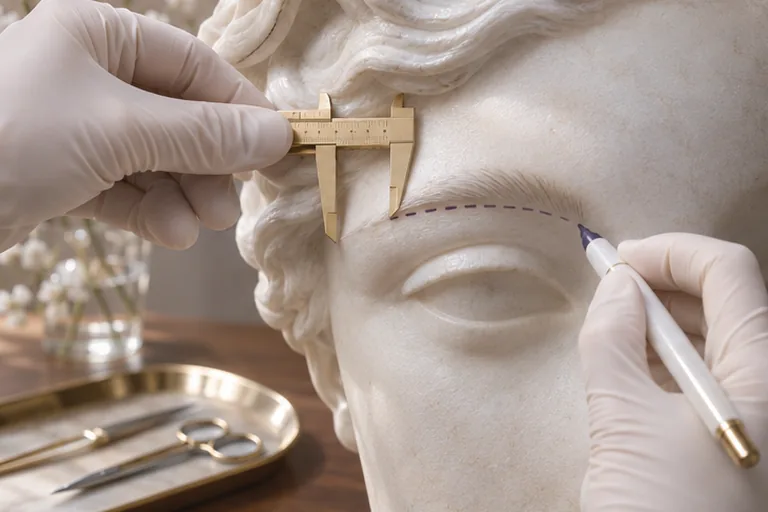
Sagging eyelid skin and drooping eyebrows require different operations. Removing skin without identifying the cause can leave the eyes looking hooded or narrow the distance between the eyebrows and eyes, changing your appearance. During the consultation, we first listen to what bothers you most and which aspects of your appearance you want to preserve. We then compare scar locations and recovery timelines.
Photos serve as a reference; the procedure is not finalized through a photo consultation alone. Eyelid opening and closing, compensatory eyebrow movement, and skin condition need to be assessed in person. You will have time to understand the explanation and ask questions, and you do not need to make a decision on the day of your consultation. Treatment may not be recommended right away if its burden is greater or if you cannot allow enough recovery time.
Surgery is not recommended right away in the following situations. We will discuss what to do while waiting and when to reassess.
- When eyelid closure or dryness needs to be assessed first
- When significant forehead and eyebrow descent requires assessing the forehead first
- When it is difficult to allow enough time for recovery
- When health issues such as blood pressure or blood sugar need to be controlled first
08Three things we check first during your consultation
What we assess first during consultation
- Sagging skin or ptosis
- Extent of skin correction needed
- Comparison with forehead and eyebrow approaches
These are general care principles. The actual decision is made after an examination.
When other care is needed first If you also have ptosis caused by weak eyelid-lifting muscles, ptosis repair may be considered first. If the forehead and eyebrows have drooped significantly, a forehead lift may be considered first. If you have severe dryness or difficulty closing your eyes, the condition of the eye surface is assessed first. If your blood pressure or blood sugar needs to be controlled, that takes priority. We do not describe this as a scar-free procedure.
The answer to the original question, “If an incision is made below my eyebrows, won't the scar be noticeable?” is this: a scar will remain, but the key is to plan the incision along the lower border of the eyebrow and secure the muscle layer first to reduce tension on the suture line. The scar may be red and firm for the first few months, so it is checked and managed at each stage. However, this procedure may not be suitable depending on eyelid-lifting strength and eyebrow position, so the cause needs to be identified first.
— VITAL Plastic Surgery
When booking, simply leave a note saying, “Please assess whether a subbrow lift is right for me, starting with the scar location.” We will begin the consultation there. You do not need to make a decision on the day of your consultation.
Related ReadingUpper Blepharoplasty Care Guide
READ NEXT
Read Next
FAQ
Frequently Asked Questions
Will the scar disappear completely?
No. The incision is planned to follow the lower border of the eyebrow. Redness and firmness change over several months or longer as the scar gradually fades.
My scar looks firmer at 3 weeks.
This is common between 3 weeks and 3 months, when tissue thickens and tightens. We assess it during follow-up visits rather than judging it by its appearance at this stage alone.
Can drooping skin be removed without creating an eyelid crease?
In many cases, yes. A subbrow lift does not create a new upper eyelid crease. If the muscles that open your eyes are weak or your skin thickness is not suitable, we also compare other options.
Does removing more skin make the scar less visible and the eyes look more open?
No. Removing more skin does not mean a better result, and excessive removal can cause incomplete eyelid closure or dryness. We measure eyelid closure and the available skin to determine how much needs to be removed.
Can older adults have this surgery?
We assess your current condition rather than your age alone. For people in their 60s and older, we examine the eye surface, eyelid support, and overall health more closely.
BEFORE CONSULTATION
What to Prepare Before Your Consultation
- Everyday PhotosPlease bring a front-facing photo with your eyes comfortably open and your eyebrows relaxed, along with a photo from a few years ago if available.
- Your Desired Eye AppearanceConsider whether you want a double eyelid crease or prefer to preserve your current eye appearance.
- Scarring HistoryPlease let us know if scars from other surgeries have ever become thick and raised.
- Previous Procedure HistoryPlease tell us about any previous eye surgery and any injections or fillers you have received in your forehead or around your eyes.
- Medications and HealthPlease provide complete information about your blood pressure, blood sugar, and all medications and supplements you take.
REFERENCES
References
- Yazıcıoğlu T, Ağaçkesen A, Boğazlıyan ÖF. Subbrow blepharoplasty for mild and moderate brow ptosis in Caucasians. International Ophthalmology. 2025. doi:10.1007/s10792-025-03858-y (View abstract)
- Wang T, Li Y, Pang M. Evaluation of morphological and psychological outcomes after sub-brow blepharoplasty. Frontiers in Surgery. 2025. doi:10.3389/fsurg.2025.1658806 (View abstract)
- Karanfilian TS, Thuma T, Cheng T, et al. Efficacy of Silicone Gel Versus Placebo for Postsurgical Scars of the Eyelids: A Randomized, Controlled, Double-Blinded Study. Ophthalmic Plastic and Reconstructive Surgery. 2025. doi:10.1097/IOP.0000000000002913 (View abstract)
- Cadet N, Hardy I, Dudek D, et al. Prospective case-control trial evaluating silicone gel for the treatment of direct brow lift scars. Canadian Journal of Ophthalmology. 2018. doi:10.1016/j.jcjo.2017.07.017 (View abstract)
The findings in these papers reflect the participants and conditions of each study and do not mean that every individual will have the same results.
This article provides general medical information and does not replace diagnosis or treatment. Surgical results and recovery vary by individual, and complications such as bleeding, infection, scarring, and asymmetry may occur.
More articlesVITAL Plastic Surgery Medical Articles
RESERVATION
You do not need to decide the day of your consultation.
Organize questions about this page without entering your name, contact information, or medical history. This does not submit an appointment request.