PLASTIC SURGERY
MEDICAL COLUMN
Questions Answered Directly by the Doctor Before You Decide on Surgery
Facelift
Articles
Neck Lift vs. Double Chin Liposuction: What Determines the Difference?
It depends on whether your jawline looks less defined because of accumulated fat or because of loose skin and separated platysma muscles (the thin muscles covering the front of the neck).
Medically reviewed by Dr. Hyungwoo Yim, Chief Surgeon (Board-Certified Plastic Surgeon) · Published 2026.11.20 · Last reviewed 2026.11.20
SHORT ANSWER
First, the Short Answer
- It depends on whether your jawline looks less defined because of accumulated fat or because of loose skin and separated platysma muscles (the thin muscles covering the front of the neck).
- If excess fat is the main concern, we consider double chin liposuction. If skin and muscle need to be lifted and repositioned, we consider a neck lift.
- At VITAL Plastic Surgery, we assess excess neck skin, the condition of the platysma, fat under the chin, and bone structure separately before determining which procedure is appropriate.
“My jawline has become less defined, but I don't know whether I need fat removed or a lift.”
This is a paraphrase of a question we often hear during consultations.
To answer this question, we first need to distinguish where your current concern comes from. We will explain each point below, then return to the original question at the end.
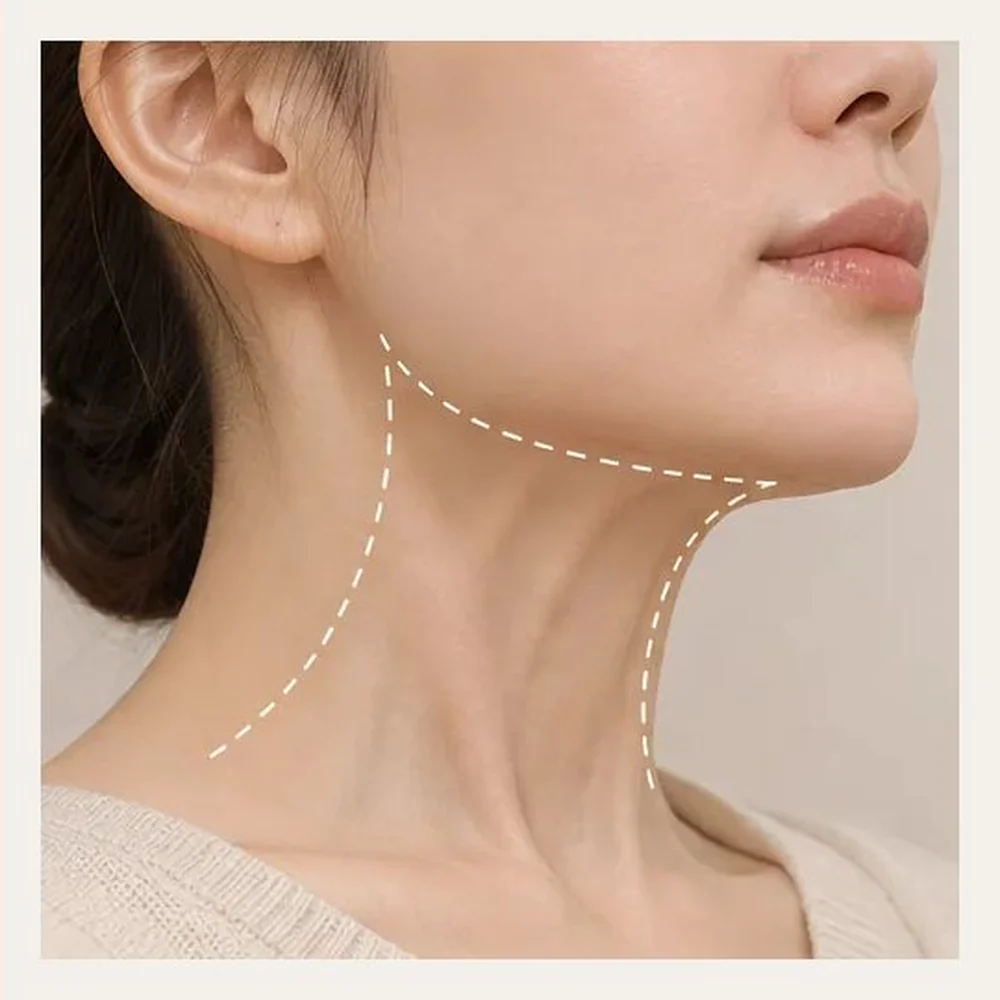
01What ultimately determines which procedure is right?
Answer It depends on whether there is something left to remove or something left to lift and reposition.
Double chin liposuction reduces the amount of fat beneath the chin. A neck lift addresses sagging neck skin and separated platysma muscles to restore definition between the jawline and the neck. VITAL Plastic Surgery sees these as procedures suited to different concerns, rather than classifying one as a major surgery and the other as a minor one.
That is why the consultation starts with the cause, not the name of a procedure. We look separately at whether the fullness beneath the chin comes from fat, separated muscles, excess skin, or the size and position of the salivary glands beneath the jaw or the jawbone. Since there is often more than one cause, the first step is to determine which contributes most.
Without looking at each cause separately, treatment may miss the mark. If fat is the main cause but only the skin is tightened, or if the skin is loose but only fat is removed, the neck contour may not be sufficiently defined. This is how muscle bands can remain after fat removal, or the skin can appear looser.
This is also why it is hard to describe every indistinct jawline with one term. People may use the same phrase, double chin, but someone concerned about fullness they can pinch is describing a different issue from someone concerned about bands that appear when they lift their head. That is why, during a consultation, we ask what bothers you most when you look in the mirror now, rather than relying on photographs. The moment when it bothers you most can offer a clue to the cause.
In Simple Terms It is similar to a full drawer. If a drawer will not close because it contains too much, removing some of its contents may help. But if the drawer frame itself is out of alignment, removing contents will not make the lines match. Beneath the chin, the fat is what can be removed, while the misaligned frame represents loose skin and separated platysma muscles. During the consultation, we first assess whether something needs to be removed or the frame needs to be realigned.
So what can you learn by pinching beneath your chin?
02What can you learn by pinching the area under your chin?
Answer It helps distinguish fat you can pinch from deeper fullness you cannot grasp.
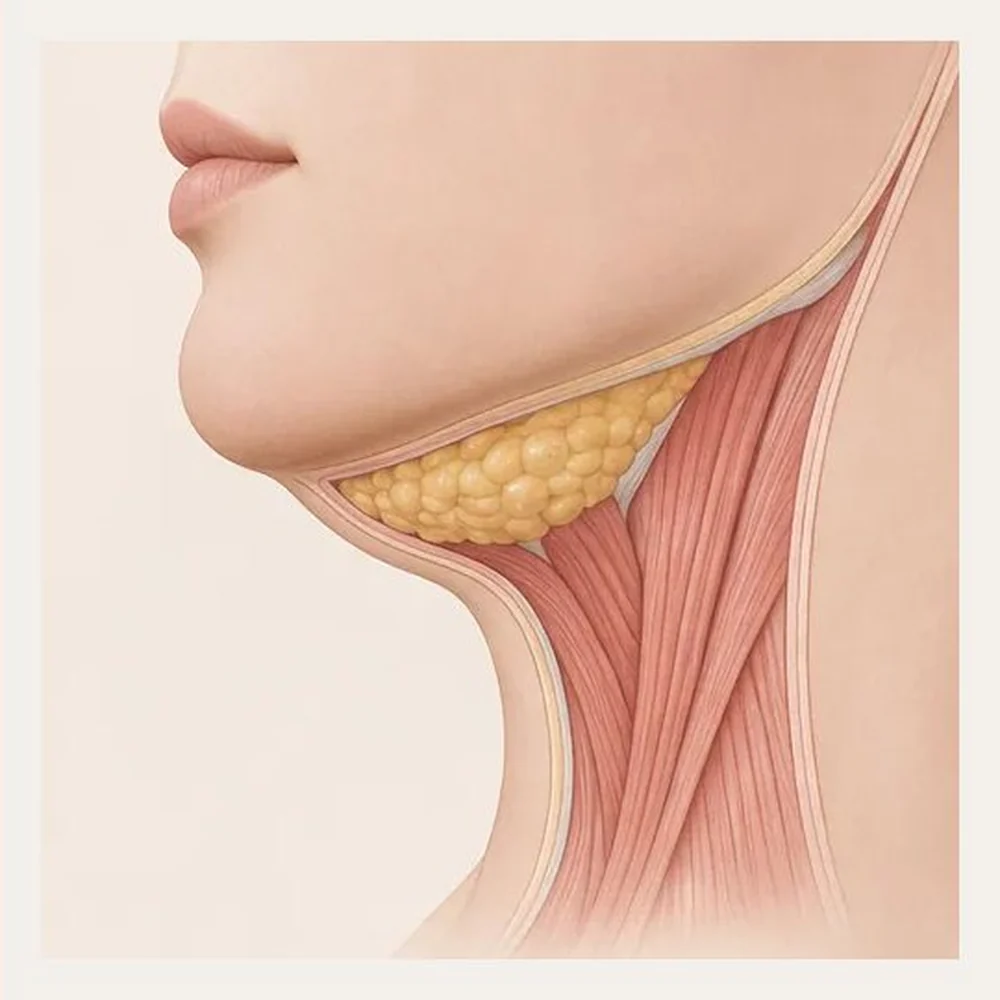
The fat beneath the chin is not confined to a single layer. There is fat directly beneath the skin and fat beneath the platysma muscle, and the approach differs depending on the layer. If enough fat can be pinched and the skin retains its elasticity, we first consider double chin liposuction.
The amount of fat and the layer in which it is located vary from person to person. In a study measuring 26 cadavers, tissue removed from the layer beneath the skin accounted for 56.6% of the total weight in women, while tissue from beneath the platysma accounted for 43.4%. In men, the opposite was true: 60.7% came from beneath the platysma2. This does not mean the layer can be determined by sex, but it does mean that people who look similar may need treatment in different layers.
During the consultation, we therefore examine the neck both while you are sitting and with your head raised, and mark the areas where fat can be pinched. If the area under your chin bulges but cannot be pinched, deeper structures should also be evaluated.
We also examine the shape of the jawbone. If the chin is recessed or the space beneath the jaw is narrow, the boundary between the jawline and neck may appear less defined even when there is not much fat. In these cases, there is a limit to how much fat can be reduced, so we first discuss the changes that may be achieved and what the area may look like afterward. The guiding factor is the individual's space beneath the jaw, rather than the amount that can be removed from under the chin.
| Category | How it looks | What we look at first |
|---|---|---|
| Fat just beneath the skin | A thick layer can be pinched | Skin elasticity and the area that can be pinched |
| Structures beneath the platysma | The area under the chin bulges but cannot be pinched | Deep fat · salivary glands · jawbone |
| Skin and muscle | Vertical bands and sagging appear when the head is raised | Excess neck skin and the condition of the platysma |
What if vertical bands appear when I raise my head?
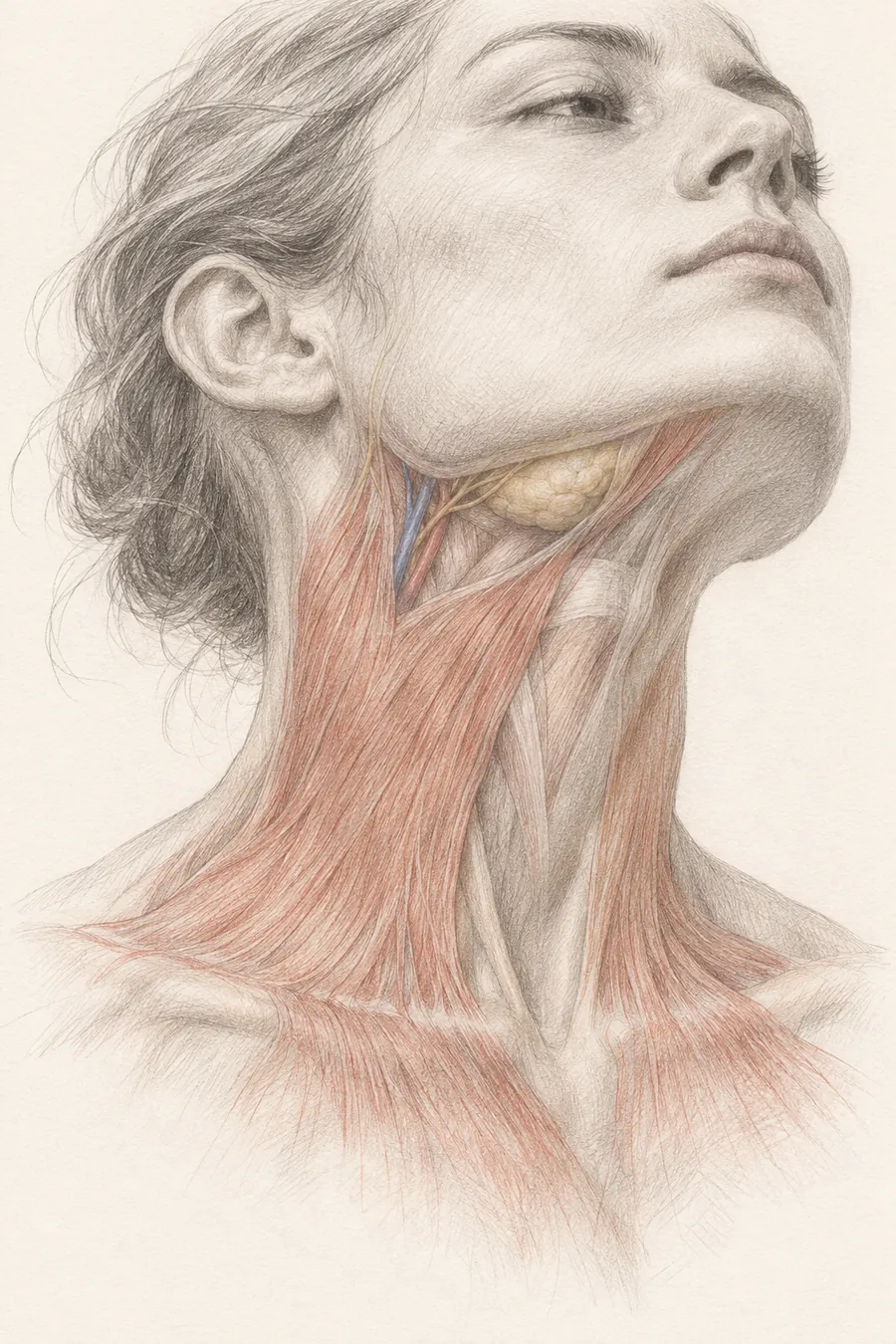
03Which procedure is appropriate if vertical bands appear when you lift your head?
Answer This may be related to the muscle, so liposuction alone may not be enough.
The platysma is a thin muscle that covers the front of the neck. As the central edges separate with age, they become prominent like vertical bands, and support beneath the chin also weakens. These bands can appear regardless of the amount of fat, so reducing fat alone will not resolve them.
When vertical bands are visible and the angle between the chin and neck is poorly defined, we also consider a neck corset procedure. Through a small incision beneath the chin, the separated edges of the platysma are brought together and secured. This creates a structure that supports the area beneath the chin. A neck corset may be performed on its own or with a facelift, depending on the degree of facial sagging.
The platysma is known to be challenging to treat. A study that dissected 16 sides from eight cadavers and compared several methods of correcting the platysma sought to explain the recurrence of bands by examining the course of the nerves entering the muscle3. This also suggests that the extent to which the muscle is addressed can affect the outcome.
Vertical bands are therefore an important sign when determining the scope of surgery. If the bands are pronounced, reducing fat alone may make them appear more prominent as the area becomes thinner. During the consultation, we mark the location and extent of the separated bands with your head raised and discuss how the area may look if the bands are left as they are. Even if you only want liposuction, we explain this beforehand.
How do you tell whether excess skin will remain?
04How can you tell whether there is excess skin?
Answer We look at whether the skin has enough elasticity to contract as the volume decreases.
If the skin retains its elasticity, we expect it to contract as the fat is reduced. The extent of contraction varies with age and skin condition. If the skin and muscle under the chin have loosened and sagged downward, creating what is called a turkey neck, the skin may remain loose and appear to sag even after the fat is removed.
In this case, we consider a neck lift, which repositions the neck skin upward and backward, or combining it with a facelift. During the consultation, we grasp the skin before surgery to assess how much excess skin may remain. This is why we do not make the decision based only on the visible thickness.
Changes in skin elasticity begin before visible signs appear. In a study of 450 Chinese women aged 16 to 66, signs such as horizontal neck lines, neck sagging, and platysmal bands began at different ages, and changes in skin elasticity appeared before these signs5. These figures cannot predict an individual's result, but they show that the skin is already changing before visible signs appear.
- How much excess skin there is when the skin is grasped
- Whether vertical bands also appear when you raise your head
- Whether you are going through a period of significant weight change
Can the jawline look the same even after fat is removed?
05Can the jawline look the same even after fat is removed?
Answer Yes, if the fullness is caused by structures in deeper layers.
Fullness under the chin is not caused by subcutaneous fat alone. Fat beneath the platysma, the salivary glands under the jaw (submandibular glands), the V-shaped muscles under the chin, and the size and position of the jawbone all play a role. Reducing subcutaneous fat alone does not reach these structures.
In a study of 152 patients who underwent surgery involving the deeper layers of the neck, 73% of the tissue volume removed from under the chin came from beneath the platysma1. Because the study included only people who had chosen to undergo deep-plane surgery, the figure cannot be applied directly to everyone. It does, however, show that fullness under the chin may involve more than subcutaneous fat alone.
A literature review of recent neck lift techniques makes the same point. It notes that conventional approaches have focused mainly on superficial structures and paid less attention to the layer beneath the platysma muscle4. At VITAL Plastic Surgery, we generally plan to preserve the salivary glands beneath the jaw. If prominent salivary glands are a concern, we first consider whether a nonsurgical treatment such as Botox may be an option.
The more a choice affects normal structures, the more carefully we weigh its benefits and risks. This is because we first consider whether it is appropriate to remove healthy structures based on the contour beneath the chin alone. Whether to address the deeper layers depends on whether you want a change that cannot be achieved without altering those structures, and whether you can accept the extent of the procedure and the recovery involved. This is why the answer can differ from person to person, even when the appearance is similar.
How do the incisions and recovery differ?
06How different are the incisions and recovery?
Answer The difference is between a procedure completed through small entry points and surgery that requires planned incisions.
Double chin liposuction generally involves making small entry points in the crease beneath the chin or behind the ears and using a thin tube to reduce the fat layer evenly. Removing too much fat can make the surface look uneven or make the skin appear stuck to the muscle, so a layer of fat of consistent thickness is left beneath the skin.
A neck lift uses incisions beneath the chin and along the hairline behind the ears, depending on your condition. Surgery takes about 4 hours and is performed under sedation. The scar beneath the chin lies in the shadow under the jaw, but it is still visible, so we discuss incision placement along with how you usually wear your hair.
Recovery guidance is based on swelling being at its worst 3–4 days after surgery, stitches being removed after 5–7 days on the face and 10–14 days on the scalp, and a return to daily activities after about 10 days. Scars may initially be red and firm and may continue to change for a year or longer, so progress is checked at 1, 3, and 6 months and at 1 year. These are average estimates and vary depending on the extent of surgery and individual differences.
When considering the demands of recovery, it helps to look beyond the date you can return to daily activities. The time you may feel tightness and firmness while the tissues heal, the time it takes for scars to mature, and follow-up visits are all part of the process. As the extent of surgery increases, these periods also become longer. If it is difficult to make time for recovery, we may recommend against extending the scope of surgery at that time.
- Swelling peaks 3–4 days after surgery, and we recommend sleeping with your head slightly elevated
- Stitches are removed after 5–7 days on the face and 10–14 days on the scalp. A return to daily activities is generally expected after about 10 days, though this varies by individual.
- Initial contour changes and the time it takes for tissues to settle are considered separately, and scars can continue to change for over a year
- If you experience sudden severe pain, bleeding that does not stop, rapidly worsening swelling on one side, or a high fever, please contact us without waiting for your appointment.
| Category | Double Chin Liposuction | Neck Lift |
|---|---|---|
| Main concern addressed | Amount of fat under the chin | Loose neck skin and separated platysma muscles |
| Approach | Small entry point in a crease under the chin or behind the ear | Incisions under the chin and along the hairline behind the ear, depending on your condition |
| When it may be considered | When fat can be pinched and the skin retains elasticity | When there is significant excess skin or prominent vertical bands |
Do I have to choose just one?
07Do you have to choose just one?
Answer They are often planned together.
There is often more than one cause. If fat can be pinched and vertical bands are also visible, the fat is reduced and the separated platysma muscles are brought together and secured during the same operation. If there is also significant excess skin, we consider adding an incision behind the ear to remove it.
If facial sagging is also present, we consider a broader treatment area. When the neck is a major concern, correcting only the face may not sufficiently improve the transition between the jawline and neck. The same can be true when treating only under the chin. A broader treatment area changes the operating time and recovery demands, so we explain those differences as well.
You do not need to make a decision on the day of your consultation. VITAL Plastic Surgery's approach is to recommend the necessary treatment at the appropriate time, so we do not recommend proceeding immediately if you cannot make time for recovery or have an uncontrolled health condition.
The process is always the same. We identify whether the fullness under the chin is due to fat, muscle, skin, or deeper structures, determine the treatment area based on the most significant factors, and explain both the changes that treatment can achieve and what may remain. The name of the procedure is determined through this process. We do not choose liposuction or a neck lift first and then try to fit your body to it.
08Three things we check first during your consultation
What we assess first during consultation
- Excess neck skin — We check the position and support of the tissues as well as the amount of excess skin.
- Condition of the platysma — We distinguish volume loss from sagging and consider the relationship to the whole face.
- Fat and bone structure under the chin — We also review previous surgery, scars, and your health.
These are general care principles. The actual decision is made after an examination.
When other care is needed first We do not immediately recommend a neck lift when there are only horizontal lines with little sagging, when fat under the chin appears to be the main concern, when a health condition such as high blood pressure or diabetes needs to be controlled first, or when it is difficult to make time for recovery. Conversely, we do not immediately recommend double chin liposuction when someone with significant excess skin wants only fat removed, when the face is thin and hollow and further fat reduction would be difficult, during a period of significant weight change, or when the salivary glands appear to be the main cause and nonsurgical options should be considered first.
The answer to the initial question, “My jawline has become less defined, but I’m not sure whether I need fat removal or a lift,” is this: If fat you can pinch is the main cause and your skin still has some elasticity, double chin liposuction is considered first. If vertical bands become prominent when you lift your head, or if there is enough excess skin that it is likely to remain after fat removal, a neck lift is considered. Both issues often occur together, so VITAL Plastic Surgery determines the extent of treatment after separately assessing excess neck skin, the condition of the platysma muscle, fat under the chin, and bone structure.
— VITAL Plastic Surgery
When booking, simply let us know, “Please first check whether the concern under my chin is due to fat or to skin and muscle.” We will start by looking at that together during your consultation. You do not need to make a decision on the day of your consultation.
Related ReadingNeck lift treatment information
READ NEXT
Read Next
FAQ
Frequently Asked Questions
Can I have both procedures at the same time?
When the causes overlap, both can be addressed during the same surgery. Fat is contoured and separated platysma muscles are brought together and secured. If there is also significant excess skin, an incision behind the ear may be added to address it. A more extensive procedure changes the operating time and recovery demands, and we explain those differences as well.
Will losing weight bring back my jawline?
If the area under your chin still feels thick after losing weight, we recommend a consultation. However, during periods of significant weight change, we do not recommend immediate surgery. Instead, we reassess after your weight has stabilized.
Will horizontal neck lines improve as well?
Horizontal lines etched into the skin have different causes from platysma bands or sagging and may not disappear with a lift alone. We explain how much improvement may be possible and which lines may remain, and plan separate treatment if needed.
What if I am still concerned about my neck after a facelift?
Continued concerns about the neck after a facelift are one reason to seek a consultation. We reassess whether the remaining concern is excess skin, platysma bands, or fat under the chin before determining the extent of treatment.
How long does neck tightness last after surgery?
As the tissues heal, firmness and tightness may become more pronounced between 3 weeks and 3 months, then gradually soften over the following 3 months to 1 year. If you have difficulty breathing or one side suddenly becomes severely swollen, please contact us immediately rather than waiting.
BEFORE CONSULTATION
What to Prepare Before Your Consultation
- What concerns you mostWrite down which you notice first: fullness under the chin, vertical bands, or sagging skin.
- Photos with your head liftedFront and side photos, along with a photo with your head lifted, can help distinguish fat from muscle bands.
- Weight change historyLet us know whether your weight has changed significantly over the past few years and whether it is currently stable.
- Previous filler, thread lift, and lift historyPlease tell us about previous fillers, threads, and lifting procedures. If needed, we use ultrasound to assess their location and distribution.
- Health conditions and medicationsBe sure to tell us if you have high blood pressure or diabetes, take anticoagulants, or use herbal medicines or supplements such as omega-3.
REFERENCES
References
- O'Daniel TG. Optimizing Outcomes in Neck Lift Surgery. Aesthetic Surgery Journal. 2021. doi:10.1093/asj/sjab056 (View abstract)
- Cakmak O, et al. Deep Neck Contouring With a Focus on Submandibular Gland Vascularity: A Cadaver Study. Aesthetic Surgery Journal. 2023. doi:10.1093/asj/sjad079 (View abstract)
- Sinno S, et al. Cervical Branch of Facial Nerve: An Explanation for Recurrent Platysma Bands Following Necklift and Platysmaplasty. Aesthetic Surgery Journal. 2019. doi:10.1093/asj/sjy150 (View abstract)
- Chinta S, et al. Current Trends in Deep Plane Neck Lifting: A Systematic Review. Annals of Plastic Surgery. 2025. doi:10.1097/SAP.0000000000004163 (View abstract)
- Xie H, et al. Characteristic features of neck skin aging in Chinese women. Journal of Cosmetic Dermatology. 2019. doi:10.1111/jocd.12762 (View abstract)
The findings in these papers reflect the participants and conditions of each study and do not mean that every individual will have the same results.
This article provides general medical information and does not replace diagnosis or treatment. Surgical results and recovery vary by individual, and complications such as bleeding, infection, scarring, and asymmetry may occur.
More articlesVITAL Plastic Surgery Medical Articles
RESERVATION
You do not need to decide the day of your consultation.
Organize questions about this page without entering your name, contact information, or medical history. This does not submit an appointment request.