PLASTIC SURGERY
MEDICAL COLUMN
Questions Answered Directly by the Doctor Before You Decide on Surgery
Facelift
Articles
Nasolabial Fold Surgery: Does It Directly Smooth the Folds?
Nasolabial fold surgery does not directly cut along and smooth the fold. Instead, it lifts cheek tissue that has descended from above back into position to soften the boundary. Anatomical research suggests that nasolabial folds form at the boundaries between adjacent fat compartments, which limits what filling that area alone can achieve.
Medically reviewed by Dr. Hyungwoo Yim, Medical Director (Board-Certified Plastic Surgeon) · Published November 3, 2026 · Last reviewed November 11, 2026
SHORT ANSWER
First, the Short Answer
- Nasolabial fold surgery does not directly cut along and smooth the fold. Instead, it lifts cheek tissue that has descended from above back into position to soften the boundary. Anatomical research suggests that nasolabial folds form at the boundaries between adjacent fat compartments, which limits what filling that area alone can achieve1.
- When sagging is limited to the under-eye area and front of the cheeks, a midface lift through the inside of the eyelid is considered. When changes in the jawline and neck are more pronounced, a facelift is also considered. Lines that form with facial expressions may remain after surgery, so we do not say that the folds will disappear completely.
- At VITAL Plastic Surgery, we determine the treatment area after a hands-on examination to assess whether there is also sagging in the midface—from under the eyes to the front of the cheeks—whether changes in the jawline and neck are more pronounced, and how much elasticity remains in the skin and the muscles around the eyes.
“Can surgery eliminate just my nasolabial folds?”
This is a paraphrase of a question we often hear during consultations.
To answer this question, we first need to distinguish where your current concern comes from. We will explain each point below, then return to the original question at the end.
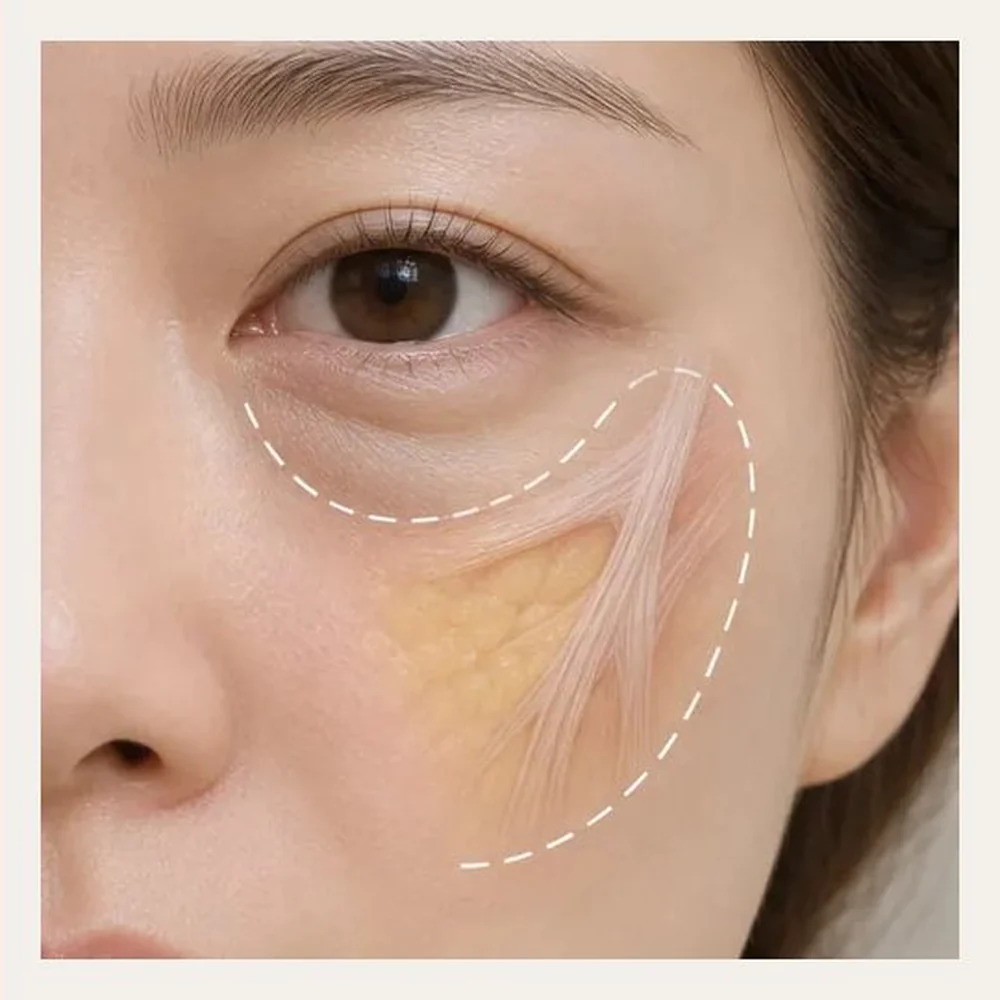
01Why Do Nasolabial Folds Deepen?
Answer Because cheek tissue descends, making the boundaries between fat compartments more visible.
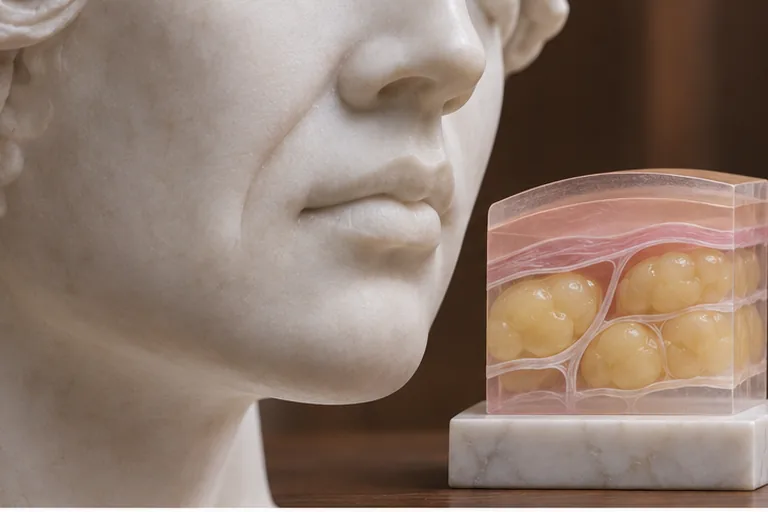
At VITAL Plastic Surgery, we view sagging cheeks, deep nasolabial folds, and a less defined jawline as the result of changes in the positions of the underlying fat, fascia, and supporting structures, as well as the skin. Under-eye fat and cheek fat may appear separate, but they are connected through shared fibrous structures and fat layers. When the front of the cheeks descends, the under-eye area looks longer and the boundary along the nasolabial folds deepens.
Anatomical research also describes nasolabial folds as “boundaries.” In a study that injected contrast material into facial fat compartments in nine cadavers aged 72–89 and examined them with CT, the nasolabial folds, tear troughs, and marionette lines were located at the boundaries between adjacent fat compartments1. The authors concluded that because these boundaries extend to the skin, adding volume to individual compartments alone has limitations.
Fat volume also changes differently in different areas. A CT study comparing 60 Asian women by age group found that thinner deep medial cheek fat was associated with deeper nasolabial folds and tear troughs, while a thicker lower third of the nasolabial fat compartment was associated with deeper nasolabial folds2. This means that hollowing in some areas and thickening in others occur together.
- Whether descended tissue at the front of the cheeks makes the under-eye area look longer
- Whether the boundary between the under-eye area and cheeks has also deepened
- Whether the area above the nasolabial folds bulges while the area below looks hollow
- Whether sagging extends to the jawline and corners of the mouth
In Simple Terms It is similar to a well-used sofa cushion. When the cushion slides forward and down, a deep groove forms along the seam at the front. That seam represents the nasolabial fold. Pushing stuffing into the groove may temporarily make it look filled, but the seam remains and the cushion looks heavier. Pushing the cushion back up into its original position and securing it makes the groove shallower. If the stuffing inside has actually decreased, more can then be added. Just as creases that form when you sit cannot all be eliminated, lines that form with facial expressions may remain.
So What Does Nasolabial Fold Surgery Lift?
02What Does Nasolabial Fold Surgery Lift?
Answer It lifts and secures the cheek fat layer that has descended from the under-eye area toward the front of the cheeks, along with the retaining ligaments that support it.
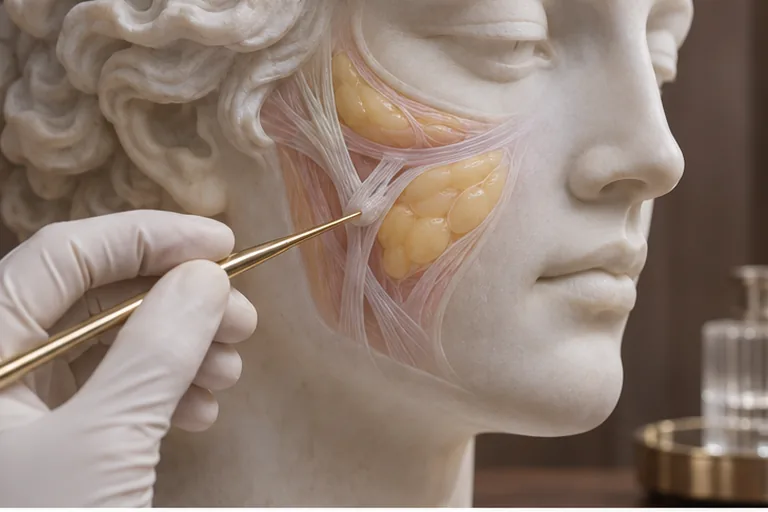
At VITAL Plastic Surgery, a midface lift raises and secures the cheek fat layer that has descended from the under-eye area toward the front of the cheeks, along with its retaining ligaments—cord-like structures that anchor the skin and deeper tissues toward the bone. The procedure uses an incision through the conjunctiva inside the eyelid and is performed in conjunction with transconjunctival lower eyelid surgery, leaving no skin incision.
During the examination, we assess the firmness of the ligaments by touch. Releasing them as needed creates room for the tissue to move upward, and the lifted tissue is secured to firm tissue around the eyes. While lower eyelid surgery addresses the skin and orbicularis oculi muscle—the muscle around the eye—a midface lift goes deeper to address the sagging cheek fat layer and retaining ligaments together. The extent of release and the fixation sites depend on the degree of sagging and the condition of the tissues.
For each side, surgical planning takes about 1 minute, access and dissection about 5 minutes, fixation about 5 minutes, and closure about 5 minutes, for approximately 30 minutes total for both sides. However, this estimate assumes no diabetes or high blood pressure and minimal bleeding. Additional procedures may increase the time, and the duration of surgery does not indicate the recovery period.
- Mark the groove and the boundary of the sagging front cheek tissue while the patient is seated
- Enter through the conjunctiva inside the lower eyelid and dissect down to the upper cheek
- Release the retaining ligaments, then lift and secure the sagging cheek fat layer
- Complete closure on the conjunctival side (no skin incision)
So Which Is Appropriate: a Midface Lift or a Facelift?
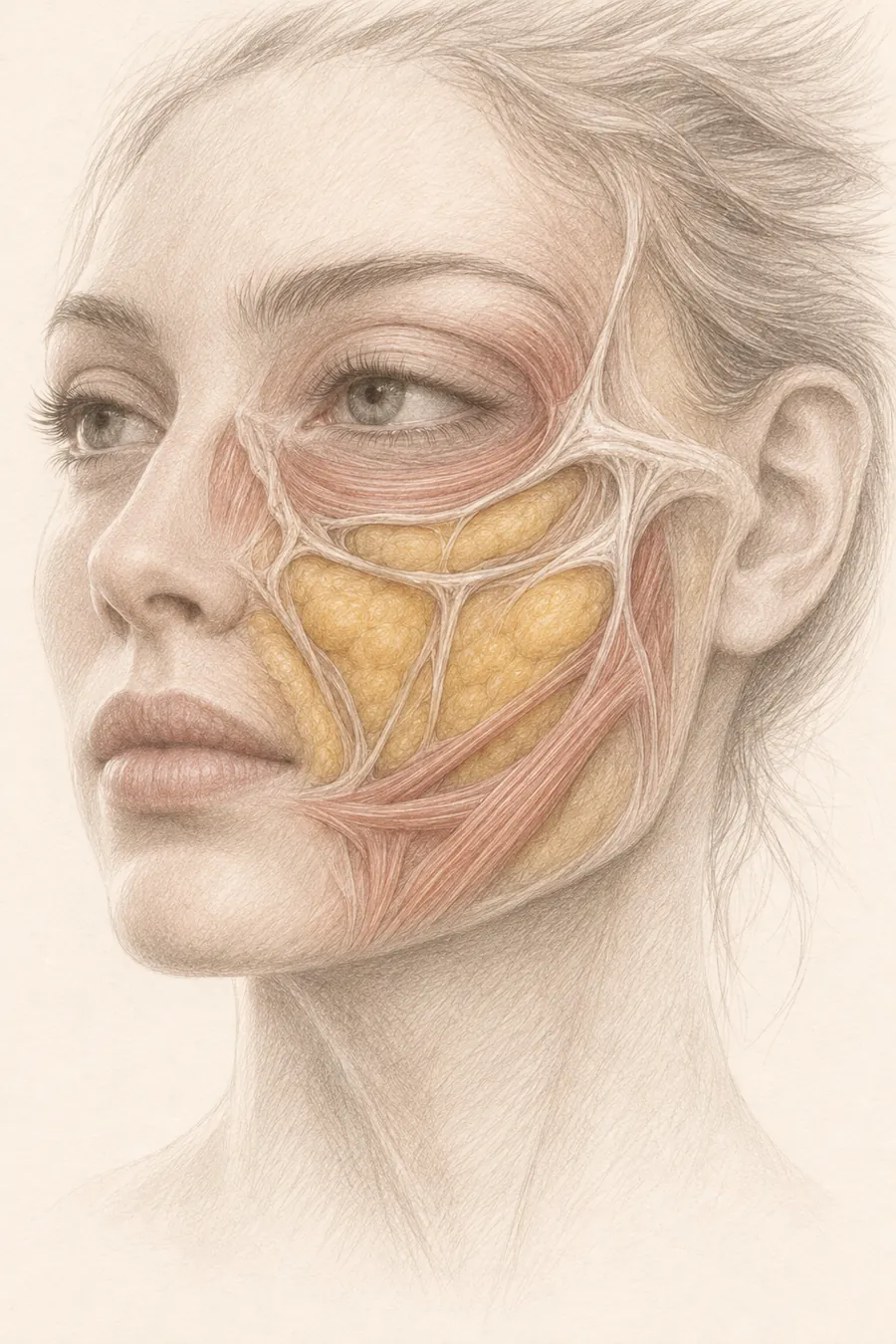
03Midface Lift or Facelift: Which Is Appropriate?
Answer It depends on how far the sagging extends.

A midface lift uses a conjunctival approach to address sagging under the eyes and at the front of the cheeks. A facelift uses incisions at the temples, around the ears, and along the rear hairline to address the cheeks, jawline, and, when needed, the neck. The treatment areas, incisions, and surgical times differ, so the choice depends on where the sagging is most pronounced.
When sagging is limited to the under-eye area and front of the cheeks, a midface lift is considered. When changes in the jawline and neck are more pronounced, a facelift is also considered. Conversely, if the concern is clearly limited to the under-eye area, treatment is not extended to the cheeks. A larger treatment area can mean more swelling and postoperative care. When the bone beneath the eyes slopes farther back, tissue is more likely to descend, which can affect what can be expected from the same procedure.
During consultation, we assess the face both at rest and while smiling. The under-eye area and cheeks affect each other, so their boundary can look different with facial expressions. Treating only the under-eye area while leaving sagging cheek tissue in place may make the boundary more prominent or create a hollow appearance after surgery. Conversely, extending treatment beyond what is needed adds to the recovery burden. That is why defining the treatment area comes before choosing the surgical technique.
| Extent of Sagging | How it looks | Approach Considered |
|---|---|---|
| Under-eye area to front of cheeks | The under-eye area looks longer, and the upper nasolabial folds deepen | Midface lift (conjunctival approach) |
| Cheeks · Jawline · Neck | Sagging around both the nasolabial folds and mouth, with a less defined jawline | Deep plane facelift, with a neck lift if needed |
| Mild sagging limited to a small area | Only a specific area appears to have descended | Mini lift limited to either the midface or lower face |
| Hollowing is the main concern rather than sagging | The cheeks look flat and shadowed | Consider fat grafting if there is an actual volume deficit |
So How Much Did Nasolabial Folds Improve in Research?
04How Much Did Nasolabial Folds Improve in Research?
Answer Improvement has been reported, but that does not mean the folds disappear completely.

One study examined the results of surgery that also repositions cheek tissue. In 62 Asian women followed for an average of 15 months after surgery that overlapped and secured the lateral superficial musculoaponeurotic system (SMAS) while repositioning the muscle around the eyes and cheek fat together, the average nasolabial fold depth score assigned by three evaluators who did not know one another decreased from 2.01 to 0.933. In the same study, the tear trough score also decreased from 2.40 to 1.27.
This technique is not the same as the midface lift performed at VITAL Plastic Surgery, and these findings come from a single research team. A lower score means the folds became shallower, not that they disappeared, and it does not directly predict an individual's results. The study is best understood as evidence that surgery to lift cheek tissue can affect nasolabial folds.
That is why, during a consultation, we first ask, “What has descended to create these nasolabial folds?” rather than “How much can they be reduced?” If the depth comes from sagging upper cheek tissue, lifting comes first. If the shadow comes from volume loss, restoring volume comes first. If fine lines come from thinning skin, treating the skin comes first. When all three overlap, we determine the order of treatment.
Then why not fill them with filler or fat?
05Can’t They Be Filled with Filler or Fat?
Answer Adding volume can help where it is truly lacking, but filling an area of sagging tissue may make the face look heavy.

At VITAL Plastic Surgery, we evaluate sagging structures by their position, volume loss by the amount missing, and skin quality separately. Filling descended tissue with fat may make the face look heavy, so we view fat grafting as a way to restore volume where tissue is actually lacking. We do not immediately recommend fat grafting when sagging is the main cause. When sagging and hollowing occur together, we first lift the sagging tissue and then reassess the remaining hollowing.
As the anatomical research discussed earlier shows, the nasolabial fold is a boundary that extends to the skin, so adding volume there does not eliminate the boundary itself1. Fillers are injectable materials that restore contour and volume, but they can rarely cause vascular complications and vision damage, making the injection site and a safe technique important.
For thin, hollow faces, we are also cautious about the opposite approach. Repeated treatments intended to reduce fat in an effort to improve sagging may make hollowing more noticeable, so careful assessment is needed. Lifting and adding volume do not replace one another; when needed, they can be planned together at separate stages.
- Lifting treatment: Repositions descended cheek fat layers and ligaments
- Volume restoration: Adds volume where tissue is actually lacking
- Skin treatment: Addresses thinning skin and fine lines separately with Re2O or lasers
- When both problems overlap, plan treatment in stages rather than doing everything at once
What is recovery like, and how long do the results last?
06What Is Recovery Like, and How Long Do Results Last?
Answer Swelling peaks on days 3–4, and the lifted midface usually begins to sag again after 3–5 years.

Below is VITAL Plastic Surgery’s recovery guide for a midface lift. Between 3 weeks and 3 months, the tissue may feel firm and tight as part of healing, so we do not decide on revision surgery based only on its appearance during this period. Combining the procedure with lower eyelid surgery or other surgery may increase swelling and aftercare needs.
Although it varies by person, the lifted midface usually begins to sag again after 3–5 years because aging continues after surgery. We therefore recommend monthly maintenance with laser lifting treatments, using a schedule of monthly InMode and ONDA treatments and annual Ultherapy and Thermage treatments.
We assess recovery in stages. Early on, we check swelling, bruising, wounds, and eye function, and provide guidance on returning to work, wearing makeup, and other daily activities based on the extent of surgery. Later, we monitor changes in tightness, scars, dryness, and asymmetry. We do not assume every symptom is part of normal recovery; we assess it through an examination. Patients traveling from abroad also need to coordinate follow-up visits with their departure schedule.
| Timing | What Happens | What to Keep in Mind |
|---|---|---|
| 3–4 days after surgery | When swelling and bruising are most pronounced | Sleep with your head slightly elevated, and apply cold compresses gently without letting ice touch the skin or eyes directly |
| Days 5–7 | Suture removal if an incision was made | Eye makeup and contact lenses can be used after 2 weeks; light daily activities can be resumed after 2–3 days. |
| 3 weeks–3 months | A period of tissue firmness and tightness | Do not decide on revision surgery based on appearance alone at this stage. Saunas can be used after 1–2 weeks, and strenuous exercise can be resumed after 1 month. |
| 3 months–1 year | Tissue softens and the two sides gradually become more balanced | Follow-ups at 1, 3, and 6 months and 1 year |
When would you not recommend a midface lift for nasolabial folds?
07When Is a Midface Lift Not Recommended for Nasolabial Folds?
Answer When there is little sagging and the concern is mainly under the eyes, or when changes in the jawline and neck are a greater concern.

An approach through the conjunctiva leaves no incision line on the skin, but it does not address excess skin itself. We therefore manually assess the elasticity of the skin and orbicularis oculi muscle to determine whether Re2O or laser treatment may be sufficient. If those treatments appear insufficient, we treat that area separately later. If the loss of elasticity is too substantial for a conjunctival approach alone, we consider an incision in the skin below the eyelashes.
We also review eye-related medical history first. Thyroid eye disease, glaucoma, severe dry eye, autoimmune disease, and anticoagulant use may be reasons to postpone or avoid surgery. Preparation also includes minimizing contact lens use, applying artificial tears frequently, and avoiding rubbing the eyes.
If you have previously had a lift or under-eye surgery, we first assess altered tissue, scars, and adhesions, then plan treatment according to your current stage of recovery. Some patients come in because the boundary between the under-eye area and cheek looks more pronounced after previous surgery. In these cases, we first identify what made the boundary more noticeable rather than simply repeating the same surgery.
- When sagging is mild and the concern is clearly limited to the under-eye area
- When changes in the jawline and neck are the greater concern
- When loss of skin and orbicularis oculi muscle elasticity is too significant for a conjunctival approach alone
- When health conditions such as high blood pressure or diabetes need to be controlled first
08Three things we check first during your consultation
What we assess first during consultation
- Whether there is also sagging in the midface (from under the eyes to the front of the cheeks), or the concern is mainly under the eyes
- Whether changes in the jawline and neck are more pronounced (and whether to also consider a facelift)
- Whether a conjunctival approach alone is sufficient, based on a manual assessment of skin and orbicularis oculi muscle elasticity
These are general care principles. The actual decision is made after an examination.
When other care is needed first We do not immediately recommend a midface lift when there is little sagging and the concern is mainly under the eyes, when changes in the jawline and neck are a greater concern, when loss of skin and orbicularis oculi muscle elasticity makes a conjunctival approach alone insufficient, or when a health condition such as high blood pressure or diabetes needs to be controlled first. If volume loss is the main cause rather than sagging, we consider volume restoration first.
The answer to the initial question, “Can surgery eliminate just the nasolabial folds?” is this: there is no surgery that erases only the fold itself. Surgery reduces its depth by lifting cheek tissue that has descended from above. First determining how far the sagging extends and whether volume is truly lacking helps establish whether a midface lift, facelift, or volume restoration should come first.
— VITAL Plastic Surgery
When booking, simply leave a note saying, “Please first assess whether my nasolabial folds are caused by sagging or hollowing,” and we will begin the consultation there. You do not need to make a decision on the day of your consultation.
Related ReadingMidface Lift Consultation Guide
READ NEXT
Read Next
FAQ
Frequently Asked Questions
Will nasolabial fold surgery completely eliminate the folds?
No. The goal is to reduce their depth by lifting descended cheek tissue. Lines that form with facial expressions may remain.
Will there be scars on the skin?
A midface lift uses an incision through the conjunctiva inside the eyelid, so there is no skin incision. This differs when significantly reduced skin elasticity requires an incision below the eyelashes.
Does a shorter surgery mean less swelling?
Procedure time and swelling are not the same thing. Swelling peaks on days 3–4, and it takes several months for the tissues to settle.
Can I have surgery if I have been getting fillers?
We first check which material was injected and when. If needed, ultrasound is used to assess its location and distribution. Dissolving hyaluronic acid filler may be considered.
When are Re2O or laser treatments added?
Laser treatment is performed before surgery, and Re2O, which supports recovery, is performed after the surgical swelling has subsided (usually after 4 weeks). The treatment area and depth are determined based on the condition of the wound, inflammation, and sensation.
BEFORE CONSULTATION
What to Prepare Before Your Consultation
- Your Main Area of ConcernTell us which area stands out first: above the nasolabial folds, the boundary between the under-eye area and cheek, or around the mouth.
- Previous treatment recordsList when and where you had fillers, threads, fat grafting, or device-based lifting treatments.
- Eye-Related Medical HistoryTell us whether you have thyroid eye disease, glaucoma, or dry eye, and whether you wear contact lenses.
- Medications and SupplementsList all medications and supplements, including anticoagulants, herbal medicines, and omega-3 supplements.
- Past photosPhotos from a few years ago can help us see the direction in which your cheeks have descended.
REFERENCES
References
- Gierloff M, Stöhring C, Buder T, Wiltfang J. The subcutaneous fat compartments in relation to aesthetically important facial folds and rhytides. Journal of Plastic, Reconstructive & Aesthetic Surgery. 2012. doi:10.1016/j.bjps.2012.04.047 (View abstract)
- Wen LH, Zhong PH, Wang XL, et al. Analysis of age-related changes in midfacial fat compartments in Asian women using computed tomography. Journal of Plastic, Reconstructive & Aesthetic Surgery. 2019. doi:10.1016/j.bjps.2019.05.035 (View abstract)
- Gong M, Yu L, Ren L, Sui B, Yang D. Lateral Superficial Muscular Aponeurotic System Stacking/Superficial Muscular Aponeurotic Systemectomy With Orbicularis-Malar Fat Repositioning: A Procedure Tailored for Female Asian Patients. Dermatologic Surgery. 2020. doi:10.1097/DSS.0000000000002202 (View abstract)
The findings in these papers reflect the participants and conditions of each study and do not mean that every individual will have the same results.
This article provides general medical information and does not replace diagnosis or treatment. Surgical results and recovery vary by individual, and complications such as bleeding, infection, scarring, and asymmetry may occur.
More articlesVITAL Plastic Surgery Medical Articles
RESERVATION
You do not need to decide the day of your consultation.
Organize questions about this page without entering your name, contact information, or medical history. This does not submit an appointment request.