PLASTIC SURGERY
MEDICAL COLUMN
Questions Answered Directly by the Doctor Before You Decide on Surgery
Skin Tightening
Articles
Facelift Scars: Where Are They, and How Visible Are They?
A facelift requires incisions, so it leaves scars. Depending on the surgical plan, incisions are placed at the temples, around the ears, and along the hairline at the back. Scars are initially red and firm, then mature over several months or longer and may continue to change for more than a year.
Medically reviewed by Dr. Hyungwoo Yim, Medical Director (board-certified plastic surgeon) · Published November 6, 2026 · Last reviewed November 11, 2026
SHORT ANSWER
First, the Short Answer
- A facelift requires incisions, so it leaves scars. Depending on the surgical plan, incisions are placed at the temples, around the ears, and along the hairline at the back. Scars are initially red and firm, then mature over several months or longer and may continue to change for more than a year.
- Scar visibility depends not only on incision placement but also on tension on the wound and how postoperative instructions are followed during recovery. Scars around the ears may be visible with short hair or hair worn up.
- VITAL Plastic Surgery plans to place lifting tension on the deeper layers rather than the skin and determines incision placement after discussing your usual hairstyle. If you expect no visible scars at all, we do not recommend proceeding directly with surgery.
“Will a facelift leave noticeable scars in front of my ears?”
This is a paraphrase of a question we often hear during consultations.
To answer this question, we first need to distinguish where your current concern comes from. We will explain each point below, then return to the original question at the end.
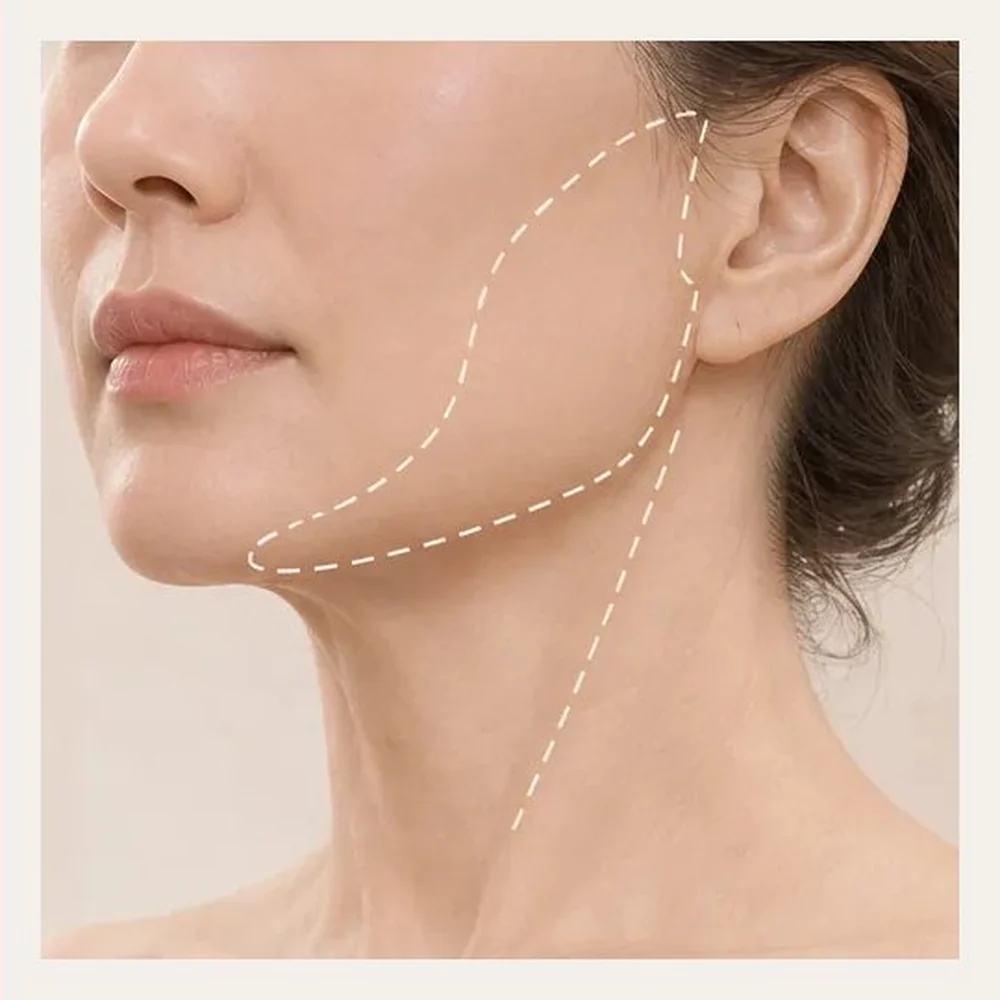
01Where do facelift scars form?
Answer Scars form at the temples, in front of and behind the ears, and along the hairline at the back. Their exact locations depend on the incision plan.
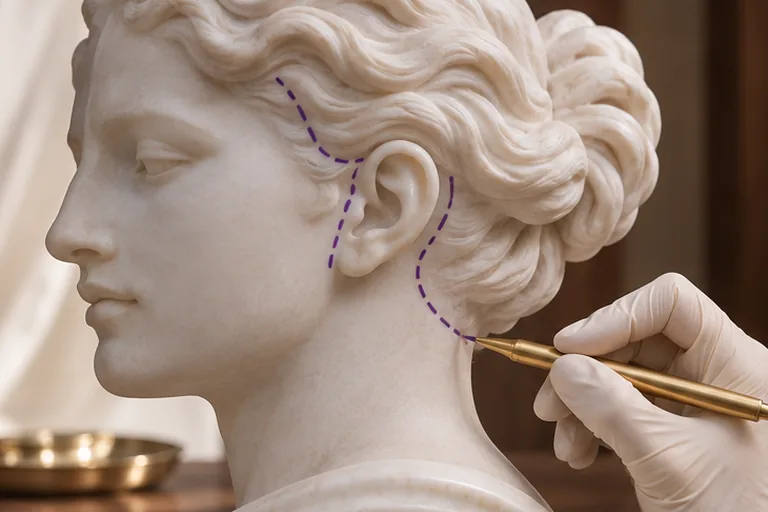
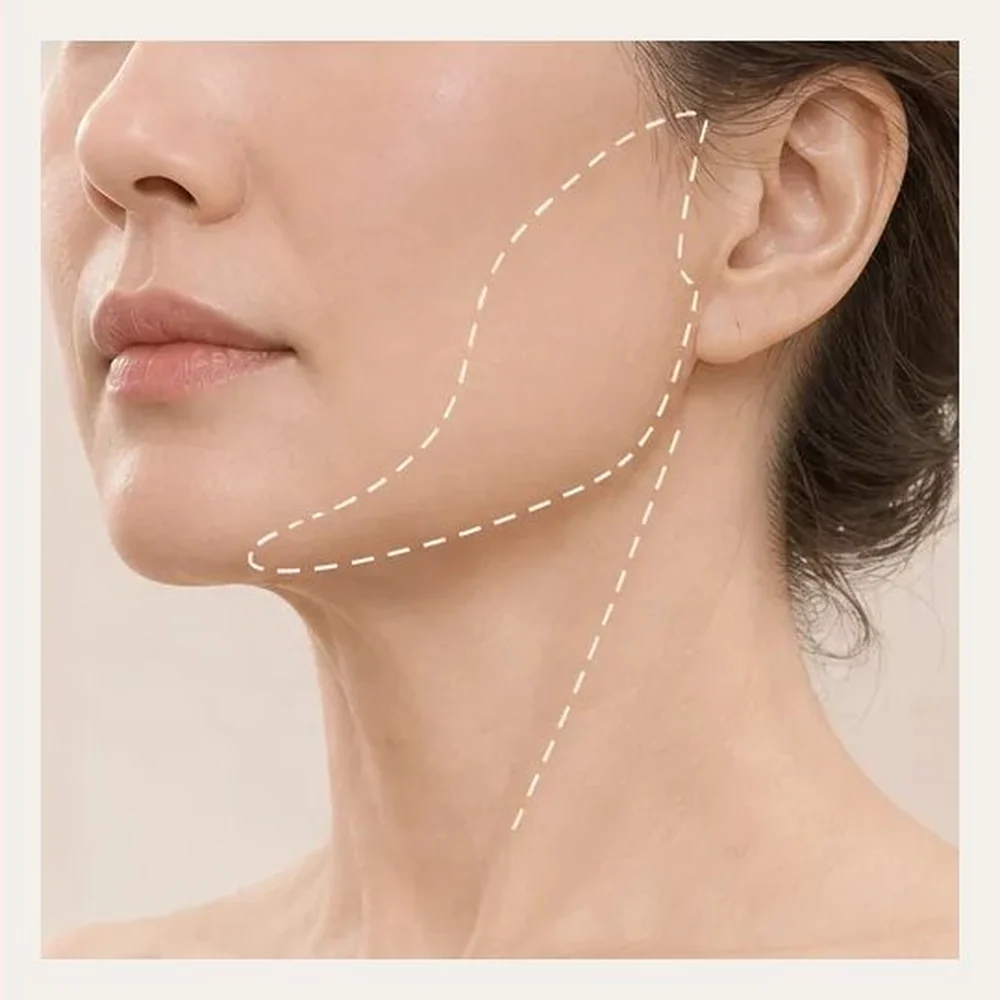
A facelift involves making incisions around the ears to reposition the sagging tissue beneath the skin. For a deep plane facelift at VITAL Plastic Surgery, incisions are placed at the temples, around the ears, and along the hairline at the back, depending on the surgical plan. The incision locations in front of and behind the ears are explained before surgery. If neck sagging is also present and a neck lift is included in the plan, an additional incision is made under the chin.
When sagging is relatively mild and a mini facelift is being considered, the front incision does not extend into the scalp. However, the incision behind the ear is nearly the same length as in a full facelift, so a mini facelift does not substantially reduce scarring. The appropriate approach is determined after examining the location and extent of sagging.
Incisions are planned with the patient sitting upright so the direction of sagging can be assessed. This is because sagging can appear to follow different directions when lying down and sitting up. For major procedures, the plan is reviewed using photographs the day before surgery, and diagrams are drawn. This also includes determining where the incisions will follow the hairline and the contours of the ears.
The first question in a scar consultation is therefore not whether there will be scars, but where they will be and what shape they will take. Even with the same facelift procedure, scar locations vary depending on whether the neck is also treated and whether the front incision extends into the scalp.
| Incision Site | How It May Look | What we assess first during consultation |
|---|---|---|
| Temples · In Front of the Ears | A red, firm line early on | Usual hairstyle and sideburn position |
| Behind the Ears · Hairline at the Back | May be visible when hair is worn up or cut short | Whether you often wear your hair up |
| Under the Chin (With a Neck Lift) | Located in the shadow under the chin, but still present | Whether neck sagging and platysmal bands are both present |
In Simple Terms It is similar to altering clothing. When shortening pants, hiding the seam inside the fold makes it less visible from the outside. But if the fabric is pulled too tightly when sewn, the seam puckers and gaps. The tension is therefore placed on the lining, while the outer fabric is fitted comfortably. A new seam is stiff at first, then settles with repeated wear and washing. How you wear the clothing—whether you roll up the sleeves or fold the hem—also affects how much the seam shows. Similarly, facelift incisions are concealed along the hairline and around the ears, tension is placed on the deeper layers, and scars settle over the course of a year. Their visibility also depends on your usual hairstyle.
What determines how noticeable scars are?
02What determines how noticeable scars are?
Answer Tension on the wound is just as important as incision placement.
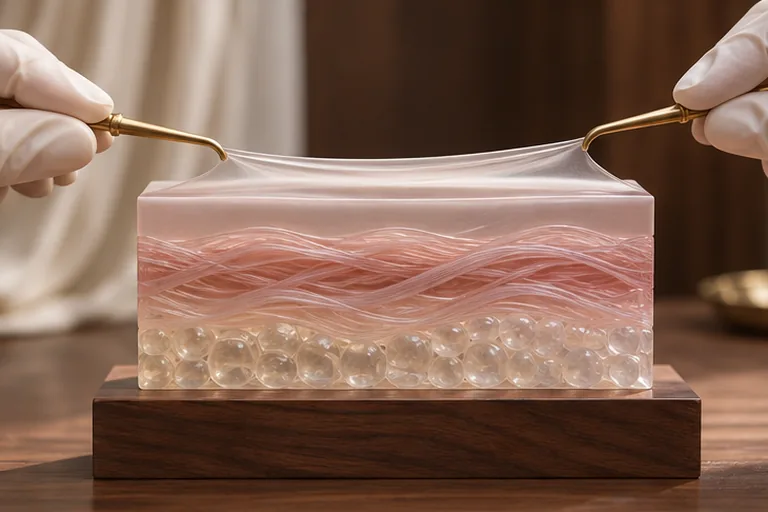
When only the skin is pulled, the tension falls directly on the skin and incision line. If the wound heals under constant tension, the scar is more likely to widen or thicken, while the sagging fat beneath it may remain in place. VITAL Plastic Surgery plans to reposition the skin, fat, and fascia together in the plane beneath the fascia so that tension is placed on the deeper layers. The lifted tissue is secured in the direction opposite to the sagging, and the skin is then trimmed with less tension on it.
Research has reported findings consistent with this approach. In a study of 61 Asian patients who underwent deep plane facelifts and were followed for an average of 19 months, the authors described precise, tension-free skin closure as part of their surgical plan. Hypertrophic scarring—a red, thick, raised scar—occurred in 1 patient (1.6%)4. This reflects one research team's experience and does not mean everyone will have the same results.
The direction of tension affects more than scars. Lifting mainly the skin can make facial expressions look pulled, while sagging in the deeper layers may remain. However, working in the deeper layers requires a thorough understanding of the areas where the facial nerve runs, so risks such as nerve injury, changes in sensation, and hematoma are also explained before surgery.
How often are scar problems reported in research?
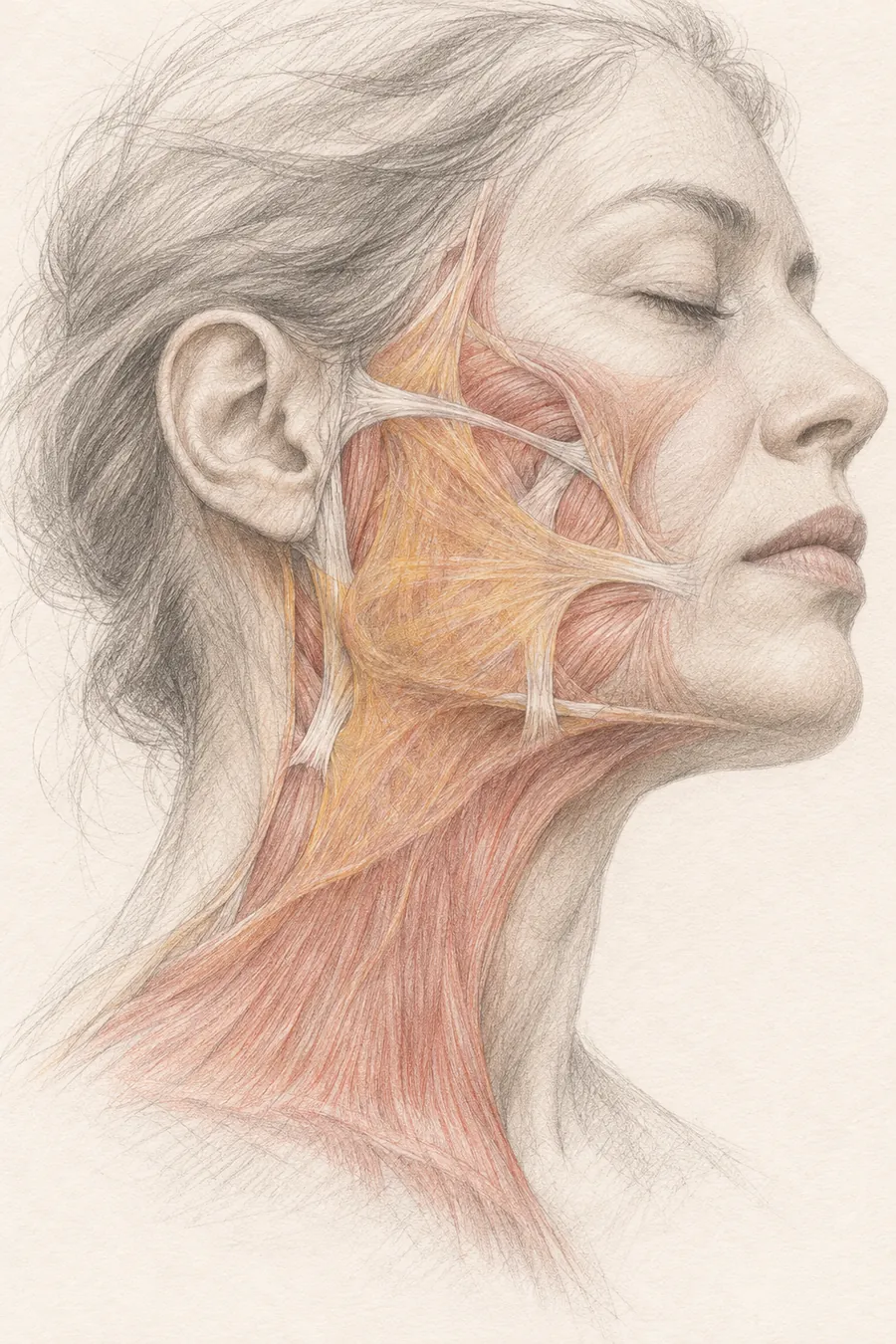
03How often are scar problems reported in research?
Answer Scar problems are reported to be relatively uncommon, but the risk is not zero, and how much scars bother people varies.

A meta-analysis of 45 deep plane facelift studies involving 10,784 patients estimated the rate of hypertrophic scarring at approximately 2.8%1. In the same analysis, temporary facial nerve weakness occurred in 1.2% and hematoma in 1.8%, with no permanent facial nerve injury observed. However, these averages combine multiple studies and cannot directly predict an individual's results.
A literature review of 49 studies examined incision techniques across four topics: temporal incision placement, pretragal incisions in front of the ear, earlobe management, and incision design behind the ear. Scar problems were reported at low rates with each approach, but differences in measurement methods between studies prevented conclusions about which approach was better2.
People also differ in how they feel about scars. In a study of 147 East Asian and White patients who had undergone facial surgery, Asian patients had a lower median total SCAR-Q score for scar satisfaction: 234, compared with 260 among White patients3. This suggests that the same scar may bother some people more than others, making a detailed discussion of scar locations before surgery important.
Overall, the research figures suggest that scar problems are uncommon, but they cannot tell you how your own scars will look. That question needs to be addressed during a consultation that considers incision placement, skin condition, care during recovery, and how much scars concern you personally.
How do scars change at different stages after surgery?
04How do scars change at different stages after surgery?
Answer Scars are initially red and firm, then mature over several months or longer and may continue to change for more than a year.
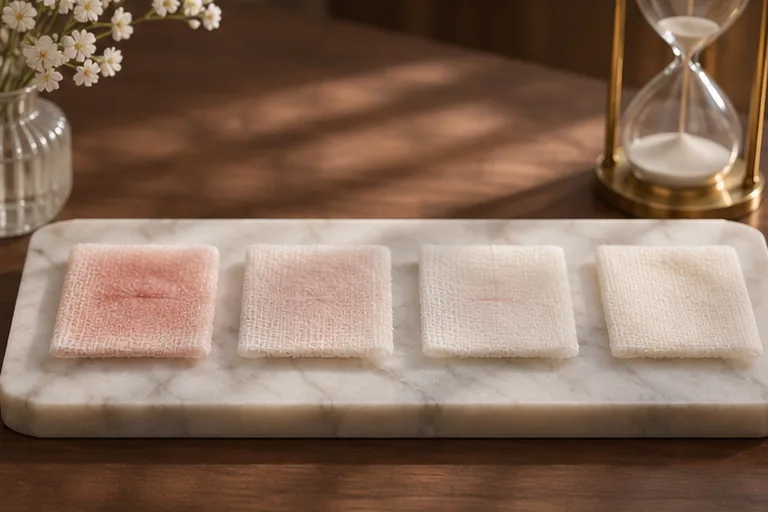
Below is the typical course described by VITAL Plastic Surgery. Recovery rates vary, and progress is assessed at 1, 3, and 6 months and 1 year, with the assessment updated at each visit. Through about 3 months after surgery, we check swelling, bruising, wounds, and scars, and consider laser treatment for scars and recovery if needed.
During the first week, we check for bleeding, infection, swelling, and wound condition to determine when to remove the sutures. Around 1 month, even if the two sides look different, photographs alone are not used to determine whether healing is normal. Around 3 months, firmness and tightness may occur, but persistent pain is assessed without waiting. At 6 months, photographs from different stages and changes in function are compared, and an examination is used to determine whether additional care is needed.
Scars tend to be most concerning during the first few months after surgery. Redness and firmness are common during scar maturation, so we do not judge the result based on these signs alone and continue monitoring for up to a year.
| Timing | What Happens | What to Keep in Mind |
|---|---|---|
| 3–4 days after surgery | Peak Swelling | Sleep with your head slightly elevated, and use compression only when instructed for your procedure |
| 7–10 Days | Sutures are removed after 5–7 days on the face and 10–14 days on the scalp. | Return to daily activities is generally around 10 days, with individual variation |
| Several Months | Contour changes and tissue stabilization occur at different stages | Tie your hair back only after checking that it does not pull on the incision |
| Up to 1 Year | Scars are initially red and firm, then gradually change | Follow-ups at 1, 3, and 6 months and 1 year |
What should I prepare before surgery to make scars less noticeable?
05What can I prepare before surgery to make scars less noticeable?
Answer Tell us how you usually wear your hair, and review smoking cessation, avoiding alcohol, and your medications with us.
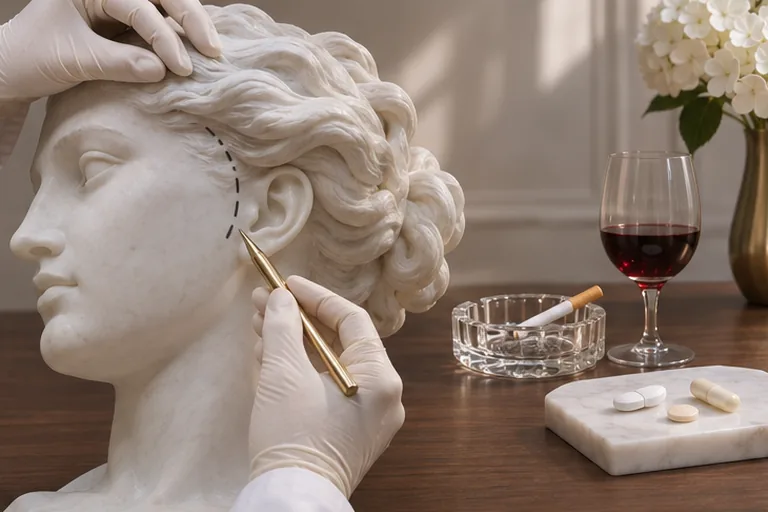
Whether you usually have short hair or frequently tie your hair back helps guide incision planning. Scars around the ears may be visible when your hair is tied back. After surgery, we also check healing and whether tying your hair back pulls on the incision before deciding when you can do so again.
We also review habits that affect wound healing in advance. Instructions to stop smoking and drinking alcohol are an essential part of preparation because both affect bleeding and wound healing. We recommend stopping herbal medicines and supplements such as omega-3 when possible because of their potential to increase bleeding, and first check for high blood pressure, diabetes, and anticoagulant use. If these issues are not controlled, surgery cannot proceed right away.
Please also tell us about previous fillers, threads, and facelift procedures. If needed, we use ultrasound to assess their location and distribution. Tissue changes from previous procedures can affect the dissection plane and incision plan, so it is helpful to check these before deciding where to place the scars.
- Your usual hairstyle (short hair, tied-back hair, sideburns)
- Smoking and alcohol use, and how long you can stop
- Medications, supplements, and medical history, including high blood pressure and diabetes
- Previous fillers, threads, and facelift procedures
Can existing facelift scars be revised?
06Can existing facelift scars be revised?
Answer We assess the stage of scar healing and any tissue shortage before deciding between scar care and surgical revision.

Some patients come to us because they are concerned about scars or ear shape after a previous facelift. For revision facelift planning at VITAL Plastic Surgery, we assess the previous incision lines, ear shape, and hairline together, then check the stage of scar healing and any tissue shortage in front of the ear to determine whether scar care or surgical revision is appropriate. We do not use the same laser at the same stage for every red scar. We first explain what can be improved and the limitations, then determine the approach to scar treatment and the extent of revision surgery through a thorough discussion.
If surgical revision is chosen, we plan a new incision that includes the bothersome scar, release the surrounding tissue, and transfer tension on the incision to deeper layers. However, scars continue to change for months and may change for more than a year. If healing is still underway, revision to improve appearance is generally considered after 6 months to a year or longer of tissue healing.
Dissection during revision surgery is often more difficult because of adhesions and new blood vessels from the previous surgery. Previous surgical records are helpful. If they are unavailable, we use current photographs and an examination to assess scar location, tissue mobility, and adhesions. Because some areas carry risks related to nearby nerves, we discuss how the scar and nerves will be managed before proceeding.
- Whether the scar is still red and firm as it matures, or remains bothersome after it has settled
- Whether a shortage of tissue in front of the ear makes the ear look pulled
- How the previous incision lines, hairline, and sideburn positions have changed
- The plane and extent of the previous surgery, and the degree of adhesions
- Which areas should be given time with scar care and which should be surgically revised
When should surgery be postponed if I am concerned about scars?
07When should surgery be postponed because of concerns about scars?
Answer We do not recommend proceeding right away if you expect no scars at all or cannot allow enough time for recovery.

Facelift risks include hematoma, infection, scarring, changes in sensation, nerve injury, and asymmetry. This is not a complete list of possible risks. If you have a health condition that needs to be controlled first, such as high blood pressure or diabetes, or if volume loss or skin quality is the main concern rather than sagging, we consider other care first.
Some patients consider only device-based treatments because they are concerned about scars. Depending on the condition, a minor procedure may be sufficient, but if the internal support structures have broken down, precise restoration may be needed. Energy-based devices and facelifts address different tissues and treatment areas, so they cannot fully substitute for one another. We explain which concerns can be addressed with nonsurgical procedures and which require surgery.
During recovery, some symptoms need attention before scar concerns. If you experience any of the symptoms below, contact us immediately instead of waiting for your scheduled appointment. Blood collecting around the incision or an infection can also affect scarring, so prompt evaluation helps protect the scar as well.
- Sudden severe pain
- Bleeding that does not stop
- Rapidly worsening swelling on one side
- Signs of possible infection, such as a high fever or pus
- Decreased vision
08Three things we check first during your consultation
What we assess first during consultation
- Your usual hairstyle (short or tied back) and an incision design suited to it
- Factors affecting wound healing, including smoking, alcohol use, medications, supplements, high blood pressure, diabetes, and anticoagulant use
- Previous fillers, threads, and facelift procedures, and the healing stage of existing scars if you are considering revision surgery
These are general care principles. The actual decision is made after an examination.
When other care is needed first We do not recommend surgery right away if you expect no scars at all, cannot allow enough time for recovery, or have a health condition that needs to be controlled first, such as high blood pressure or diabetes. If volume loss or skin quality is the main concern rather than sagging, those concerns should be addressed first.
The answer to the opening question, “Will a facelift leave noticeable scars in front of my ears?” is this: scars remain, and they are initially red and firm before changing over the course of a year. How visible they are depends on incision placement, tension on the wound, and your usual hairstyle, so these are the first things to discuss before surgery.
— VITAL Plastic Surgery
When booking, simply leave a note saying, “Please start by assessing incision placement based on my usual hairstyle,” and we will begin with that during your consultation. You do not need to make a decision on the day of your consultation.
Related ReadingDeep Plane Facelift · Neck Lift Care Guide
READ NEXT
Read Next


FAQ
Frequently Asked Questions
Do facelift scars eventually become invisible?
They do not disappear. They are initially red and firm, then mature over several months or longer and may become less noticeable as they continue to change for more than a year. However, scars around the ears may be visible with short hair or hair worn up.
Are the scars much shorter with a mini facelift?
The front incision does not extend into the scalp, but the incision behind the ear is nearly the same length as in a full facelift. The approach is chosen based on the extent of sagging.
When can I wear my hair up again?
You can resume after a follow-up assessment confirms that doing so will not pull on the wound. If you often wear your hair up, please mention this when your incisions are being planned.
If a scar stays red, is laser treatment started right away?
The same laser is not used at the same time for every red scar. The type and timing of care depend on the scar's stage of healing.
Does smoking affect scars?
We instruct patients to stop smoking and drinking alcohol before surgery because both affect bleeding and wound healing.
BEFORE CONSULTATION
What to Prepare Before Your Consultation
- Your usual hairstyleTell us whether you have short hair, often tie it back, and how you wear your sideburns. This helps guide incision planning.
- Smoking and alcohol useCome prepared to discuss how long you can stop. Instructions to stop smoking and drinking alcohol are an essential part of preparation for surgery.
- Medications and SupplementsList everything you take, including herbal medicines, omega-3, and anticoagulants.
- Previous treatment and surgery historyTell us as much as you know about previous fillers, threads, and facelift procedures, including when you had them.
- Recovery TimelineStitches are typically removed after 5–7 days on the face and 10–14 days on the scalp. Return to daily activities is generally possible after about 10 days, but recovery varies by person. Please allow flexibility in your schedule and discuss it with your doctor.
REFERENCES
References
- Koroma P, Reji N, Burridge I, et al. Deep Plane Facelifts: A Systematic Review and Meta-Analysis of Outcomes. Aesthetic Plastic Surgery. 2026. doi:10.1007/s00266-026-06138-x (View abstract)
- Liu KY, Chou DW, Verma H, et al. Rhytidectomy Incision Techniques and Scar Outcomes: A Scoping Review. Facial Plastic Surgery. 2025. doi:10.1055/a-2404-1995 (View abstract)
- Garg SP, Wan R, Reddy NK, et al. Impact of Facial Surgery Scars on Quality-of-Life: Perspectives of East Asian and White Patients. Journal of Craniofacial Surgery. 2026. doi:10.1097/SCS.0000000000012216 (View abstract)
- Wong CH, Hsieh MKH, Mendelson B. Deep Plane Face Lift in Asian Patients. Plastic and Reconstructive Surgery. 2025. doi:10.1097/PRS.0000000000012102 (View abstract)
The findings in these papers reflect the participants and conditions of each study and do not mean that every individual will have the same results.
This article provides general medical information and does not replace diagnosis or treatment. Surgical results and recovery vary by individual, and complications such as bleeding, infection, scarring, and asymmetry may occur.
More articlesVITAL Plastic Surgery Medical Articles
RESERVATION
You do not need to decide the day of your consultation.
Organize questions about this page without entering your name, contact information, or medical history. This does not submit an appointment request.