PLASTIC SURGERY
MEDICAL COLUMN
Questions Answered Directly by the Doctor Before You Decide on Surgery
Skin Tightening
Articles
Re2O Results: When and How Will You Notice Them?
Most of the firmness immediately after injection is due to swelling, so we do not count it as a treatment effect. Many patients begin to notice hydration and elasticity around one week later, as swelling subsides, and these perceived changes last 1–2 months or more than a month.
Medically reviewed by Dr. Hyungwoo Yim, Medical Director (Board-Certified Plastic Surgeon) · Published November 1, 2026 · Last reviewed November 11, 2026
SHORT ANSWER
First, the Short Answer
- Most of the firmness immediately after injection is due to swelling, so we do not count it as a treatment effect. Many patients begin to notice hydration and elasticity around one week later, as swelling subsides, and these perceived changes last 1–2 months or more than a month.
- Re2O is a powdered extracellular matrix material made by removing cells from human dermis. It supplements the dermis rather than replacing volume. It is therefore considered primarily for skin with a damaged or thinned dermis.
- VITAL Plastic Surgery develops a plan after assessing your skin thickness and condition, previous treatments and stage of recovery, the treatment area, and the changes you hope to see. The standard plan is one vial per treatment, for three treatments spaced 3–4 weeks apart. We document your progress to determine when to proceed with the next treatment.
“My skin felt firmer right after the injection. Is that the Re2O effect?”
This is a paraphrase of a question we often hear during consultations.
To answer this question, we first need to distinguish where your current concern comes from. We will explain each point below, then return to the original question at the end.

01What kind of material is Re2O?
Answer It contains only extracellular matrix (ECM), the structure that surrounds and supports cells, and is best understood as a material that supplements the dermis.

Re2O is a powdered extracellular matrix material made by removing cells from human dermis. The extracellular matrix consists of structural components such as collagen that surround and support cells. Re2O uses only this structure, with the cells removed. In simple terms, you can think of it as providing an intact home where cells can settle.
Re2O therefore differs from skin boosters that add hydration, and we do not consider it equivalent to fat grafting that replaces volume. Hyaluronic acid fillers primarily supplement shape and volume, and Re2O should not be described as equivalent to conventional fillers or stem cells. Re2O is a human tissue product based on acellular dermal allograft. During consultation, we explain how it is used and the extent of the supporting evidence.
The dermis diminishes with age. Under-eye skin, the thinnest skin on the body, shows these effects more noticeably. When the dermis is damaged, supplementing collagen may be an option.
For injectable materials, the first step is to distinguish their categories rather than their names. Even injections into the skin serve different purposes, so we choose a material after identifying the treatment goal.
| Material | Primary Role | When It Is Considered First |
|---|---|---|
| Re2O | Supplements the dermal framework with extracellular matrix | When the dermis is damaged, leaving thin skin with many fine lines |
| Hyaluronic Acid Filler | Supplements shape and volume | When shape or volume itself is lacking |
| Fat Grafting | Adds actual soft tissue volume | When insufficient volume makes tissue supplementation the priority |
In Simple Terms If we compare skin to a tent, surgery tightens loose tent ropes, while Re2O reinforces thinning tent fabric by adding another layer. Adding fabric does not change the tent’s shape or increase what it holds. Instead, it strengthens the underlying fabric so it does not wrinkle as easily in the wind. That is why we look for Re2O-related changes in skin texture and elasticity rather than volume.
So When Will I Start Noticing Results?
02When will I start noticing results?
Answer We assess changes after swelling subsides, around one week later. We do not describe swelling immediately after injection as a treatment effect.

During the first week after treatment, you may have swelling, bruising, and raised or uneven marks at the injection sites. Swelling peaks on days 2–3. The skin may look firm at this point because of the injected volume and swelling, so we do not count this appearance as a treatment effect.
Many patients begin to notice hydration and elasticity around one week later, as swelling subsides, and these perceived changes last 1–2 months or more than a month. However, individual responses vary, so we document progress by comparing photographs taken under the same conditions along with skin assessments.
Mistaking swelling for results can distort your assessment. You may feel that the effects have disappeared as swelling subsides, or mistakenly consider prolonged swelling a positive sign. At VITAL Plastic Surgery, we explain from the outset that the appearance at one week serves as the baseline, which we then compare with changes over the following 1–2 months.
Photographs taken with the same lighting and angle are important when assessing results. Your impression in the mirror can vary considerably depending on how you feel that day, your sleep, and the lighting. We use documented progress to determine whether another treatment is needed and how to space sessions.
Sunscreen is the most important part of aftercare. For treatments that address the skin’s underlying structure, daily care after treatment also helps maintain changes.
| Timing | What Happens | What to Keep in Mind |
|---|---|---|
| 1 Week After Treatment | Swelling, bruising, and raised or uneven marks may occur | Do not count early swelling as a treatment effect |
| 1–2 Months | Hydration and elasticity begin to become noticeable after swelling subsides | Compare photographs taken under the same conditions |
| One Month Apart | Proceed with the standard three-session plan | Document progress to determine whether to proceed with the next session |
| Throughout the Post-Treatment Period | Care for the Skin’s Underlying Structure | Sunscreen is most important |
So What Have Studies Found?
03What have studies found?
Answer A small randomized study reported changes in skin measurements, but its small sample and the involvement of a researcher associated with product development mean the findings cannot establish individual outcomes.

A Korean research team conducted a randomized, double-blind study in 20 adults with moderately rough cheek skin, comparing injections of human-derived acellular dermal particles on one side of the face with hyaluronic acid on the other over 20 weeks1. The study reported greater improvements on the dermal particle side in several measurements, including skin density, elasticity, wrinkle depth, pore area, and hydration, at multiple time points, with no serious adverse events1.
The same paper also included cell and animal experiments. After injection into mice, researchers observed fibroblasts (collagen-producing cells) entering the material and new collagen forming locally. They also observed restoration of basement membrane proteins in human skin tissue exposed to ultraviolet light1. However, laboratory findings do not mean that effects of the same magnitude occur in human skin.
There are also limitations to keep in mind when reading the study. It included only 20 participants, and one author disclosed serving as an adviser on Re2O product development1. We therefore interpret these findings as evidence of the material’s potential, rather than evidence that your skin will undergo the same changes.
Studies of other products in the same category also provide context. A randomized study of 202 participants at multiple centers in China evaluated micronized acellular dermal injections for nasolabial folds using a product other than Re2O. Results were similar to those of the collagen filler used for comparison. Early swelling and pain were more frequent with acellular dermis, but most cases were mild or moderate and resolved within one week2. This also relates to why we assess results starting one week later rather than counting early swelling as a treatment effect.
So How Many Sessions Are Needed, and How Far Apart?
04How many sessions are needed, and how far apart?
Answer The standard plan is one vial per treatment, for three treatments spaced 3–4 weeks apart. Because individual responses vary, we document your progress to determine when to proceed with the next session.

The procedure takes about 10 minutes and is performed under local anesthesia. The standard plan is one vial per treatment, for three treatments spaced 3–4 weeks apart. Rather than injecting a large amount at once, treatments are spaced out so progress can be assessed.
After each session, we compare changes once swelling has subsided to determine whether another treatment is needed. We do not recommend the same number of sessions for everyone. We assess the need for treatment and its timing alongside other procedures based on previous treatments and recovery status.
When planning treatment with a laser procedure, we perform the laser treatment first, followed by the injections. When combining it with other skin injections, we also explain the purpose of each material separately.
Before treatment, we review the medications and dietary supplements you take. Medications or supplements that affect blood clotting can increase the risk of bruising and bleeding, so please tell us about everything you take.
We use the same assessment process after the third session. We document your condition before treatment, check the initial response and any wounds, and compare photos taken under the same conditions for changes in skin texture and elasticity before deciding whether additional care is needed. We do not recommend the same additional treatment for everyone; we explain the options based on your condition.
Why is the under-eye area treated differently?
05Why is the under-eye approach different?
Answer Under-eye skin is very thin, so injections placed at individual points can look like nodules. We use a cannula to distribute a product formulated for the under-eye area across a broader plane.
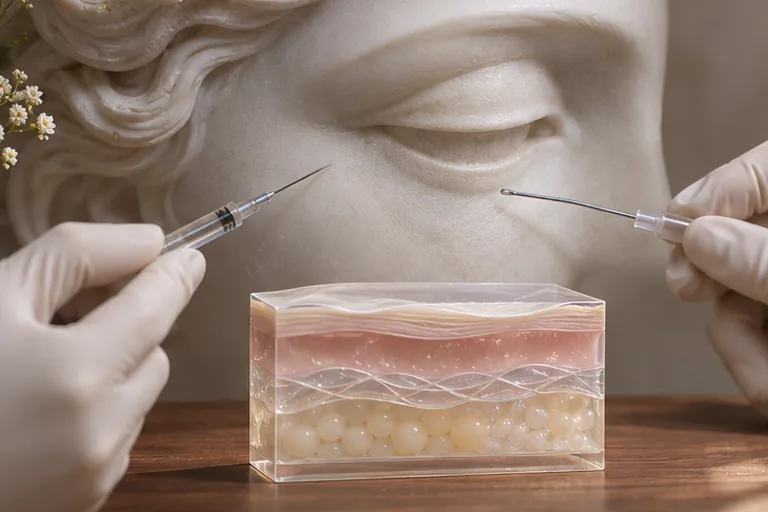
Under-eye skin is the thinnest skin on the body, so even a slight error in injection placement can create the appearance of nodules (small lumps). Instead of injecting at individual points, we use a cannula (a thin tube with a rounded tip) to spread the product across a plane. The injection depth and amount are determined by skin thickness.
For the under-eye area, we use Re2O Fine, which is formulated for thin skin. The standard product can also be used under the eyes, but Fine can reduce the likelihood of swelling and lumpiness. Before Fine became available, some patients experienced prolonged under-eye swelling that interfered with daily life.
Fine tends to be less effective in areas other than under the eyes, so we use different products for different areas. This is why the product and injection technique can vary by treatment area, even when the treatment has the same name.
We also consider Re2O when thin under-eye skin makes skin excision a concern. During consultations for lower eyelid surgery, if the elasticity of the skin and orbicularis oculi muscle can be addressed with Re2O or laser treatment, we compare an approach that combines surgery through the conjunctiva with subsequent treatment of the skin using those methods.
Is it also used on the neck, around the mouth, on the backs of the hands, or during surgical recovery?
06Is it also used on the neck, around the mouth, on the backs of the hands, or during surgical recovery?
Answer Yes. In areas with many blood vessels, the technique used to avoid bruising and hematomas matters. When combined with surgery, timing matters.

Besides the under-eye area, we commonly use it on the neck, around the mouth, and on the backs of the hands. Skin changes are readily visible in all of these areas, but they also have many blood vessels, making injection technique important for avoiding bruising or hematomas. We assess skin thickness and blood vessel distribution in each area, then slowly inject small amounts along the tissue plane while avoiding blood vessels.
When combined with surgery, the procedures are scheduled at different times. When used to support recovery after surgery, the treatment is performed after surgical swelling has subsided, usually after 4 weeks. If you have just had surgery and have not yet reached that point, we do not recommend immediate treatment.
For reconstructive surgery to correct ectropion, in which the lower eyelid turns outward, we provide Re2O treatment for about 3 months before surgery. The skin and dermis beneath an eye with ectropion are often damaged, so this process allows time for the damaged tissue to normalize first.
It may also be considered during postoperative recovery if reduced dermal elasticity is observed. In every case, we assess the extent of surgery and the recovery status before deciding. Whether to combine the treatments is determined after an examination.
When is it not recommended?
07When is it not recommended?
Answer We do not recommend it when the skin is already in good condition, when the underlying issue is insufficient volume, or when inflammation needs to be treated first.

Re2O is a material we primarily consider for skin that has become thinner because of dermal damage. If your skin is already in good condition in terms of hydration, pores, and other factors, the expected change may be limited, so we may not recommend it. If the underlying issue is insufficient volume, we first consider tissue augmentation.
We also explain the risks and limitations. Depending on how it is administered, risks include swelling, bruising, infection, inflammatory reactions, and nodules. If you notice skin changes that look like blisters or burns, progressively worsening pain or swelling, or signs of possible infection such as pus, contact us right away rather than waiting for your scheduled appointment.
If sagging or protrusion, rather than the condition of your skin itself, led you to consider Re2O, another type of care may need to come before injections. Reinforcing a tent's fabric alone cannot fix loose guy lines. During the consultation, we separately assess sagging structures, insufficient volume, and skin quality, then determine the appropriate materials and treatment sequence.
We do not recommend proceeding directly with treatment in the following cases.
- When skin condition, including hydration and pores, is already good
- When a lack of volume requires tissue augmentation to be considered first
- When inflammation or a skin condition needs treatment first
- When it is too soon after surgery for treatment intended to support recovery
08Three things we check first during your consultation
What we assess first during consultation
- Skin thickness and condition (barrier function · sensitivity · tendency toward pigmentation · inflammation)
- Previous treatments and stage of recovery
- Treatment areas and expected changes
These are general care principles. The actual decision is made after an examination.
When other care is needed first If your skin is already in good condition, we may not recommend Re2O. If you lack volume, we first consider tissue augmentation such as fat grafting. If you have inflammation or a skin condition, we address that first. Immediately after surgery, we wait until the appropriate time for treatment to support recovery—the third postoperative week. We do not tell patients that one session will produce their desired change.
Here is the answer to the opening question, “My skin felt firmer right after the injections. Was that the effect of Re2O?” The firmness immediately after injection is swelling, so we do not consider it a treatment effect. We assess changes in hydration and elasticity after the swelling subsides, about 1 week later. Re2O supplements the dermis rather than adding volume, so changes should be evaluated in the underlying condition of the skin rather than its fullness. Whether your skin is a suitable candidate is determined by assessing skin thickness, previous treatments, and the treatment area together.
— VITAL Plastic Surgery
When booking, simply leave a note saying, “Please assess whether Re2O is right for my skin first,” and we will start there during your consultation. You do not need to make a decision on the day of your consultation.
Related ReadingRe2O Treatment Guide
READ NEXT
Read Next

FAQ
Frequently Asked Questions
How many Re2O sessions do I need?
The standard plan is one vial per treatment, for three treatments spaced 3–4 weeks apart. Because individual responses vary, we document your progress to determine when to proceed with the next treatment.
Can Re2O fill an area instead of fat grafting?
We do not consider them equivalent materials. Fat grafting is considered when actual volume is lacking, while Re2O supplements the dermis rather than replacing volume.
Is it the same as regular fillers or stem cells?
We do not describe them as the same. Re2O is a human tissue product based on acellular allogeneic dermis. During consultation, we explain how it is used and the scope of the supporting evidence.
What if swelling or bruising lasts a long time?
Swelling is managed with injections, laser treatment, and other measures. If you have worsening pain and swelling or pus, please contact us without waiting for your scheduled appointment.
How long does the procedure take?
It takes about 10 minutes and is performed under local anesthesia. Swelling may peak on days 2–3.
BEFORE CONSULTATION
What to Prepare Before Your Consultation
- MedicationsPlease tell us about any medications and dietary supplements you take. We assess the risk of bruising and bleeding.
- Previous Procedure HistoryPlease tell us which fillers and injectable products you have received, as well as any recent laser treatments.
- Your main area of concernIdentify which area concerns you most: under the eyes, the neck, around the mouth, or the backs of the hands.
- Current photosIf you have front and side photos taken under the same lighting, we can use them to compare your progress later.
- SchedulingSwelling and bruising may last about 1 week, so please schedule treatment away from important events.
REFERENCES
References
- Lee YI, Chau NH, Nguyen NH, et al. Injectable Particulated Human Acellular Dermal Matrix Booster for Skin Restoration: An Integrated Randomized, Split-Face, Double-Blinded Clinical Trial and Preclinical Study. International Journal of Molecular Sciences. 2026. doi:10.3390/ijms27052193 (View abstract)
- Zhang C, Chang X, Chen L, et al. Safety and Efficacy of Micronized Acellular Dermal Matrix Injection for Correction of Moderate to Severe Nasolabial Folds: A Double-Blind, Multicenter, Randomized Controlled, Non-inferior Clinical Trial. Aesthetic Plastic Surgery. 2026. doi:10.1007/s00266-025-05494-4 (View abstract)
The findings in these papers reflect the participants and conditions of each study and do not mean that every individual will have the same results.
This article provides general medical information and does not replace diagnosis or treatment. Surgical results and recovery vary by individual, and complications such as bleeding, infection, scarring, and asymmetry may occur.
More articlesVITAL Plastic Surgery Medical Articles
RESERVATION
You do not need to decide the day of your consultation.
Organize questions about this page without entering your name, contact information, or medical history. This does not submit an appointment request.