PLASTIC SURGERY
MEDICAL COLUMN
Questions Answered Directly by the Doctor Before You Decide on Surgery
Skin Tightening
Articles
Forehead Lift Cost: What Determines the Price?
The cost of a forehead lift is not determined by the procedure name alone. The extent of surgery depends on whether you need a forehead lift, whether the incision is placed within the scalp or along the hairline, and whether upper eyelid surgery or ptosis correction is performed at the same time.
Medically reviewed by Dr. Hyungwoo Yim, Medical Director and board-certified plastic surgeon · Published 2026.11.28 · Last reviewed 2026.11.28
SHORT ANSWER
First, the Short Answer
- The cost of a forehead lift is not determined by the procedure name alone. The extent of surgery depends on whether you need a forehead lift, whether the incision is placed within the scalp or along the hairline, and whether upper eyelid surgery or ptosis correction is performed at the same time.
- In particular, if a heavy feeling around the eyes is caused by weak eyelid opening or excess eyelid skin, another procedure may be considered before a forehead lift. That is why we first check eyelid opening strength and eyebrow position, even during a consultation about cost.
- VITAL Plastic Surgery creates a treatment plan based on eyelid opening (MRD1), eyebrow position, forehead length, and scalp condition. Individual fees are published in the non-covered medical fees guide (/ko/price.html), and the final cost is provided after an examination.
“I asked about the cost of a forehead lift. Why do you need to examine my eyes first?”
This is a paraphrase of a question we often hear during consultations.
To answer this question, we first need to distinguish where your current concern comes from. We will explain each point below, then return to the original question at the end.
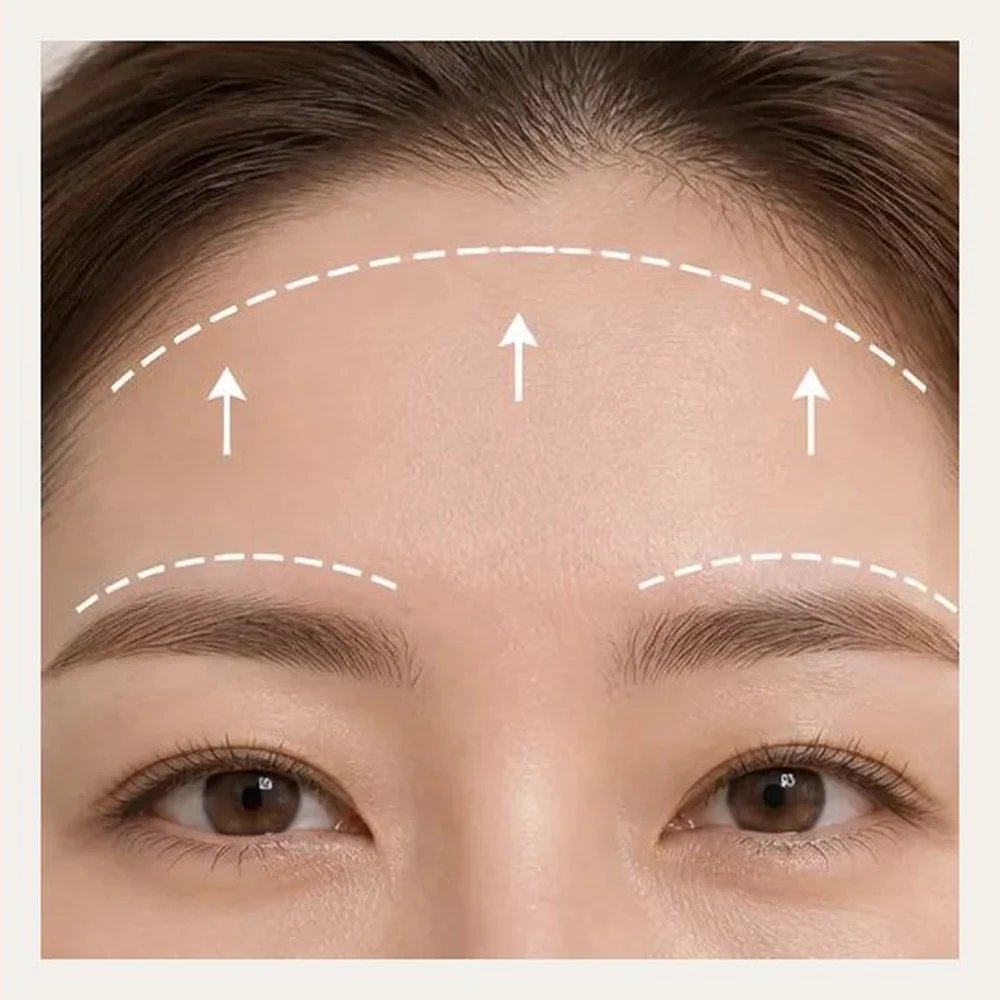
01What determines the cost of a forehead lift?
Answer The main factors that determine the cost are which procedure is needed and why, the incision location and technique, any procedures performed at the same time, health conditions and previous treatments to check beforehand, and follow-up care after surgery.
A forehead lift raises the position of the lowered forehead and eyebrows to address heaviness above the eyelids and forehead wrinkles. It may be considered for people whose upper eyelids feel heavy when removing excess eyelid skin alone is not enough. Even when the concerns are similar, the procedure needed may be a forehead lift, a sub-brow lift, upper blepharoplasty, or ptosis correction, depending on the cause.
The fee guide lists forehead lifts, sub-brow lifts, upper blepharoplasty, and ptosis correction separately. Items added when performed with another procedure are marked “Additional.” The cost can be determined once the necessary combination of procedures is established.
When asked, “How much does a forehead lift cost?” VITAL Plastic Surgery first shows the price of each item and explains which items apply after an examination. The table below summarizes the factors that determine the cost and what is checked during the consultation.
| Cost factor | What varies | What we assess during a consultation |
|---|---|---|
| Procedure needed | Whether a forehead lift or an eyelid procedure should come first | Ability to open the eyes (MRD1) · eyebrow position |
| Incision Location | Within the scalp or along the hairline | Forehead length · hair density · hairline shape |
| Procedures performed at the same time | Whether to perform upper blepharoplasty and ptosis correction together or separately | Eyelid closure · dryness · total surgery time |
| Health and medical history | Conditions to manage first; ultrasound evaluation if needed | Blood pressure · diabetes · anticoagulants; history of fillers, threads, and lifts |
| Postoperative care | Follow-up assessments and additional care as needed | Recovery progress (varies by patient) |
In Simple Terms The cost of a forehead lift is much like an estimate for repairing window curtains. When a covered window makes a room feel closed in, what needs fixing depends on whether the curtain fabric is too long, the curtain rail is sagging, or the window handle is stiff. Even after deciding to fix the rail, whether to place screws inside the wall or along the frame depends on the condition of the wall. An accurate estimate therefore requires opening the window and examining it directly. Likewise, the extent of surgery is determined after examining the eyebrows, eyelids, forehead, and scalp in person.
Could another procedure be needed before a forehead lift?
02Could another procedure be needed before a forehead lift?
Answer Yes. If the muscles that open the eyes are weak, ptosis correction may be considered first. If excess eyelid skin is the only concern, upper blepharoplasty or a sub-brow lift may be considered first.
When the eyes are difficult to open, people may use their forehead muscles to open them, which can deepen forehead wrinkles. In this case, lifting the forehead alone may allow the same habit to return. VITAL Plastic Surgery measures eyelid position using MRD1 (the distance from the center of the pupil to the upper eyelid margin). If the measurement meets the normal benchmark of 4 mm, ptosis surgery is not performed. If the muscles that open the eyes are weak, we first discuss ptosis correction.
One study examined the relationship between forehead wrinkles and the eyelids. In a US study comparing photographs of 160 people aged 50 or older who had consultations for facial aging, the 100 people with horizontal forehead wrinkles had a higher rate of drooping eyelids (ptosis) than the 60 without wrinkles (90% vs. 76.67%). All 28 people who had forehead wrinkles on only one side also had a drooping eyelid on the same side1. The researchers concluded that when forehead wrinkles are present, the eyelids should be checked first; otherwise, forehead treatment may not eliminate these wrinkles.
We also distinguish between drooping eyelids and lowered eyebrows. During the examination, we manually lift the eyebrows into position and then reassess the eyelids. If excess skin remains after the eyebrows are lifted, upper eyelid surgery may be an option. If lifting the eyebrows alone makes the eye area look more open, a forehead lift may be considered first. If both are present, we plan for both.
A sub-brow lift involves an incision beneath the eyebrow to lift the orbicularis oculi and underlying muscle layer and secure them toward the forehead muscle. It addresses a different area from a forehead lift. If excess skin is the only concern and upper eyelid surgery or a sub-brow lift appears sufficient, we do not immediately recommend a forehead lift. Once the appropriate procedure has been determined, we can provide a more accurate cost estimate.
| Surgery | Area addressed | When it is considered |
|---|---|---|
| Forehead Lift | Forehead and eyebrow position | When Both the Eyebrows and Forehead Have Dropped |
| Subbrow Lift | Skin and orbicularis oculi muscle beneath the eyebrow | When excess eyelid skin is the main cause of hooding |
| Upper Eyelid Surgery | Excess eyelid skin and muscle | When excess skin remains after the eyebrows are lifted |
| Ptosis correction | Muscles that open the eyes | When eyelid muscle strength is weak |
What changes depending on the incision location?
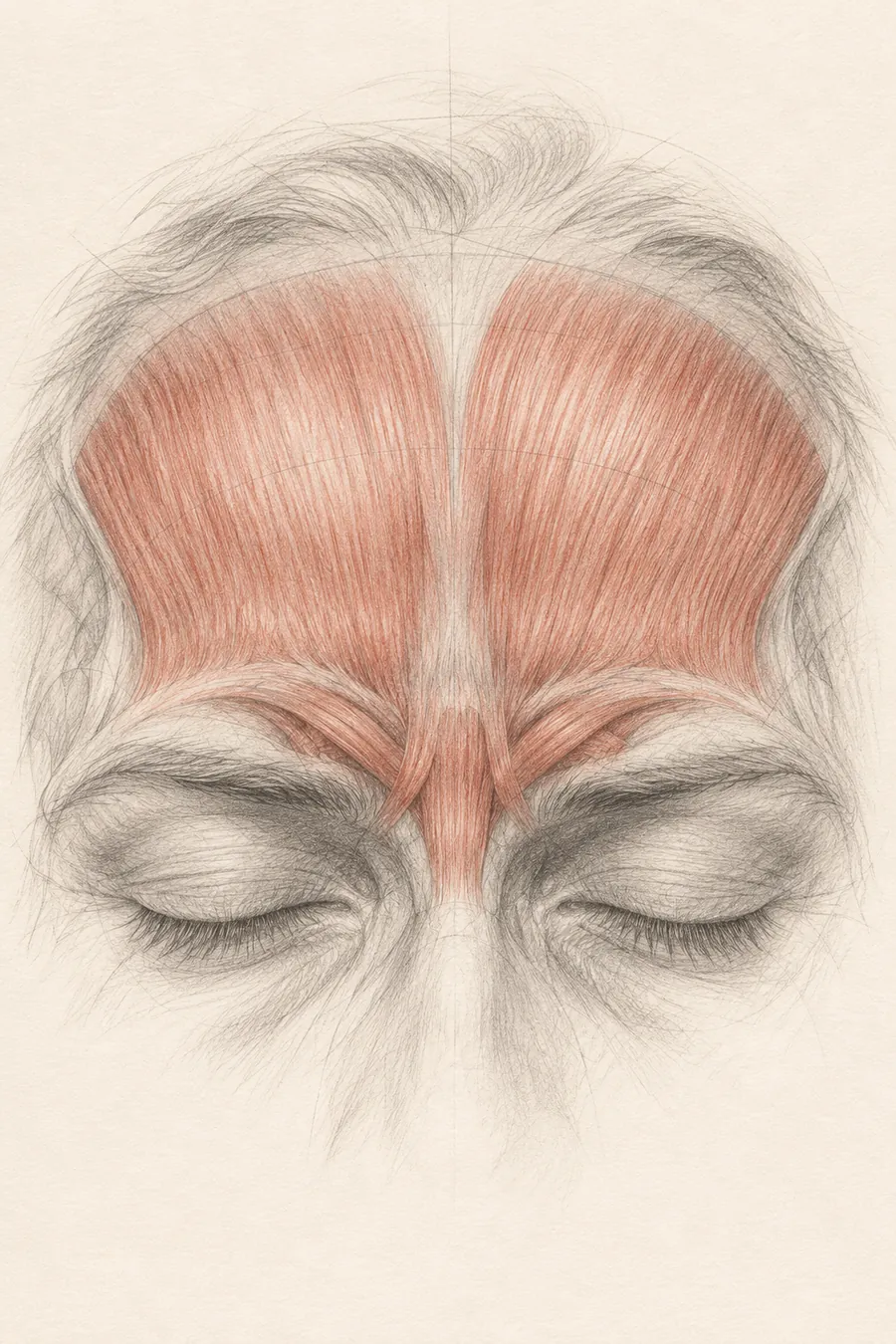
03What changes depending on the incision location?
Answer An incision within the scalp hides the scar in the hair, but it may raise the hairline slightly. An incision along the hairline helps maintain forehead length, but scar care is more important.
When both the eyebrows and forehead have descended, small incisions are made within the scalp to reach the deeper layers of the forehead. The tissue around the eyebrows is then released, lifted, and secured. A technique that uses an endoscope inserted through small scalp incisions to release and lift the forehead tissue is called an endoscopic forehead lift.
For patients who already have a high forehead, we measure the forehead and plan the incision along the hairline. An incision is made at the hairline, and the tissue beneath the forehead is dissected. The forehead and brows are lifted and secured, and excess skin is trimmed before the incision is closed with fine sutures. Before surgery, we measure the forehead and explain how the hairline may change.
Neither method is inherently better; they are suited to different patients. In a study at a tertiary medical center in the United States comparing 50 patients who underwent an endoscopic forehead lift with 22 who underwent a hairline forehead lift, there was no significant difference between the groups in the frequency of complications such as bruising, reduced sensation, scarring, and hair loss. The brows were lifted more immediately after surgery in the endoscopic group, but among the 45 patients followed for more than six months, there was no difference between the methods. The researchers concluded that the method should be chosen based on hairline position and forehead length.2.
We also consider hair density. If the hair is thin, scars may be visible or hair around the incision may temporarily become thinner. We check for hair loss and ask how you usually wear your bangs. If you already have a high forehead or thin hair, we discuss the incision method first before planning surgery.
How does combining a forehead lift with upper eyelid surgery or ptosis correction change things?
04What changes if upper blepharoplasty or ptosis correction is performed at the same time?
Answer Combining procedures increases the extent and duration of surgery and the demands of recovery. The amount of eyelid skin to remove also depends on the order of the procedures.
Lifting the forehead also changes how much loose eyelid skin remains. If a large amount of skin is removed during upper eyelid surgery before the forehead is lifted, the eyes may not close as fully. When both procedures are needed, we therefore calculate the amount of eyelid skin based on the forehead's lifted position. If one procedure must be done first, we make this calculation in advance.
Lifting the brows also lifts the upper eyelids, so closing your eyes may feel awkward at first. Combining the procedure with upper eyelid surgery adds to this effect. We therefore check for dry eye symptoms and assess how well the eyes close before surgery. If double eyelid surgery or ptosis correction is also needed, surgery is usually performed even if dry eye is present, and dryness lasting one to two months usually improves with artificial tears.
When several procedures are performed at once, the recovery periods do not simply add up, but swelling, discomfort, and the demands of aftercare may increase. Even if having everything done at once seems preferable, it may be better to separate the procedures to allow for normal recovery. We make the decision based on your health, the total surgery time, and your schedule. The surgical plan and cost breakdown also vary depending on whether the procedures are combined or separated.
The information on upper eyelid surgery and forehead lift states that upper eyelid surgery is performed under local anesthesia or sedation, while a forehead lift is performed under intravenous sedation. Whether to perform them on the same day or separately is determined by the patient's health and the length of surgery. When difficulty opening the eyes is the cause, the eyes may be corrected first. After monitoring recovery, the surgeon may reassess eyebrow height and forehead wrinkles to determine whether a forehead lift is needed.
Do eyebrow height and health also affect the plan?
05Do eyebrow height and health conditions also affect the plan?
Answer Yes. How far to lift the eyebrows is decided with your usual facial expressions in mind. If issues such as blood pressure, diabetes, or medications need to be managed first, the timing and surgical plan may change.
Lifting the eyebrows higher is not always better. Lifting them too high can create a surprised appearance, so we look at your usual expressions and eyebrow movement together. The outer eyebrows often descend first, so the plan may start by lifting the outer portions back into position and checking how the eyelids change. If you are concerned about a change in your appearance, please let us know at the consultation.
We also discuss your expectations during the consultation. Tell us what bothers you most and which aspects of your appearance you want to keep, and we will explain the appropriate extent of treatment. We do not promise results identical to a photograph or someone else's outcome. If the change you expect is beyond what is medically possible, we do not recommend proceeding directly to surgery.
Your health determines whether and when surgery can be performed. We first check for high blood pressure, diabetes, and use of anticoagulants. If these are not controlled, surgery cannot proceed immediately. If needed, testing, observation, or other medical care may come first. If the burden of treatment would be greater or it would be difficult to set aside recovery time, we may not recommend immediate treatment.
Are risks such as nerve problems, scarring, and hair loss also considered in the plan?
06Are risks such as nerve injury, scarring, and hair loss also considered in the plan?
Answer Yes. Before surgery, we discuss which tissue layer to enter and how to address scars and nerves. The risks to consider differ somewhat with each incision method.
The forehead is an area that requires care because nerves travel upward from the eyebrow area. These nerves are involved in forehead sensation and movement, so after surgery the forehead may feel numb or sensation may change. In rare cases, movement may also change. Risks and limitations discussed during the consultation include changes in sensation, scarring, hair loss, asymmetry, and possible nerve injury.
A U.S. review of 76 studies on complications associated with different forehead lift methods found that the hairline forehead lift had the highest revision surgery rate (7.4%), while the endoscopic forehead lift had the highest hair loss rate (2.8%). The patterns of complications differed by method.3. Although differences in study criteria make the numbers difficult to compare directly, they show why both scarring and hair-related concerns should be considered when choosing an incision site.
Changes in sensation often improve or change over time. In a US study that measured sensation before and after surgery in 10 patients who had an open forehead lift with an incision across the scalp or along the hairline and 11 who had an endoscopic procedure, scalp sensation was more reduced in the open surgery group at 1–2, 4–6, and 12–14 weeks after surgery, but the difference had disappeared by 24–26 weeks. In a separate survey of people who had already undergone surgery, a difference was still apparent at 6–18 months but disappeared after 18 months4.
The duration and severity vary from person to person. If your forehead does not move or symptoms persist, they will be evaluated at a follow-up visit. This list does not include every risk. Risks may vary depending on your health, previous treatments, and the technique and extent of the procedure, and will be explained in detail during your consultation and the consent process. Please tell us about any previous fillers, threads, or lift procedures. If needed, ultrasound may be used to check their location and distribution.
What can I expect during recovery and follow-up after surgery?
07What happens during recovery and follow-up after surgery?
Answer Swelling is greatest on days 3–4. Scalp stitches are removed after 10–14 days, and return to daily activities is expected in about 10 days. Scars can continue to change for more than a year, so follow-up visits are scheduled at 1, 3, and 6 months and 1 year.
Swelling is greatest during the first 3–4 days after surgery. Sleep with your head slightly elevated, and use compression only if instructed to do so for your procedure. Scalp stitches are removed after 10–14 days. Return to daily activities is expected in about 10 days, although recovery varies from person to person.
Over the following months, we assess the initial changes in contour and the period when the tissues settle separately. You can tie your hair back again after checking that it does not pull on the incision. Scars may be red and firm at first and can continue to change for more than a year.
VITAL Plastic Surgery's follow-up plan includes checks immediately after surgery and at 1 week, 1 month, 3 months, 6 months, and 1 year. The timing and duration are adjusted according to the type of surgery, your condition, and your symptoms. We assess discomfort and changes in function as well as photographs. Additional care is explained based on your condition rather than recommended uniformly to everyone, so the total cost may vary depending on what is added.
If you experience sudden severe pain, reduced vision or an obstructed field of vision, bleeding that does not stop, or rapidly worsening swelling on one side, contact us immediately rather than waiting for your appointment. The guidance below describes typical recovery, and individual experiences vary.
| Timing | What Happens | What to Keep in Mind |
|---|---|---|
| 3–4 days after surgery | Peak Swelling | Sleep with your head slightly elevated |
| 7–10 Days | Stitch removal starting on day 7; return to daily activities in about 10 days | Allow extra time, as recovery varies by person |
| Several Months | When contour changes and tissues settle | Check for pulling at the incision before tying your hair up |
| Up to 1 Year | The scar is initially red and firm, then changes over time | Follow-ups at 1, 3, and 6 months and 1 year |
08Three things we check first during your consultation
What we assess first during consultation
- Eyebrow position — whether lifting the eyebrows by hand relieves the heavy feeling
- Forehead, scalp, and skin condition — forehead length and hair density
- Eyelid drooping and function — eyelid opening strength (MRD1) and eyelid closure
These are general care principles. The actual decision is made after an examination.
When other care is needed first When weak eyelid opening is the main cause, ptosis correction should be discussed first. A forehead lift is also not immediately recommended when excess skin alone appears treatable with upper blepharoplasty or a brow lift, when the forehead is already wide or hair is thin and the incision method needs to be discussed first, or when health conditions such as high blood pressure or diabetes need to be controlled first.
Here is the answer to the initial question, “I asked about the cost of a forehead lift, so why do you need to examine my eyes first?” If the heavy feeling around your eyes is caused by weak eyelid opening or excess eyelid skin, ptosis correction, upper blepharoplasty, or a brow lift may be considered before a forehead lift. The surgical plan and cost will vary accordingly. VITAL Plastic Surgery first checks eyelid opening strength, eyebrow position, forehead length, and scalp condition to develop a plan. Individual fees are listed in the non-covered services fee schedule, and the final cost is provided after an examination.
— VITAL Plastic Surgery
When booking, simply let us know, “Please check first whether I need a forehead lift or an eye procedure.” We will start by discussing that during your consultation. You do not need to make a decision on the day of your consultation.
Related ReadingForehead Lift Information
READ NEXT
Read Next

FAQ
Frequently Asked Questions
Can forehead Botox be used instead?
They serve different purposes. Botox treats wrinkles that appear with movement. For people who use their forehead muscles to open their eyes, weakening those muscles can make the eyes feel heavier, so we first assess eyelid function.
Can I get a price just by sending photos?
Photos are for reference. Because determining which procedure is needed requires directly measuring eyelid opening (MRD1) and forehead length and assessing the effect of lifting the eyebrows, the exact cost is provided after an examination.
Is it covered by health insurance or private medical expense insurance?
We cannot make that determination here. We will let you know whether it applies to you after examining your eyes and forehead. VAT is charged separately for cosmetic procedures listed in the non-covered medical fees guide.
Will my forehead look taller?
The position of the hairline changes depending on the incision method. An incision within the scalp can raise the hairline slightly, so if your forehead is already broad, we compare it with a hairline incision and measure your forehead length before surgery to discuss your options.
Will my forehead feel numb after surgery?
Because the procedure involves an area where sensory nerves pass, you may experience numbness or itching. These sensations usually change over time, but their duration and severity vary from person to person.
Do I have to decide on the day of my consultation?
No. You do not need to decide on surgery the day of your consultation. You can learn about the procedure you need and its cost, take time to consider your options, and decide afterward.
BEFORE CONSULTATION
What to Prepare Before Your Consultation
- History of fillers, threads, and liftsPlease tell us about previous fillers, threads, and lifting procedures. If needed, we use ultrasound to assess their location and distribution.
- Blood pressure, diabetes, and medicationsWe first check for high blood pressure, diabetes, and anticoagulant use. If these conditions are not controlled, surgery cannot proceed right away.
- Supplements, smoking, and alcoholWe recommend stopping herbal medicines and supplements such as omega-3 when possible because they may increase bleeding. We advise all patients that they must stop smoking and drinking alcohol before surgery.
- Your usual hairstyleLet us know if you wear bangs or often tie your hair up. This can help us discuss the incision location.
- Clear Your SchedulePlease plan around the first 3–4 days, when swelling is most pronounced, suture removal, and the approximately 10 days before returning to daily activities.
REFERENCES
References
- Wu-Fienberg Y, Bafna KR, Guyuron B. Horizontal Forehead Lines: A Reflection of Eyelid Ptosis or Blepharodermachalasia. Aesthetic Plastic Surgery. 2018. doi:10.1007/s00266-018-1198-7 (View abstract)
- Garg N, Alnemri A, DeKloe J, et al. A Comparison of Brow Elevation and Complications: Endoscopic Versus Pretrichial Brow Lift. Laryngoscope. 2026. doi:10.1002/lary.70236 (View abstract)
- Cho MJ, Carboy JA, Rohrich RJ. Complications in Brow Lifts: A Systemic Review of Surgical and Nonsurgical Brow Rejuvenations. Plastic and Reconstructive Surgery Global Open. 2018. doi:10.1097/GOX.0000000000001943 (View abstract)
- Guillot JM, Rousso DE, Replogle W. Forehead and scalp sensation after brow-lift: a comparison between open and endoscopic techniques. Archives of Facial Plastic Surgery. 2011. doi:10.1001/archfacial.2010.97 (View abstract)
The findings in these papers reflect the participants and conditions of each study and do not mean that every individual will have the same results.
This article provides general medical information and does not replace diagnosis or treatment. Surgical results and recovery vary by individual, and complications such as bleeding, infection, scarring, and asymmetry may occur.
More articlesVITAL Plastic Surgery Medical Articles
RESERVATION
You do not need to decide the day of your consultation.
Organize questions about this page without entering your name, contact information, or medical history. This does not submit an appointment request.