PLASTIC SURGERY
MEDICAL COLUMN
Questions Answered Directly by the Doctor Before You Decide on Surgery
Revision surgery
Articles
How Much Can a Double Eyelid Crease Be Lowered?
How much the crease can be lowered is determined first by the amount of remaining skin, rather than the desired height. There must be skin between the new crease and the eyelashes, with enough left to close the eyes.
Medically reviewed by Dr. Hyungwoo Yim, Medical Director (board-certified plastic surgeon) · Published 2026.11.10 · Last reviewed 2026.11.11
SHORT ANSWER
First, the Short Answer
- How much the crease can be lowered is determined first by the amount of remaining skin, rather than the desired height. There must be skin between the new crease and the eyelashes, with enough left to close the eyes.
- We must also first determine whether the current fullness is lingering swelling or a structural issue involving crease position, adhesions, tissue thickness, or eyelid-opening strength. Cosmetic revision is generally better performed after the tissues have stabilized, usually 6 months to a year or longer after surgery.
- At VITAL Plastic Surgery, we measure the available skin with the eyes closed, the extent of adhesions, and eyelid-opening strength (MRD1) to determine together how much lowering is possible. The limit is the point at which the eyes can still close properly.
“My crease is so high that it looks like a sausage. Can it be lowered as much as I want?”
This is a paraphrase of a question we often hear during consultations.
To answer this question, we first need to distinguish where your current concern comes from. We will explain each point below, then return to the original question at the end.
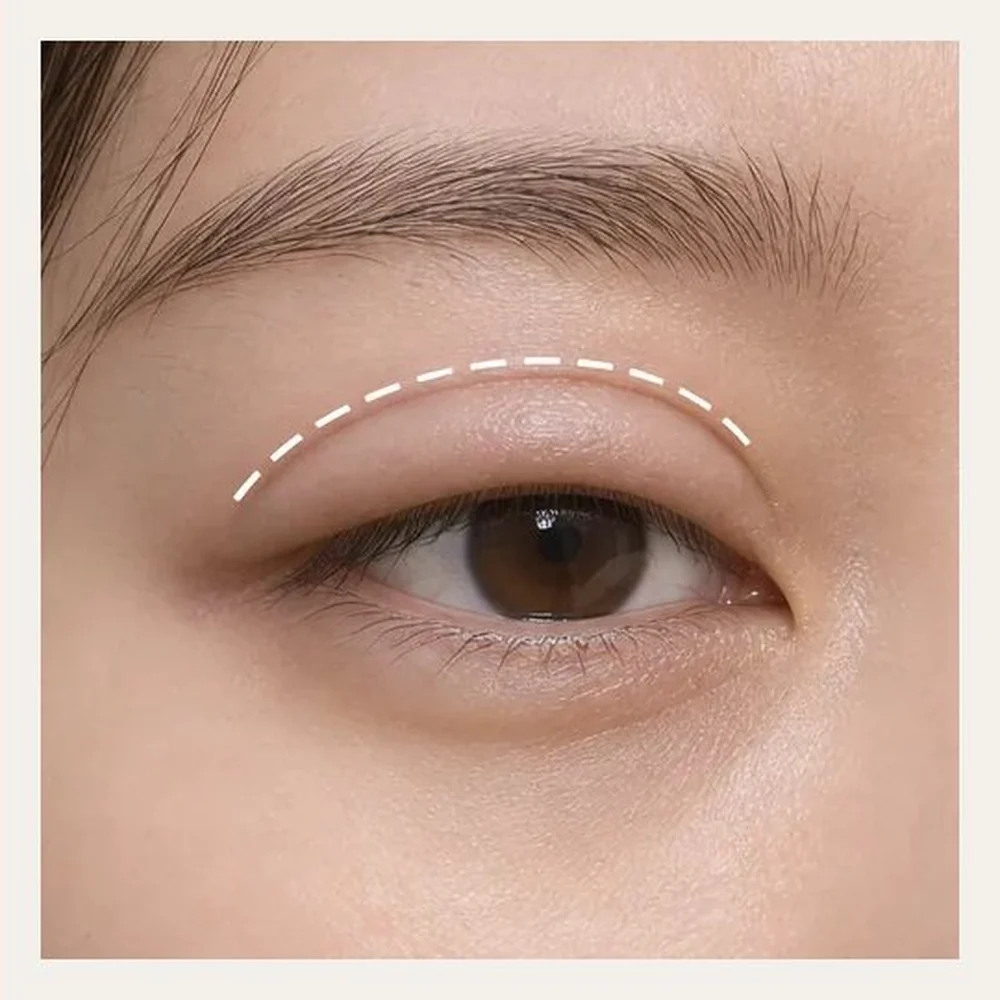
01A High, Thick Crease: Swelling or a Structural Issue?
Answer We first check when the surgery was performed. If the appearance remains unchanged after enough time has passed, we consider it a structural issue.

A high double eyelid crease with a thick fold of skin below it that looks swollen even when the eyes are open is often called “sausage eyelids.” This is not a medical term, but it is one of the expressions we hear most often during consultations.
Even when the initial shape is visible after eyelid surgery, swelling takes several months to subside and the tissues need time to settle. Revision surgery may take longer. In particular, from 3 weeks to 3 months after surgery, the tissues become firm, which can make the crease look thick. Deciding on another operation based only on the appearance during this period can mean operating again on areas that would have improved with time.
That is why we first ask when the surgery was performed. Between 3 months and a year, the tissues soften, redness fades, and the two sides become more even. If there is no change after enough time has passed, we consider structural factors such as crease position, adhesions, tissue thickness, and eyelid-opening strength.
However, if the eyes do not close properly and the cornea—the clear membrane in front of the colored part of the eye—is exposed, or if pain persists, an earlier evaluation is needed regardless of how much time has passed. Waiting applies only to concerns about appearance.
In Simple Terms A double eyelid crease is similar to the point where a curtain is tied back. If the tie is too high, the fabric below it bunches up and looks bulky. To move the tie lower, there must be enough fabric below it to extend downward. If the old tie point has stuck to the fabric, it must first be separated. The separated surfaces can stick together again if left alone, so a supporting layer is placed between them. The same principle explains why a crease cannot be lowered as much as desired if there is too little skin.
So what makes the crease look thick?
02What makes the crease look thick?
Answer There can be more than one cause, so the plan does not focus only on lowering the crease.
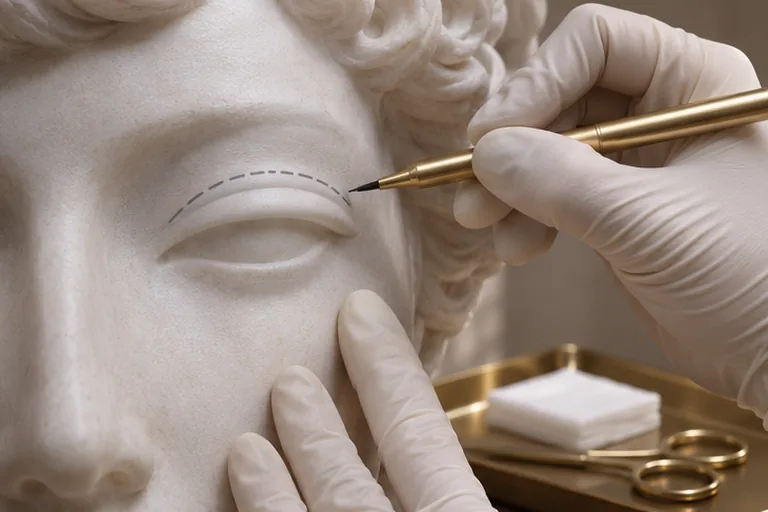
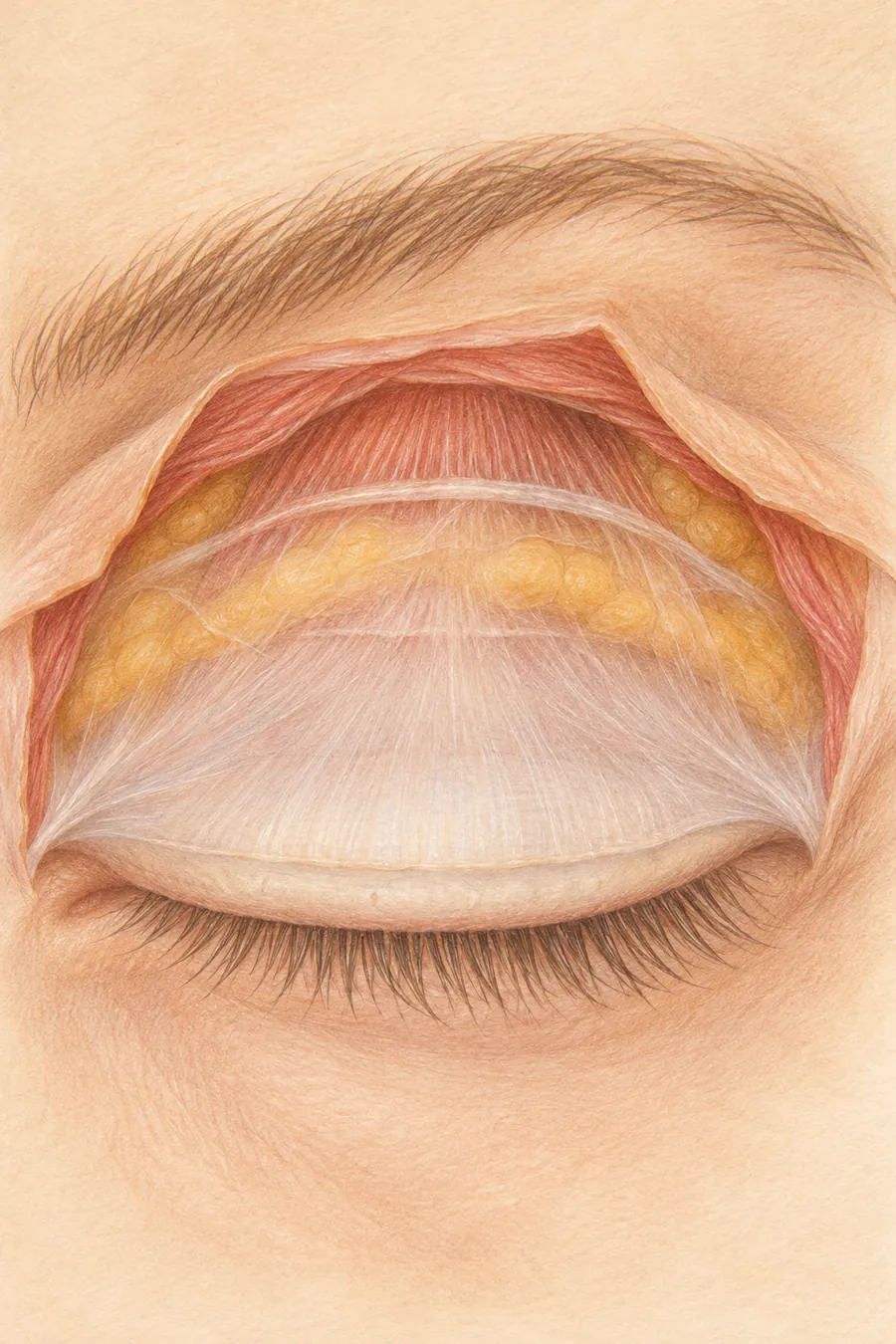
The crease itself may be fixed too high, or deep adhesions may pull the skin below the crease upward with it. Thick muscle and fat can make the folded skin look bulky, while weak eyelid-opening strength can keep the skin from unfolding fully. Excessive tissue removal during a previous surgery can also cause hollowing that makes the crease look deeper.
Each cause requires a different approach. Simply lowering the crease may leave adhesions that pull it back up, or make eyes with weak eyelid-opening strength look more hooded. Conversely, if hollowing is the cause, removing more tissue may deepen the crease.
A report from a plastic surgery clinic in Korea reviewing 1,225 patients who underwent revision for high creases and bulky skin below them also explained that too little fat and soft tissue, or extensive fat removal during a previous surgery, can lead to a high crease, upper eyelid hollowing, and adhesions extending into deeper layers2. This means that a high crease, hollowing, and adhesions often occur together.
If hollowing is the cause, we consider adding tissue rather than removing it. Upper eyelid hollowing may result not only from a lack of fat, but also from weak eyelid-opening muscles that allow the eyelid to roll upward and the fat to move backward. We therefore assess eyelid-opening function first, then determine whether the remaining eyelid fat can be repositioned and whether fat grafting is needed.
| Cause | How it looks | What we look at first |
|---|---|---|
| Crease fixed too high | A crease mark remains high on the eyelid even with the eyes closed | Previous crease position and available skin |
| Deep adhesions | Skin below the crease rolls upward, creating bulk | Extent and depth of adhesions |
| Thick muscle and fat | Folded skin looks heavy and swollen | Tissue to remove and tissue to preserve |
| Weak eyelid lifting strength | Fullness below the crease and reduced eye opening | MRD1 |
| Hollowing from excessive tissue removal | A deeply indented crease and upper eyelid hollowing | Tissue deficiency and the need for replacement |
So how much can the crease be lowered?
03How much can the crease be lowered?
Answer It is difficult to give a number in advance. How much the crease can be lowered depends on the remaining skin length, the extent of adhesions, and eyelid-opening strength.
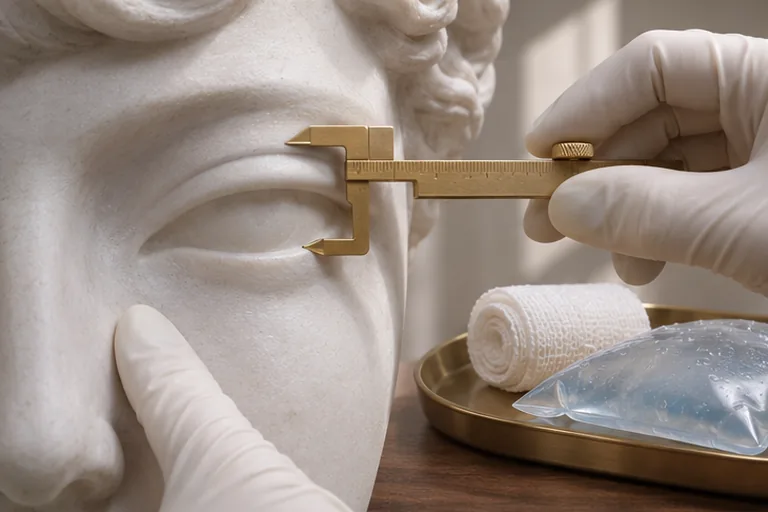
To lower the crease, there must be skin between the new crease and the eyelashes, with enough left to close the eyes. This available skin is the length of eyelid skin that can be used when the eyes are closed, and it is measured directly during the examination. If a large amount of skin was removed during the previous surgery, lowering the crease as much as desired may be difficult.
If enough skin is available, we mark both the planned lower crease and the previous crease, then remove a strip of skin that includes the old crease and scar. After releasing adhesions and reducing thick tissue, we fix the crease to a deep layer at a lower position. If skin is limited, we consider making a lower incision without removing skin, carefully releasing the adhesions above it, and creating a new attachment at the lower position.
The final criterion when deciding how much to lower the crease is eyelid closure. Removing more skin to lower the crease can cause lagophthalmos, or incomplete eyelid closure, and dry eye. We therefore take measurements with the eyes both closed and open, and choose a height that allows proper closure. If the desired height differs from the safe height, we explain that difference first.
Research also shows that the amount of lowering is determined within limits. A study of 86 patients (154 eyelids) who underwent revision for high creases at three institutions in China found that average crease height decreased from 9.8mm to 6.8mm, while the visible width of skin below the crease with the eyes open decreased from 3.5mm to 1.9mm1. Two patients were dissatisfied because of undercorrected ptosis and asymmetry and underwent another operation1.
These figures are averages from a single surgical approach and should not be taken as a guide to how many millimeters your own crease can be lowered. If your desired height is beyond what can be safely achieved, we explain this first.
So can adhesions form again after they are released?
04Can adhesions form again after they are released?
Answer The tissues can stick together again if the space is left empty, so fat or nearby tissue is placed between the released surfaces.
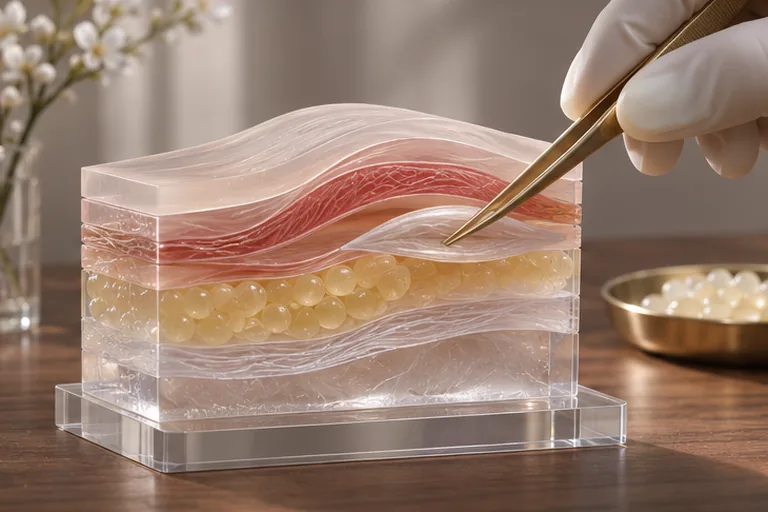
A high crease usually has adhesions at that level that must be released before it can be lowered. However, even after those adhesions are released, the tissues can stick together again in the same place if the space is left empty. One approach is to reposition eyelid fat or nearby tissue between the released surfaces. If there is not enough tissue, fat grafting is also considered.
The Chinese study described above also used an approach that fully released adhesions between the skin and the levator aponeurosis, the sheet of tissue attached to the eyelid-opening muscle, then repositioned the remaining eyelid fat or, when needed, grafted lower eyelid fat to recreate a gliding layer.1. In a Korean report, tissue removed while thinning bulky muscle and scar tissue below the crease was used as flaps or grafts to fill the gap. Among 425 patients followed, 7.8% were dissatisfied with the results, 6.8% had mild asymmetry, and 4% underwent another surgery2.
The exact extent of the adhesions can only be determined during surgery. Before surgery, we explain the expected extent and what may change based on the findings during the procedure.
Releasing adhesions and adding support involves more tissue manipulation than an initial double eyelid surgery. Please allow for potentially longer recovery and swelling when planning your schedule.
If the eyelid-opening strength is weak, is lowering the crease alone insufficient?
05If eyelid-opening strength is weak, is lowering the crease alone insufficient?
Answer Yes. If the eyelid looks thick because the skin is not pulled upward enough, lowering the crease alone may make the eyes look more hooded.
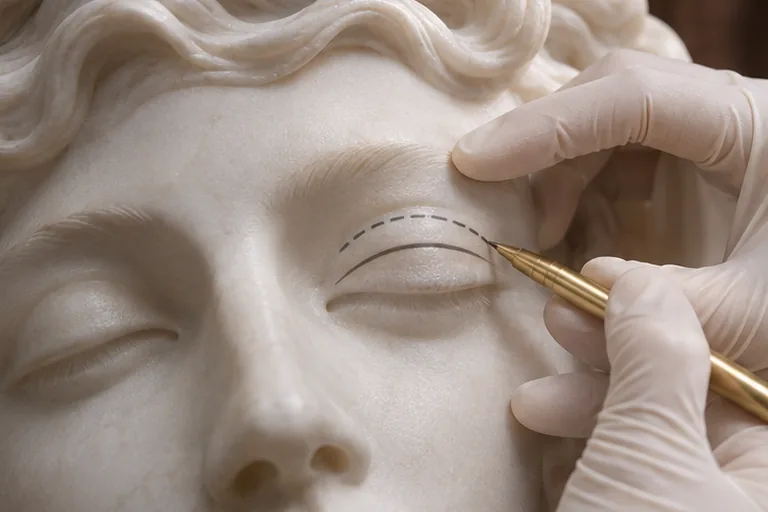
When eyelid-opening strength is weak, the skin is not pulled upward enough, making the area below the crease look bulky. Lowering the crease alone may cause the folded skin to hang farther down, making the eyes look more hooded. We therefore measure MRD1 (the distance from the center of the pupil to the upper eyelid margin) to determine whether ptosis repair is also needed.
When both procedures are performed, we make an incision along the planned lower crease and release the adhesions. We then adjust the eyelid height by correcting the eyelid-lifting muscle and its aponeurosis (the sheet of tissue connecting the end of the muscle to the firm plate inside the eyelid), before securing the crease at a lower position.
However, ptosis repair involves more manipulation of the eyelid tissues, which can lead to more swelling and bruising, as well as dryness or incomplete eyelid closure. As illustrated by one case of dissatisfaction in the study mentioned earlier, which involved insufficient correction of ptosis1, crease height and eyelid-opening strength need to be addressed together.
We assess cases in which only one crease looks high and thick in the same way. Often, the issue is that the eye on that side opens less and the patient raises the eyebrow to compensate, rather than a problem with the crease itself. Adjusting only the crease may allow the difference to reappear. We therefore first measure how much of each iris is visible, listen to what concerns you most, and then explain the cause.
Will lowering the crease leave two scar lines?
06Will lowering the crease leave two scar lines?
Answer If there is enough skin, we consider removing the old crease along with the surrounding tissue to leave one line. If there is little extra skin, the old scar above the new crease may remain.
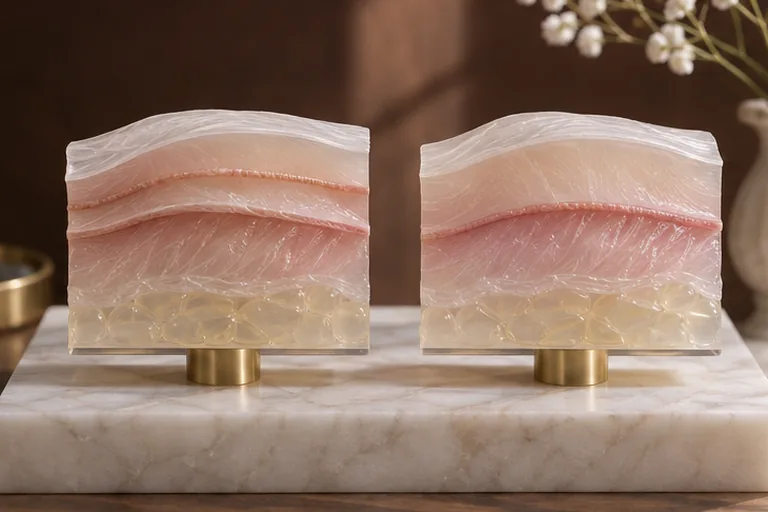
If there is enough skin to remove a strip that includes the old crease and scar, we consider an approach that leaves a single new crease. If there is little extra skin and a new crease is secured lower down without removing skin, the old scar above it may remain. We explain this before choosing the surgical approach.
The goal is a new crease that folds with muscle movement only when the eyes open and unfolds when they close. If the skin is secured too tightly to the deeper layers, the crease may remain indented even when the eyes are closed, creating a pinched appearance. We use this same principle to determine the fixation position and depth when lowering a high crease. This difference becomes more apparent several years later than immediately after surgery.
We assess the healing stage and any tissue deficiency to determine whether an old scar should be managed with scar treatments or revised surgically. Redness and firmness may last several months or longer, and we do not use the same laser at the same time for every scar.
Injection and laser treatments generally begin one month after surgery and need to continue consistently for at least six months. We assess progress at 1, 3, and 6 months and at one year, so we do not judge the final scar based only on its early appearance.
When is immediate surgery not recommended, and what is recovery like?
07When is surgery delayed, and what is recovery like?
Answer We do not recommend immediate surgery if fewer than three months have passed since the previous surgery, or if there is so little skin that lowering the crease could interfere with eyelid closure.

The procedure is performed under IV sedation. Swelling and bruising peak on days 3–4. If an incision is made, sutures are removed on days 5–7. The table below provides general recovery estimates; recovery from revision surgery may take longer than recovery from the initial surgery.
For your consultation, please bring current photos and records from your previous surgery. We can still assess your condition through an examination if records are unavailable, and we allow enough time for explanations and questions. You do not need to decide on the day of your consultation. We may also recommend observing your recovery longer before reassessing.
We do not recommend immediate surgery in the following situations.
- When less than 3 months have passed since surgery and the tissues are still firm
- When limited skin means lowering the crease would interfere with eyelid closure
- When the burden of additional surgery outweighs the expected improvement
- When the desired crease height is beyond what can safely be achieved
| Timing | What Happens | What to Keep in Mind |
|---|---|---|
| 3–4 days after surgery | Swelling and bruising are at their worst | Sleep with your head slightly elevated and gently apply cold compresses |
| Days 5–7 | Suture removal if an incision was made | Eye makeup · contact lenses after 2 weeks |
| 3 weeks–3 months | Firm tissue may make the crease look thick | At this point, do not decide on revision surgery based on appearance alone. Saunas can be used after 1–2 weeks, and strenuous exercise can be resumed after 1 month. |
| 3 months–1 year | Tissues soften and the two sides become more even | Follow-ups at 1, 3, and 6 months and 1 year |
08Three things we check first during your consultation
What we assess first during consultation
- Available excess skin when the eyes are closed
- Extent of the adhesions creating the high crease
- Eyelid-opening strength (MRD1) and whether ptosis repair is also needed
These are general care principles. The actual decision is made after an examination.
When other care is needed first If fewer than three months have passed since surgery, observation comes before another operation. If there is too little extra skin and lowering the crease could interfere with eyelid closure, we reduce the amount of lowering or compare other approaches. Functional problems, such as corneal exposure or persistent pain, need to be evaluated before changes to appearance are considered. We explain the feasible range first, without promising a particular crease height.
The answer to the opening question, “My crease is so high that it looks like a sausage. Can it be lowered as much as I want?” is this: how far the crease can be lowered depends first on the remaining skin, adhesions, and eyelid-opening strength, rather than the desired height. We also need to determine whether the current bulkiness is due to swelling or the underlying structure, so we assess both the time since surgery and the condition of the tissues. You can take time to decide after understanding the feasible range and how scars may remain.
— VITAL Plastic Surgery
When booking, simply leave a note saying, “I'd like to lower my crease. Please assess the remaining skin and adhesions first.” We will start with those areas during your consultation. You do not need to decide on the day of your consultation.
Related ReadingDouble Eyelid Crease Lowering Consultation Guide
READ NEXT
Read Next
FAQ
Frequently Asked Questions
How much can the crease be lowered?
It is difficult to give a number in advance. The amount depends on the remaining skin length, the extent of adhesions, and eyelid-opening strength. During an examination, we measure the available skin and explain the possible range.
How long should I wait before having surgery?
Cosmetic revision is generally considered after 6 months to a year or longer. Timing is not based on elapsed time alone; we also assess adhesions and tissue condition. Corneal exposure or pain calls for an earlier evaluation.
Will I have two scar lines?
If enough skin is available, we consider incorporating the old crease into the excision so that one scar line remains. If skin is limited, the old scar above the new crease may remain. We explain this before choosing an approach.
Can a crease made with the buried-suture method be lowered?
Whether lowering is possible depends more on the current adhesions, available skin, and eyelid-opening strength than on whether the original procedure used buried sutures or an incision. Knowing how your previous surgery was performed helps with the assessment.
Can I be evaluated without records from my previous surgery?
We can assess your condition using current photos and an examination. Previous records can provide additional clues about which tissue layers were treated.
BEFORE CONSULTATION
What to Prepare Before Your Consultation
- Current photosPlease bring front-view photos with your eyes open and closed, as well as side-view photos.
- Previous surgery recordsPlease note as much as you know about when your surgery was performed, whether it used a buried-suture or incisional technique, and whether fat was removed.
- Desired Crease HeightYou may bring photos of your desired crease shape, but please keep in mind that it cannot be reproduced exactly.
- Eye SymptomsPlease note any difficulty closing your eyes, dryness, or difficulty opening your eyes.
- SchedulingSwelling may last longer after revision surgery, so please let us know how much time you have before any important events.
REFERENCES
References
- Shi H, Liu M, Huang W, et al. Revisional Asian Blepharoplasty of the High Eyelid Fold: Tarsus-Orbicularis Fixation Combined With Orbital Fat Repositioning Technique. The Journal of Craniofacial Surgery. 2023. doi:10.1097/SCS.0000000000008991 (View abstract)
- Kim BG, Youn DY. Management of adhesion using a pretarsal fibromuscular flap or graft in secondary blepharoplasty. Plastic and Reconstructive Surgery. 2006. doi:10.1097/01.prs.0000200064.40520.0b (View abstract)
The findings in these papers reflect the participants and conditions of each study and do not mean that every individual will have the same results.
This article provides general medical information and does not replace diagnosis or treatment. Surgical results and recovery vary by individual, and complications such as bleeding, infection, scarring, and asymmetry may occur.
More articlesVITAL Plastic Surgery Medical Articles
RESERVATION
You do not need to decide the day of your consultation.
Organize questions about this page without entering your name, contact information, or medical history. This does not submit an appointment request.